
Valorization of whey in mozzarella cheese production: effect of acidification method and milk fat content
DOI:
https://doi.org/10.17268/agroind.sci.2026.03.07Palabras clave:
Pasta filata cheese, dairy by-product, milk preacidification, milk standardization, functional properties cheeseResumen
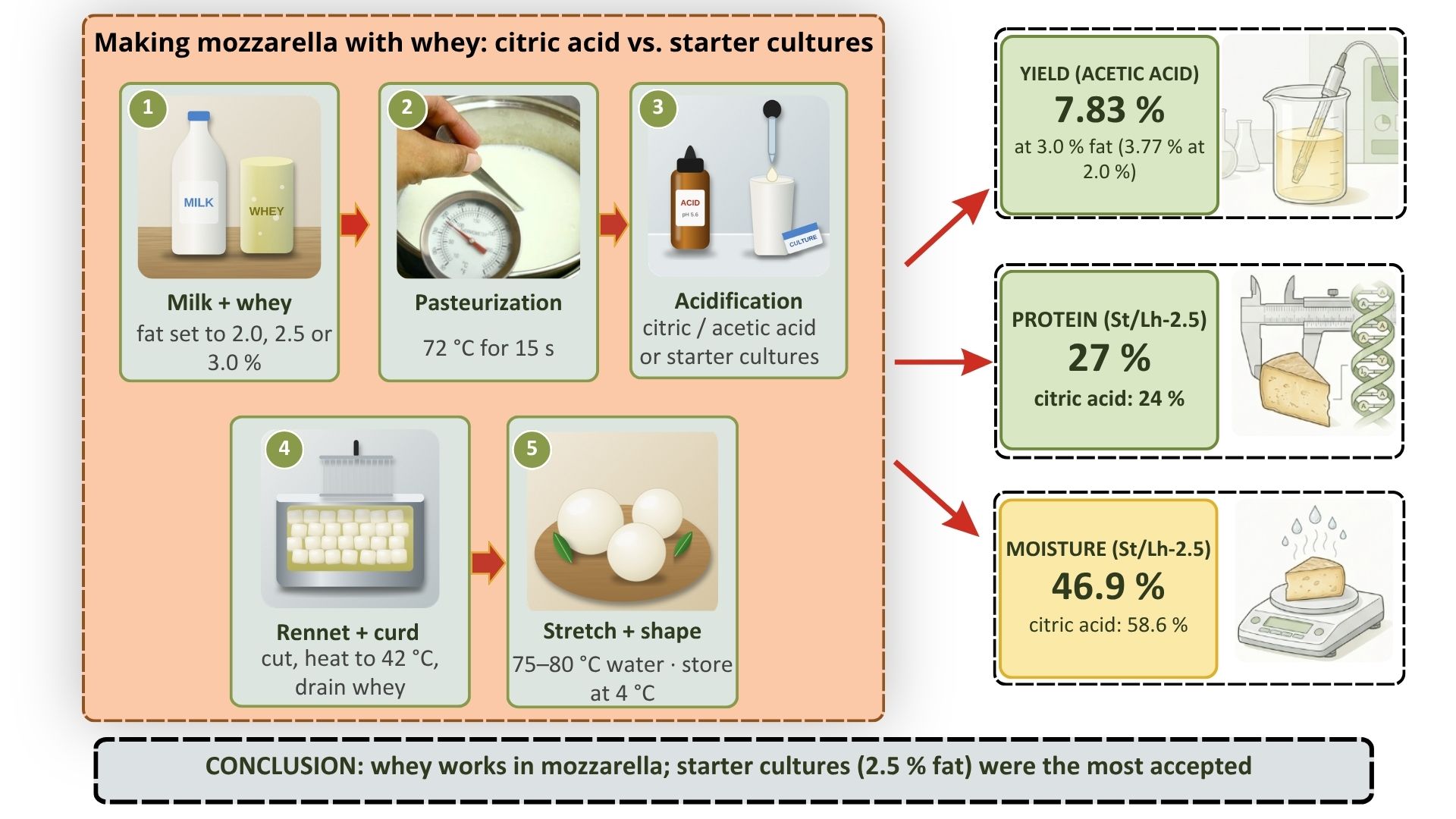
This study evaluates the physicochemical, functional, and sensory characteristics of mozzarella cheese obtained from milk standardized with whey at different fat contents (2.0%, 2.5%, and 3.0%), using two acidification methods: direct acidification with organic acids (acetic acid (AA) and citric acid (CA)) and acidification with two starter cultures (Streptococcus thermophilus/Lactobacillus helveticus (St/Lh) and Streptococcus thermophilus/Lactobacillus delbrueckii subsp. bulgaricus (St/Lb)). The effects of fat content and acidification method were evaluated for pH, meltability, and browning index during storage (days 1, 14, and 28), while yield and texture were evaluated on day 0 (immediately after production). Fat content, acidification method, or their interaction significantly influenced mozzarella cheese properties during storage, with the magnitude depending on the parameter. Yield increased with increasing fat content, regardless of the acidification method used. Two treatments were selected for sensory and physicochemical characterization: CA-2.5 and St/Lh-2.5. St/Lh-2.5 exhibited the highest overall acceptability, as well as higher fat and protein contents and lower moisture. These results show that the use of whey in milk standardization enables the production of mozzarella cheese of acceptable quality while contributing to whey valorization.
Referencias
Abdalla, A., Abu-Jdayil, B., Alsereidi, H., Hamed, F., Kamal-Eldin, A., Huppertz, T., & Ayyash, M. (2022). Low-moisture part-skim mozzarella cheese made from blends of camel and bovine milk: Gross composition, proteolysis, functionality, microstructure, and rheological properties. Journal of Dairy Science, 105(11), 8734-8749. https://doi.org/10.3168/jds.2022-22144
Ahsan, M., Ali, T. M., & Hasnain, A. (2023). Use of oxidized potato starch as simultaneous fat and casein replacer in analogue mozzarella cheese-Ⅱ: Impact on functional and sensory properties of cheese. Food Hydrocolloids, 142, 108810. https://doi.org/10.1016/j.foodhyd.2023.108810
AOAC International. (2016). Official Methods of Analysis of AOAC International. (20th ed.). AOAC International.
Asas, C., Llanos, C., Matavaca, J., & Verdezoto, D. (2021). Suero de leche: impacto ambiental, usos y aplicaciones mediante mecanismos biotecnológicos. Ciencias Agroindustriales, 11(1), 105–116. https://doi.org/10.17268/agroind.sci.2021.01.13
Ashok, P., Sabikhi, L., Khetra, Y., Ganguly, S., & Baig, D. (2022). Effect of skim milk addition and heat treatment on characteristics of cow milk Ricotta cheese manufactured from Cheddar cheese whey. LWT, 162. https://doi.org/10.1016/j.lwt.2022.113405
Banks, J. M. (2004). The technology of low‐fat cheese manufacture. International Journal Of Dairy Technology, 57(4), 199-207. https://doi.org/10.1111/j.1471-0307.2004.00136.x
Brown, R., & Ernstrom, C. (1982). Incorporation of Ultrafiltration Concentrated Whey Solids into Cheddar Cheese for Increased Yield. Journal of Dairy Science, 65(12), 2391-2395. https://doi.org/10.3168/jds.S0022-0302(82)82514-9
Casallas-Ojeda, M., Cabeza, I., Sanchez, N., Caicedo-Concha, D., & Astals, S. (2024). Cheese whey and dairy manure anaerobic co-digestion at psychrophilic conditions: Technical and environmental evaluation. Environmental Research, 251(1). https://doi.org/10.1016/j.envres.2024.118525
Chacón-Villalobos, A., & Pineda-Castro, M. (2009). Características químicas, físicas y sensoriales de un queso de cabra adaptado del tipo “Crottin de Chavignol”. Agronomía Mesoamericana, 20(2), 297-309. ISSN: 1021-7444.
Cheng, Z., Xia, W., Van Leusden, P., Czaja, T., Eisner, M., & Ahrné, L. (2024). Combined effect of acidification temperature and different acids on microstructure and textural properties of heat and acid-induced milk gels. International Dairy Journal, 161, 106117. https://doi.org/10.1016/j.idairyj.2024.106117.
Codex Alimentarius Commission. (1999). General standard for milk (CODEX STAN 206-1999). Rome: Food and Agriculture Organization of the United Nations (FAO) & World Health Organization (WHO).
Costantino, G., Calasso, M., Minervini, F., & De Angelis, M. (2020). Use of exopolysaccharide-synthesizing lactic and bacteria and fat replacers for manufacturing reduced-fat Burrata cheese: Microbiological aspects and sensory evaluation. Microorganisms, 8(10), 1618. https://doi.org/10.3390/microorganisms8101618
Da Silva, D. F., Hirschberg, C., Ahrné, L., Hougaard, A. B., & Ipsen, R. (2018). Cheese feed to powder: Effects of cheese age, added dairy ingredients and spray drying temperature on properties of cheese powders. Journal of food engineering, 237, 215-225. https://doi.org/10.1016/j.jfoodeng.2018.05.015
Dai, S., Jiang, F., Corke, H., & Shah, N. (2018). Physicochemical and textural properties of mozzarella cheese made with konjac glucomannan as a fat replacer. Food Research International, 107, 691-699. https://doi.org/10.1016/j.foodres.2018.02.069
De Angelis, M. S. de Candia, M. P. Calasso, M. Faccia, T. P. Guinee, M. C. Simonetti, & M. Gobbetti. (2008). Selection and use of autochthonous multiple strain cultures for the manufacture of high moisture traditional Mozzarella cheese. Int. J. Food Microbiol, 125, 123–132. https://doi.org/10.1016/j.ijfoodmicro.2008.03.043.
Dimitreli, G., & Thomareis, A. S. (2007). Texture evaluation of block-type processed cheese as a function of chemical composition and in relation to its apparent viscosity. Journal Of Food Engineering, 79(4), 1364-1373. https://doi.org/10.1016/j.jfoodeng.2006.04.043
Elgaml, N., Bakr, A., El- Hawary, M., & Gamihe, M. A. (2024). Quality Characteristics of Mozzarella Cheese from Cow’s Milk Using Different Acidulates. Journal of Sustainable Agricultural and Environmental Sciences, 3 (3), 92-100.
Emam, O. A., & Nasser, A. S. (2019). Effect of salting technique on shreddability, texture profile and microstructure of the pre-acidified Cow’s Mozzarella Cheese. Adv Dairy Res., 7(3), 230-248. https://doi.org/10.35248/2329-888X.19.7.230
Esen, M., & Güzeler, N. (2023). The effects of the use of whey protein as a fat replacer on the composition, proteolysis, textural, meltability, microstructural, and sensory properties of reduced-fat Boru-type Künefe cheese during storage. International Dairy Journal, 137. https://doi.org/10.1016/j.idairyj.2022.105519
FAO (2025). FAOSTAT: Production: Crops and livestock products. https://www.fao.org/faostat/es/#data/QCL
Feeney, E., Guinee, T., & Fox, P. (2002). Effect of pH and Calcium Concentration on Proteolysis in Mozzarella Cheese. Journal Of Dairy Science, 85(7), 1646-1654. https://doi.org/10.3168/jds.s0022-0302(02)74237-9
Ferroukhi, I., Bord, C., Lavigne, R., Chassard, C., & Mardon, J. (2023). Exploring alternative salting methods to reduce sodium content in blue-veined cheeses. International Dairy Journal, 138, 105555. https://doi.org/10.1016/j.idairyj.2022.105555
Foschi, M., Biancolillo, A., Reale, S., Poles, F., & D`Archivio, A. (2025). Classification of “Ricotta” whey cheese from different milk and Designation of Origin-protected samples through infrared spectroscopy and chemometric analysis. Journal of Food Composition and Analysis, 138. https://doi.org/10.1016/j.jfca.2024.107019
Fox, P. F., Guinee, T. P., Cogan, T. M., & McSweeney, P. L. H. (2017). Fundamentals of cheese science (2nd ed.). Springer.
Franceschi, P., Malacarne, M., Faccia, M., Rossoni, A., Santus, E., Formaggioni, P., & Summer, A. (2020). New Insights in Cheese Yield Capacity of the Milk of Italian Brown and Italian Friesian Cattle in the Production of High-Moisture Mozzarela. Food Technology And Biotechnology, 58(1), 91-97. https://doi.org/10.17113/ftb.58.01.20.6386
Fusco, V., Chieffi, D., & De Angelis, M. (2022). Invited review: Fresh pasta filata cheeses: Composition, role, and evolution of the microbiota in their quality and safety. Journal of Dairy Science, 105(12), 9347 - 9366. https://doi.org/10.3168/jds.2022-22254
Gonçalves, M. C., & Cardarelli, H. R. (2020). Effect of the stretching temperature on the texture and thermophysical properties of Mozzarella cheese. Journal Of Food Processing And Preservation, 44(9). https://doi.org/10.1111/jfpp.14703
Gonçalves, M. C., & Cardarelli, H. R. (2021). Mozzarella Cheese stretching: a review. Food Technology And Biotechnology, 59(1), 82-91. https://doi.org/10.17113/ftb.59.01.21.6707
Hetherington, J., Loch, A., Juliano, P., & Umberger, W. (2024). Barriers to circular economy adoption are diverse and some are business-model specific: Evidence from the Australian cheese manufacturing sector. Journal of Cleaner Production, 477. https://doi.org/10.1016/j.jclepro.2024.143879
Hynes, E., Bergamini, C., Suárez, V., & Zalazar, C. (2003). Proteolysis on Reggianito Argentino Cheeses Manufactured with Natural Whey Cultures and Selected Strains of Lactobacillus helveticus. Journal of Dairy Science, 86(12), 3831-3840. https://doi.org/10.3168/jds.S0022-0302(03)73990-3
Ibrahim, E., & El-Hendy, W. (2018). Impact of polysaccharides and lecithin as fat replacers on quality of low fat UF soft cheese. Indian Journal of Dairy Science, 71(3), 232-239. https://doi.org/10.21608/bvmj.2018.54244
Imm, J. Y., Oh, E. J., Han, K. S., Oh, S., Park, Y. W., & Kim, S. H. (2003). Functionality and physico-chemical characteristics of bovine and caprine mozzarella cheeses during refrigerated storage. Journal of Dairy science, 86(9), 2790-2798. https://doi.org/10.3168/jds.s0022-0302(03)73876-4
International Organization for Standardization. (2008). Cheese and processed cheese products — Determination of fat content — Gravimetric method (ISO 3433:2008).
Irazoqui, J., Santiago, G., Mainez, M., Amadio, A., & Eberhardt, M. (2024). Enzymes for production of whey protein hydrolysates and other value-added products. Applied Microbiology and Biotechnology, 108(1), 354. https://doi.org/10.1007/s00253-024-13117-2
Jooyandeh, H., Nooshkam, M., & Davari, A. B. (2016). Effects of Different Manufacturing Methods on Yield, Physicochemical and Sensory Properties of Mozzarella Cheese. Iranian Food Science and Technology Research Journal, 12(3), 371–381. https://doi.org/10.22067/IFSTRJ.V12I3.57525
Kabaha, A., Abdel-Mobdy, A. E., & Ali, M. N. (2025). Comparative evaluation of Mozzarella cheese characteristics manufactured from Egyptian cow, goat or ewe milk. Egyptian Journal Of Chemistry, 68(8), 495. https://doi.org/10.21608/ejchem.2024.337703.10829
Kim, M., Oh, S., & Imm, J.Y., (2018). Buffering Capacity of Dairy Powders and Their Effect on Yoghurt Quality. Korean J Food Sci Anim Resour, 38(2),273-281. https://doi.org/10.5851/kosfa.2018.38.2.273
Kumari, N., & Gihan, O. (2022). Combined Effect of Milk Source and Acidification Method of Cheese Milk on Properties of Mozzarella Cheese. Turkish Journal of Agriculture - Food Science and Technology, 10(8), 1603-1610. https://doi.org/10.24925/turjaf.v10i8.1603-1610.4689
Lo, C., & Bastian, E. (1998). Incorporation of Native and Denatured Whey Proteins into Cheese Curd for Manufacture of Reduced Fat, Havarti-type Cheese. Journal of Dairy Science, 81(1), 16-24. https://doi.org/10.3168/jds.S0022-0302(98)75545-6
Lorenzen, M., Van Den Berg, F. W., Lillevang, S. K., & Ahrné, L. (2024). The effect of milk fat content on microstructure and rheological properties of rennet casein gel emulsions. Food Hydrocolloids, 146, 109243. https://doi.org/10.1016/j.foodhyd.2023.109243
Mauriello, G., Moio, L., Genovese, A., & Ercolini, D. (2003). Relationships Between Flavoring Capabilities, Bacterial Composition, and Geographical Origin of Natural Whey Cultures Used for Traditional Water-Buffalo Mozzarella Cheese Manufacture. Journal of Dairy Science, 86(2), 486-497. https://doi.org/10.3168/jds.S0022-0302(03)73627-3
McMahon, D., Paulson, B., & Oberg, C. (2005). Influence of Calcium, pH, and Moisture on Protein Matrix Structure and Functionality in Direct-Acidified Nonfat Mozzarella Cheese. Journal of Dairy Science, 88(11), 3754-3763. https://doi.org/10.3168/jds.S0022-0302(05)73061-7
Meng, R., Feng, R., Fu, R., Wang, Z., & Zhang, B. (2025). Mechanism of microparticulated whey protein replacing milk fat during the production stages of renneted casein gel. Food Hydrocolloids, 164, 11248. https://doi.org/10.1016/j.foodhyd.2025.111248
Metzger, L., Barbano, D., Rudan, M., & Kindstedt, P. (2000). Effect of Milk Preacidification on Low Fat Mozzarella Cheese. I. Composition and Yield. Journal Of Dairy Science, 83(4), 648-658. https://doi.org/10.3168/jds.s0022-0302(00)74925-3
Moynihan, A. C., Govindasamy-Lucey, S., Jaeggi, J. J., Johnson, M. E., Lucey, J. A., & McSweeney, P. L. H. (2014). Effect of camel chymosin on the texture, functionality, and sensory properties of low-moisture, part-skim Mozzarella cheese. Journal of Dairy Science, 97(1), 85-96. https://doi.org/10.3168/jds.2013-7081
Najafi, M.B.H., Arianfar, A. & Ghoddosi, H.B. (2006). Study on Physico-Chemical, Rheological and Sensory Propierties of Mozzarella Cheese Made by Direct Acidification. American-Eurasian J. Agric. & Environ. Sci, 1(3),268-272.
Narayana, N. K., & Palliyaguru, O. G. (2022). Combined effect of milk source and acidification method of cheese milk on properties of mozzarella cheese. Turkish Journal of Agriculture-Food Science and Technology, 10(8), 1603-1610.
Nateghi, L. (2017). Identification and quantification of key volatile flavor compounds employing different adjunct starter cultures in reduced-fat Cheddar Cheeses by using GC and GC-MS. Applied Food Biotechnology, 4(1), 43-52. https://doi.org/10.22037/afb.v4i1.13532
Natrella, G., Faccia, M., Lorenzo, J., De Palo, P., & Gambacorta, G. (2020). Short communication: Sensory characteristics and volatile organic compound profile of high-moisture mozzarella made by traditional and direct acidification technology. Journal of Dairy Science, 103(3), 2089-2097. https://doi.org/10.3168/jds.2019-17059
Parhi, A., Verma, A., Nair, P. K., & Sharma, P. (2025). Invited review: Manufacture and quality control of mozzarella cheese—Scientific and technological advances. Journal of Dairy Science, 108(11), 11802-11823. https://doi.org/10.3168/jds.2024-26225
Patel, H., Jana, A., Bihola, A., & Adil, S. (2025). Changes in the physicochemical, functional and microbiological parameters of Mozzarella cheese prepared using ‘treated milk blends’ during refrigerated storage. Discover Food, 5(1). https://doi.org/10.1007/s44187-025-00527-y
Prudencio, I., Schwinden, E., Fortes, E., Tomazi, T., & Bordignon-Luiz, M. (2008). Petit suisse manufactured with cheese whey retentate and application of betalains and anthocyanins. LWT, 41(5), 905-910. https://doi.org/10.1016/j.lwt.2007.05.019
Ramírez-Navas, J. (2012). Análisis sensorial: pruebas orientadas al consumidor. Revista ReCiTeIA, 12(1), 83-102.
Rathod, G., Sutariya, S., Kumar, R., Upreti, P., Salunke, P., & Amamcharla, J. (2025). From block to shred: Understanding the factors influencing shreddability of mozzarella cheese. Journal of Dairy Science, 8(2), 1315-1325. https://doi.org/10.3168/jds.2024-25586
Sales, D. C., Urbano, S. A., De Lima Júnior, D. M., Júnior, J. G. B. G., Brito, A. F., Cipolat-Gotet, C., Borba, L. H. F., & Rangel, A. H. D. N. (2020). Factors affecting buffalo Mozzarella cheese yield: a study using regression analysis. Food Science and Technology, 41(4), 852-855. https://doi.org/10.1590/fst.25620
Sıçramaz, H., Güven, O. T., Can, A., Ayar, A., & Gül, Y. (2022). Impact of different starter cultures and Lactobacillus helveticus on volatile components, chemical and sensory properties of pasta filata cheese. Current Research In Food Science, 5, 1009-1016. https://doi.org/10.1016/j.crfs.2022.05.017
Sulieman, A. M. E., Ali, R. A. M., & Razig, K. A. A. (2012). Production and effect of storage in the chemical composition of Mozzarella cheese. International Journal of Food Science and Nutrition Engineering, 2(3), 21-26. https://doi.org/10.5923/j.food.20120203.02
Sutariya, S. G., Metzger, L. E., & Meletharayil, G. H. (2022). An approach to improve the baking properties and determine the onset of browning in fat-free mozzarella cheese. Journal of Dairy Science, 105(3), 2153-2165. https://doi.org/10.3168/jds.2021-21188
Swaminathan, A. V., Lillevang, S. K., Govindasamy-Lucey, S., Jaeggi, J. J., Johnson, M. E., & Lucey, J. (2025). Impact of pre-acidification on the functionality and insoluble calcium levels of low-moisture part-skim mozzarella made from high-casein milk. Journal of Dairy Science, 8(1), 173-189. https://doi.org/10.3168/jds.2024-25505
Tarapata, J., Szymańska, E., Van Der Meulen, L., Miltenburg, J., & Huppertz, T. (2025). Moisture Loss from Cheese During Baking: Influence of Cheese Type, Cheese Mass, and Temperature. Foods, 14(2), 165. https://doi.org/10.3390/foods14020165
Thybo, C. D., Lillevang, S. K., Skibsted, L.H., & Ahrné, L. (2020). Calcium balance during direct acidification of milk for Mozzarella cheese production. LWT, 131, 109677. https://doi.org/10.1016/j.lwt.2020.109677
Tondhoush, A., Soltani, M., Azarikia, F., Homayouni‐Rad, A., & Karami, M. (2023). Fabrication of UF‐white cheese: Obtaining a different proteolysis rate, texture, and flavor via using combinations of mesophilic starter culture and Lactobacillus helveticus. Food Science & Nutrition, 12(1), 328-339. https://doi.org/10.1002/fsn3.3769
Tsermoula, P., Khakimov, B., Holm, J., & Balling, S. (2021). WHEY-The waste-stream that became more valuable than the food product. Trends in Food Science & Technology, 118, 230-241. https://doi.org/10.1016/j.tifs.2021.08.025
Tunick, M., & Van Hekken, D. (2010). Rheology and texture of commercial queso fresco cheeses made from raw and pasteurized milk. Journal of Food Quality, 33, 204-215. https://doi.org/10.1111/j.1745-4557.2010.00331.x
Turkan, K., Nuray, S., & Yasar, K. (2006). The effect of pre-acidification with citric acid on reduced-fat kashar cheese. Australian Journal of Dairy Technology, 61(1), 32-36.
Xia, W., Czaja, T. P., Via, M., Zhang, H., Clausen, M. P., & Ahrné, L. (2024). Acid-induced gels from mixtures of micellar casein and pea protein: Effect of protein ratio and preheating route. Food Hydrocolloids, 153, 110045. https://doi.org/10.1016/j.foodhyd.2024.110045
Yan, P., Mi, L., Song, L., Lu, Y., Liang, Q., Zhang, L., Zhang, Y., & Zhu, Y. (2026). Physicochemical Properties and Consumer Acceptance of Yak Mozzarella Cheese Produced by Culture Acidification and Direct Acidification. Foods, 15(2), 252. https://doi.org/10.3390/foods15020252
Zisu, B., & Shah, N. (2005). Low-Fat Mozzarella as Influenced by Microbial Exopolysaccharides, Preacidification, and Whey Protein Concentrate. Journal Of Dairy Science, 88(6), 1973-1985. https://doi.org/10.3168/jds.s0022-0302(05)72873-3
Descargas
Publicado
Número
Sección
Licencia
Derechos de autor 2026 Claudia Galarreta-Morales, Ariana F. Angulo-Nuñez del Arco, Paola Huarca-Saénz, Rosa Deza-Cueva, Diego Mendoza-Huertas, Fanny Ludeña-Urquizo, Pedro P. Ugarte-Espinoza

Esta obra está bajo una licencia internacional Creative Commons Atribución-NoComercial 4.0.
El autor no conserva los derechos de autor ni los derechos de publicación de forma ilimitada. El autor conserva la totalidad de sus derechos morales, en particular el de paternidad y el de integridad del artículo.