
Integrating breeding, feeding and keeping systems in the Lowland Livestock-Crop Agriculture Developing Centre; perspectives from West Papua
DOI:
https://doi.org/10.17268/agroind.sci.2026.02.06Palabras clave:
Livestock management, Feeding strategies, Lowland agriculture, Sustainability, Agricultural developmentResumen
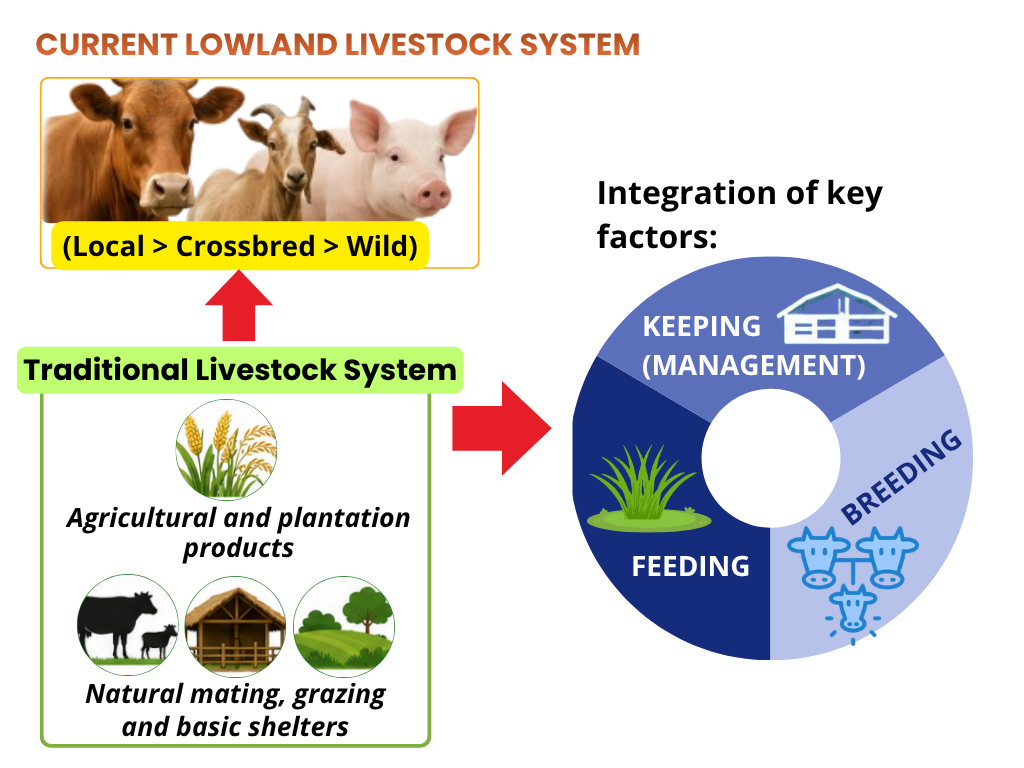
The integration of breeding, keeping, and feeding practices is essential for improving livestock productivity and sustainability, particularly in lowland agricultural systems. This study investigates the integration of these practices in the Lowlands Agriculture Development Centre of Manokwari, West Papua. Using Principal Component Analysis (PCA) and hierarchical clustering, key factors influencing livestock performance were identified, including grazing systems, reproductive strategies, feeding types, and shelter management. The principle finding shown majority of livestock are of local breeds, followed by crossbred and wild types. This suggests a dominance of indigenous stock over improved or exotic breeds. The number of offspring/parents, births/parent/year, mating system, management system, feed type, and feeding frequency are significant factors influencing livestock outcomes. Wild livestock, natural mating, and artificial insemination significantly impact livestock performance. This result highlights the dominance of traditional practices such as natural mating and the use of local feeding resources, alongside significant variations in sheltering and grazing systems. Livestock relies mainly on agricultural or plantation products, while commercial feed and household waste are minimally used. Two distinct clusters of livestock management were revealed, indicating varying levels of efficiency and sustainability among farmers. This research emphasizes the importance of adopting integrated approaches to optimize livestock management, enhance productivity, and support sustainable agricultural development in tropical lowlands. The findings provide actionable insights for policymakers and practitioners in the region.
Referencias
Argo, A., Rahardjo, K., & Wicaksono, K. P. (2015). Optimalisasi Strategi Integrasi Kelapa Sawit-Sapi Pada Badan Usaha Milik Negara (BUMN) Perkebunan Di Indonesia. Profit, 9(1), 11–21. https://doi.org/10.21776/ub.profit.2015.009.01.2
Bolowe, M. A., Ketshephaone, T., Monametsi, P., Ineeleng, P., & Malejane, C. (2022). Production Characteristics and Management Practices of Indigenous Tswana Sheep in Southern Districts of Botswana. Animals, 12(7), 830. https://doi.org/10.3390/ani12070830
Boujenane, I. (2015). Growth at Fattening and Carcass Characteristics of D’man, Sardi and Meat-Sire Crossbred Lambs Slaughtered at Two Stages of Maturity. Tropical Animal Health and Production, 47(7), 1363–71. https://doi.org/10.1007/s11250-015-0872-x
Clough, Y., Vijesh, V. K., Corre, M. D., Darras, K., Denmead, L. H., Meijide, A., Moser, S., et al. (2016). Land-Use Choices Follow Profitability at the Expense of Ecological Functions in Indonesian Smallholder Landscapes. Nature Communications, 7. https://doi.org/10.1038/ncomms13137
Creswell, J. W. (2014). Research Design: Qualitative, Quantitative, and Mixed Methods Approaches. SAGE Publications.
Das, G. (2018). Traditional Livestock Management of the Tribal Communities in the State of Andhra Pradesh and Telangana. Tarnaka Secunderabad India.
Descheemaeker, K., Amede, T., & Haileslassie, A. (2010). Improving Water Productivity in Mixed Crop-Livestock Farming Systems of Sub-Saharan Africa. Agricultural Water Management, 97(5), 579–86. https://doi.org/10.1016/j.agwat.2009.11.012
Fanimo, A. O., Oduguwa, O. O., Adesehinwa, A. O. K., Owoeye, E. Y., & Babatunde, O. S. (2003). Response of Weaner Pigs to Feed Rationing and Frequency of Feeding. Livestock Research for Rural Development,15(6), 26–30.
Far, Z., & Yakhler, H. (2015). Typology of Cattle Farming Systems in the Semi-Arid Region of Setif: Diversity of Productive Directions? Livestock Research for Rural Development, 27(6).
Frison, E. A., Cherfas, J., & Hodgkin, T. (2011). Agricultural Biodiversity Is Essential for a Sustainable Improvement in Food and Nutrition Security. Sustainability, 3(1), 238–53. https://doi.org/10.3390/su3010238
Gizaw, S., Getachew, T., Goshme, S., Valle-Zárate, A., Van Arendonk, J. A. M., Kemp, S., Mwai, A. O., & Dessie, T. (2014). Efficiency of Selection for Body Weight in a Cooperative Village Breeding Program of Menz Sheep under Smallholder Farming System. Animal, 8(8), 1249–54. https://doi.org/10.1017/S1751731113002024
Goddard, M. A., Dougill, A. J., & Benton, T. G. (2013). Why Garden for Wildlife? Social and Ecological Drivers, Motivations and Barriers for Biodiversity Management in Residential Landscapes. Ecological Economics, 86, 258–73. https://doi.org/10.1016/j.ecolecon.2012.07.016.
Hosseini, M., Shahrbabak, H. M., Zandi, M. B., & Fallahi, M. H. (2016). A Morphometric Survey among Three Iranian Horse Breeds with Multivariate Analysis. Media Peternakan, 39(3), 155–60. https://doi.org/10.5398/medpet.2016.39.3.155
Hutabarat, S. (2017). Rakyat Di Kabupaten Pelalawan, Riau Dalam Perubahan Perdagangan Global. Pekanbaru Indonesia, 43, 47–64.
Iyai, D. A., Rahayu, B. W. I., Sumpe, I., & Saragih, D. (2011). Analysis of Pig Profiles on Small-Scale Pig Farmers in Manokwari-West Papua. Journal of the Indonesian Tropical Animal Agriculture, 36 (3), 190–197. https://doi.org/10.14710/jitaa.36.3.190-197
Iyai, D., Mustaqim, A. I., & Sagrim, M. (2020). Profil, Input Dan Output Sistem Peternakan Pada Kawasan Agro-Ekologi Tambrauw Provinsi Papua Barat. Jurnal Pertanian Terpadu, 8(1), 1–13. https://doi.org/10.36084/jpt..v8i1.230
Kamau, P. (2004). Forage Diversity and Impact of Grazing Management on Rangeland Ecosystems in Mbeere District, Kenya. Kenya.
Manokwari, B. P. S. (2018). Kabupaten Manokwari Dalam Angka 2018. Manokwari: BPS Manokwari.
Marandure, T., Dzama, K., Bennett, J., Makombe, G., Chikwanha, O., & Mapiye, C. (2020). Farmer Challenge-Derived Indicators for Assessing Sustainability of Low-Input Ruminant Production Systems in Sub-Saharan Africa. Environmental and Sustainability Indicators, 8(August), 100060. https://doi.org/10.1016/j.indic.2020.100060
Marie, D., Nkou, B. B., Voundi, E., Ghazoul, J., Mala, A. W., Buttler, A., & Guillaume, T. (2023). Nutrient Availability Challenges the Sustainability of Low-Input Oil Palm Farming Systems. Farming System, 1(1), 100006. https://doi.org/10.1016/j.farsys.2023.100006
McCarthy, J. F. (2010). Processes of Inclusion and Adverse Incorporation: Oil Palm and Agrarian Change in Sumatra, Indonesia. Journal of Peasant Studies, 37(4), 821–50. https://doi.org/10.1080/03066150.2010.512460
Mekonnen, A., Haile, A., Dessie, T., & Mekasha, Y. (2012). On Farm Characterization of Horro Cattle Breed Production Systems in Western Oromia, Ethiopia. Livestock Research for Rural Development, 24(6), 7.
Mezgebe, G., Gizaw, S., & Urge, M. (2018). Economic Values of Begait Cattle Breeding-Objective Traits under Low and Medium Input Production Systems in Northern Ethiopia. Livestock Research for Rural Development, 30(1).
Muhlisin, P., Lee, S. J., Lee, J. K., & Lee, S. K. (2014). Effects of Crossbreeding and Gender on the Carcass Traits and Meat Quality of Korean Native Black Pig and Duroc Crossbred. Asian-Australasian Journal of Animal Sciences, 27(7), 1019–1025. https://doi.org/10.5713/ajas.2013.13734
Musa, M. A., Peters, K. J., & Ahmed, M. K. A. (2006). On Farm Characterization of Butana and Kenana Cattle Breed Production Systems in Sudan. Livestock Research for Rural Development, 18(12).
Pagala, M. A., Zulkarnain, D., & Munadi, L. M. (2020). Kapasitas Daya Tampung Hijauan Pakan Ternak Dan Hasil Ikutan Perkebunan Kelapa Sawit Di Kecamatan Tanggetada Kabupaten Kolaka. Jurnal Sosio Agribisnis, 5(2), 70–76.
Parsons, D., Lane, P. A., Ngoan, L. D., Ba, N. X., Tuan, D. T., Van, N. H., Dung, D. V., & Phung, L. D. (2013). Systems of Cattle Production in South Central Coastal Vietnam. Livestock Research for Rural Development, 25(2).
Pasandaran, E. (2006). Alternative Policies for Controlling Conversion of Irrigated Rice Fields in Indonesia. Jurnal Litbang Pertanian, 25(4), 123–129.
Pattiselanno, F., Desni, T. R., Saragih, M., Lekitoo, N., & Iyai, D. A. (2021). Nutrient Values of Utilization of Crops Wastes as Alternative Pig Feeding Ingredient in The Coastal Agro-Ecological Area of Manokwari, West Papua. Jurnal Ilmiah Peternakan Terpadu, 9(2), 170. https://doi.org/10.23960/jipt.v9i2.p170-185
Petrus, N. P., Mpofu, I., Schneider, M. B., & Nepembe, M. (2011). The Constraints and Potentials of Pig Production among Communal Farmers in Etayi Constituency of Namibia. Livestock Research for Rural Development, 23(7), 18125.
Rao, G. N. (2018). Biostatistics & Research Methodology. PharmaMed Press.
Rojas-Downing, M., Melissa, A., Nejadhashemi, P., Harrigan, T., & Woznicki, S. A. (2017). Climate Change and Livestock: Impacts, Adaptation, and Mitigation. Climate Risk Management, 16, 145–163. https://doi.org/10.1016/j.crm.2017.02.001
Sayori, A., Widayati, T. W., Supriyantono, A., Randa, S. Y., & Iyai, D. A. (2022). Pig Farming System in West Papua: A Case Study of Three Districts. Annals of Agriculture Science and Research, 1(1), 1–10.
Serey, M., Mom, S., Kouch, T., & Bunna, C. (2014). Cattle Production Systems in NW Cambodia. Livestock Research for Rural Development, 26(3), 86320.
Shikuku, K. M., Valdivia, R. O., Paul, B. K., Mwongera, C., Winowiecki, L., Läderach, P., Herrero, M., & Silvestri, S. (2017). Prioritizing Climate-Smart Livestock Technologies in Rural Tanzania: A Minimum Data Approach. Agricultural Systems, 151, 204–216. https://doi.org/10.1016/j.agsy.2016.06.004
Sibly, R. M., Grimm, V., Martin, B. T., Johnston, A. S. A., Kulakowska, K., Topping, C. J., Calow, P., Nabe-Nielsen, J., Thorbek, P., & Deangelis, D. L. (2013). Representing the Acquisition and Use of Energy by Individuals in Agent-Based Models of Animal Populations. Methods in Ecology and Evolution, 4(2), 151–161. https://doi.org/10.1111/2041-210x.12002
Snedecor, G. W., & Cochran, W. G. (1989). Statistical Methods. 8th ed. USA: Blackwell Publishing.
Solomon, Z. A., Kassa, B., Agza, B., Alemu, F., & Muleta, G. (2014). Smallholder Cattle Production Systems in Metekel Zone, Northwest Ethiopia. Research Journal of Agriculture and Environmental Management, 3(2), 151–157.
Steffens, V. C. (2016). Potentials of Agrarian Cluster Development for Improving Smallholder ’ s Income – a Case Study from the SAGCOT Initiative in Tanzania. Universität zu Köln.
Tohiran, K. A., Nobilly, F., Zulkifli, R., Ashton-Butt, A., & Azhar, B. (2019). Cattle-Grazing in Oil Palm Plantations Sustainably Controls Understory Vegetation. Agriculture, Ecosystems and Environment, 278(March), 54–60. https://doi.org/10.1016/j.agee.2019.03.021.
Tolera, A., & Abebe, A. (2007). Livestock Production in Pastoral and Agro-Pastoral Production Systems of Southern Ethiopia. Livestock Research for Rural Development, 19(12), 2007.
Winarso, B., & Basuno, E. (2013). Pengembangan Pola Integrasi Tanaman-Ternak Merupakan Bagian Upaya Mendukung Usaha Pembibitan Sapi Potong Dalam Negeri. Forum Penelitian Agro Ekonomi, 31(2), 151. https://doi.org/10.21082/fae.v31n2.2013.151-169
Descargas
Publicado
Número
Sección
Licencia
Derechos de autor 2026 Deny Anjelus Iyai, Meky Sagrim, Stepanus Pakage, Yubelince Y. Runtuboi, Andoyo Supriyantono, Bernaddetha Wahyu Irianti Rahayu, Makarius Bajari, Hieronymus Y. Chrisostomus, Trisiwi Wahyu Widayati, Diana Sawen, Siti Aisah Bauw, Daniel Yohanes Seseray, Johan F. Koibur, Hans Mamboai, Frandz Rumbiak Pawere

Esta obra está bajo una licencia internacional Creative Commons Atribución-NoComercial 4.0.
Los autores conservan sus derechos de autor sin restricciones.