
Population and genetic characterization of Blackbelly sheep in the Amazonian Savanna
DOI:
https://doi.org/10.17268/sci.agropecu.2026.48Palabras clave:
birth weight, heritability, inbreeding, relationship, variabilityResumen
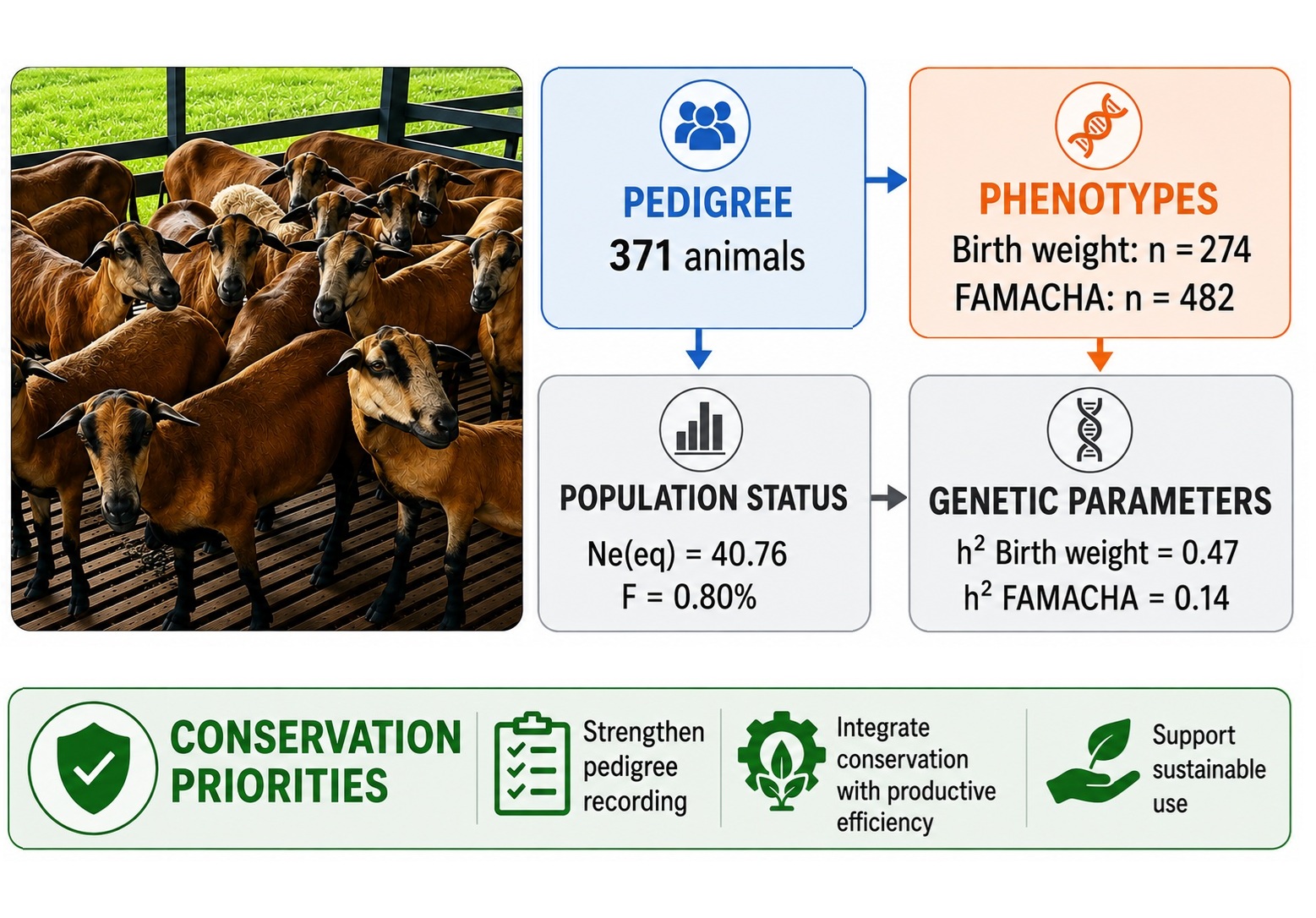
Locally adapted sheep breeds represent valuable genetic resources for livestock under tropical climatic, nutritional, and health constraints. This study characterized the population structure and estimated genetic parameters for birth weight and FAMACHA (FAffa MAlan CHArt) score in Blackbelly sheep maintained in a conservation nucleus in the Amazonian Savanna of northern Brazil. Pedigree records from 371 animals and phenotypic records for birth weight (n = 274) and repeated FAMACHA scores (n = 482) were analyzed. Population structure parameters were estimated from genealogical data, and genetic parameters were obtained using Bayesian single-trait animal models. The pedigree was shallow (1.24 equivalent generations), with an effective population size of 40.76 and an average relatedness coefficient of 3.40%. Mean inbreeding was 0.80% but increased by 0.63% per generation. Birth weight and FAMACHA score averaged 2.36 kg and 3.15, respectively. Heritability was high for birth weight (0.47) and low for FAMACHA score (0.14). These findings underscore the importance of improving pedigree recording and implementing targeted mating strategies to mitigate inbreeding, preserve genetic diversity, and ensure the long-term sustainability of Blackbelly sheep in tropical systems of the Amazonian Savanna.
Referencias
Abebe, A. S., Alemayehu, K., & Gizaw, S. (2025). Genetic and economic efficiencies of alternative breeding schemes for improvement of local breeds in low-input production systems: the case of the Farta sheep in Northwest Ethiopia. Plos One, 20(9), e0331701. https://doi.org/10.1371/journal.pone.0331701
Al-Bial, A. M., & Alkubaibi, H. (2026). Genetic parameters, breeding values, and pre-weaning growth trends of Ganadi sheep under highland conditions of Yemen. Small Ruminant Research, 264, 107862. https://doi.org/10.1016/j.smallrumres.2026.107862
Almeida, A. M. (2017). Barbados Blackbelly: the Caribbean ovine genetic resource. Tropical Animal Health and Production, 50(2), 239-250. https://doi.org/10.1007/s11250-017-1475-5
Amarilho-Silveira, F., Dionello, N. J. L., & Canaza-Cayo, A. W. (2021). Estimate of genetic components of birth weight using multi-breed models with pedigree structures in mestizo sheep. Scientia Agrária Paranaensis, 20(2), 143-149. https://doi.org/10.18188/sap.v20i2.26991
Barbosa, A. C. B., Romano, G. S., Del Solar, V. J. M., Ferraz, J. B. S., Pedrosa, V. B., & Pinto, L. F. B. (2020). Pedigree analysis of Santa Inês sheep and inbreeding effects on performance traits. Revista Mexicana de Ciencias Pecuarias, 11(2), 590-604. https://doi.org/10.22319/rmcp.v11i2.4899
Barros, E. A., Brasil, L. H. A., Tejero, J. P., Delgado-Bermejo, J. V., & Ribeiro, M. N. (2017). Population structure and genetic variability of the Segureña sheep breed through pedigree analysis and inbreeding effects on growth traits. Small Ruminant Research, 149, 128-133. http://dx.doi.org/10.1016/j.smallrumres.2017.02.009
Bayraktar, M., Durmuş, M., Uyguner, Ö., Turan, M., Özcan, B. D., & Koluman, N. (2026). Comprehensive analysis of population structure and genomic diversity in fifteen Anatolian sheep breeds. BMC Veterinary Research, 22, 404. https://doi.org/10.1186/s12917-026-05544-2
Behrem, S. (2021). Estimation of genetic parameters for pre-weaning growth traits in Central Anatolian Merino sheep. Small Ruminant Research, 197, 106319. https://doi.org/10.1016/j.smallrumres.2021.106319.
Bem, R. D., Freitas, L. A., Menegatto, L. S., Costa, K. A., Costa, R. L. D., Savegnago, R. P., Stafuzza, N. B., & Paz, C. C. P. (2023). Estimates of genetic parameters for indicator traits of resistance to gastrointestinal nematodes and growth traits in Santa Inês sheep. Small Ruminant Reseach, 224, 106983. https://doi.org/10.1016/j.smallrumres.2023.106983
Braga, R. M., & Mendonça, C. E. D. (2018). Considerações Sobre os Ovinos da Raça Barriga Negra: Aspectos Históricos e Ações de Pesquisa na Embrapa Roraima. Boa Vista, RR: Embrapa Roraima. 29p.
Burke, J. M., Popp, M., Anderson, J., Miller, J. E., & Notter, D. R. (2022). The impact of sire fecal egg counts estimated breeding values on indicators of offspring gastrointestinal nematode infection, and relative impact of lamb estimated breeding values on sale value of ram lambs. Small Ruminant Research, 216, 106830. https://doi.org/10.1016/j.smallrumres.2022.106830.
Canaza-Cayo, A. W., Amarilho-Silveira, F., Churata-Huacani, R., & Bueno Filho, J. S. S. (2024). Genetic parameter estimates for growth traits in Texel sheep of Brazil. Reproduction and Breeding, 4(3), 174-178. https://doi.org/10.1016/j.repbre.2024.07.001
Cortellari, M., Negro, A., Bionda, A., Carta, A., Macciotta, N., Biffani, S., Grande, S., Cesarani, A., & Crepaldi, P. (2022). Using Pedigree and Genomic Data toward Better Management of Inbreeding in Italian Dairy Sheep and Goat Breeds. Animals, 12(20), 2828. https://doi.org/10.3390/ani12202828
Costa, K. A., Araujo, A. C., Fonseca, P. A. S., Silva, H. T., Menegatto, L. S., Freitas, L. A., Cardoso, C. M., Carvalho Filho, I., Otto, P. I., Costa, R. L. D., Stafuzza, N. B., & Paz, C. C. P. (2025). Genetic parameters and haplotype-based genome-wide association study of indicator traits for gastrointestinal parasite resistance in Santa Ines sheep. Veterinary Parasitology, 337, 110498. https://doi.org/10.1016/j.vetpar.2025.110498
Cunha, S. M. F., Wilooughby, O., Schenkel, F., & Cánovas, A. (2024). Genetic parameter estimation and selection for resistance to grastointestinal nematode parasites in sheep – a review. Animals, 14(4), 613. https://doi.org/10.3390/ani14040613
Eydivandi, S., Roudbar, M. A., Karimi, M. O., & Sahana, G. (2021). Genomic scans for selective sweeps through haplotype homozygosity and allelic fixation in 14 indigenous sheep breeds from Middle East and South Asia. Scientific Reports, 11(2834), 2834. https://doi.org/10.1038/s41598-021-82625-2
FAO. (1998). Secondary guidelines for development of national farm animal genetic resources management plans: management of small populations at risk. Food and Agriculture Organization of the United Nations, Roma, 219 p.
Gautam, L., & Tyasi, T. L. (2025). Genetic assessment of derived growth curve parameters in Sonadi sheep within a breeding flock. Veterinary Medicine and Science, 11(6), e70658. https://doi.org/10.1002/vms3.70658
Geweke, J. (1992). Evaluating the accuracy of sampling-based approaches to the calculation of posterior moments. In: Bernardo, J.M., Berger, J.O., Dawid, A.P., Smith, A.F.M. (eds), Bayesian statistics 4. Oxford University Press, New York, 625–631.
Gonçalves, L. V. C., Pinho, R. C., Ayres, M. I. C., Ticona-Benavente, C. A., Pereira, H. S., Neves Junior, A. F., & Alfaia, S. S. (2021). Influence of the Caiçaras on soil properties in the savanna region of Roraima, northern Amazon. Sustainability 13(20), 11354. https://doi.org/10.3390/su132011354
Hashemi, M., & Hossein-Zadeh, N. G. (2020). Population genetic structure analysis of Shall sheep using pedigree information and effect of inbreeding on growth traits. Italian Journal of Animal Science, 19(1), 1195-1203. https://doi.org/10.1080/1828051X.2020.1827992
Hernandez, V. R., Vega, M. V., Costa, R. G., Parraguirre, L. C., Valencia, I. M. D. L. A., & Romero-Arenas, O. (2022). Evaluation of Genetic Parameters of Growth of Pelibuey and Blackbelly Sheep through Pedigree in Mexico. Animals, 12(6), 691. https://doi.org/10.3390/ani12060691
Justinski, C., Wilkens, J., & Distl, O. (2023). Genetic Diversity and Trends of Ancestral and New Inbreeding in German Sheep Breeds by Pedigree Data. Animals, 13(4), 623. https://doi.org/10.3390/ani13040623
Kaplan, R. M., Burke, J. M., Terrill, T. H., Miller, J. E., Getz, W. R., Mobini, S., Valencia, E., Williams, M. J., Williamson, L. H., Larsen, M., & Vatta, A. F. (2004). Validation of the FAMACHA eye color chart for detecting clinical anemia in sheep and goats on farms in the southern United States. Veterinary Parasitology, 123(1), 105-120. https://doi.org/10.1016/j.vetpar.2004.06.005
Kiya, C. K., Pedrosa, V. B., Muniz, K. F. A., Gusmão, A. L., & Batista, L. F. P. (2019). Population structure of a nucleus herd of Dorper sheep and inbreeding effects on growth, carcass, and reproductive traits. Small Ruminant Research, 177, 141-145. https://doi.org/10.1016/j.smallrumres.2019.06.015
Malan, F.S., Van Wyk, J.A. (1992). The packed cell volume and color of the conjunctivae as aids for monitoring Haemonchus contortus infestations in sheep. In: Biennial National Veterinary Congress, 1, Grahamstown, África do Sul. Anais… Grahamstown: South African Veterinary Association, v.1., p.139.
McManus, C., Faria, D. A., Lucci, C. M., Louvandini, H., Pereira, S. A., & Paiva, S. R. (2020). Heat stress effects on sheep: are hair sheep more heat resistant? Theriogenology 155, 157-167. https://doi.org/10.1016/j.theriogenology.2020.05.047
Misztal, I., Tsuruta, S., Lourenco, D. A. L., Aguilar, I., Legarra, A., & Vitezica, Z. (2019). Manual for BLUPF90 family of programs. University of Georgia, USA.
Nurfaridah, A. (2022). Evaluasi Genetik Bobot Lahir dan Bobot Sapih Domba Garut di UPTD-BPPTD Margawati Garut. Jurnal Sumber Daya Hewan 3(2), 6-12. https://doi.org/10.24198/jsdh.v3i2.42189
Oliveira, E. J., Savegnago, R. P., Freitas, L. A., Freitas, A. P., Maia, S. R., Simili, F. F., El Faro, L., Costa, R. L. D., Santana Júnior, M. L., & Paz, C. C. P. (2018). Estimates of genetic parameters and cluster analysis for worm resistance and resilience in Santa Inês meat sheep. Pesquisa Agropecuária Brasileira, 53(12), 1338-1345. https://doi.org/10.1590/S0100-204X2018001200006
Oyieng, E., Mrode, R., Ojango, J. M. K., Ekine-Dzivenu, C. C., Audho, J., Okeyo, A. M. (2022). Genetic parameters and genetic trends for growth traits of the Red Maasai sheep and its crosses to Dorper sheep under extensive production system in Kenya. Small Ruminant Research, 206, 106588. https://doi.org/10.1016/j.smallrumres.2021.106588
Paim, T. P., Santos, C. A., Faria, D. A., Paiva, S. R., & McManus, C. (2022). Genomic selection signatures in Brazilian sheep breeds reared in a tropical environment. Livestock Science, 258, 104865. https://doi.org/10.1016/j.livsci.2022.104865
R Core Team (2024). R: A language and environment for statistical computing. R Foundation for Statistical Computing, Vienna, Austria. http://www.R-project.org
Rafter, P., McHugh, N., Pabiou, T., Berry, D. P. (2022). Inbreeding trends and genetic diversity in purebred sheep populations. Animal, 16(8), 100604. https://doi.org/10.1016/j.animal.2022.100604
Saravanan, K. A., Tiwari, J., Khan, K. D., Sahana, V. N., Yadav, A., Alex, R., Gowane, G. R., Misra, S. S., & Kumar, A. (2026). Unravelling the signatures of selection for climate adaptation in worldwide sheep breeds. Small Ruminant Research, 256, 107701. https://doi.org/10.1016/j.smallrumres.2026.107701
Snyman, M. A., & Fisher, A. D. (2019). Genetic parameters for traits associated with resistance to Haemonchus contortus in a South African Dohne Merino sheep flock. Small Ruminant Research, 176, 76-88. https://doi.org/10.1016/j.smallrumres.2019.01.004
Tesema, Z., Deribe, B., Lakew, M., Getachew, T., Tilahun, M., Belayneh, N., Kefale, A., Shibesh, M., Zegeye, A., Yizengaw, L., Alebachew, G. W., Tiruneh, S., Kiros, S., Asfaw, M., & Bishaw, M. (2022). Genetic and non-genetic parameter estimates for growth traits and Kleiber ratios in Dorper x indigenous sheep. Animal, 16(6), 100533. https://doi.org/10.1016/j.animal.2022.100533
Wanjala, G., Bagi, Z., Gavojdian, D., Badaoui, B., Astuti, P. K., Mizeranschi, A., Ilisiu, E., Ohran, H., Juhas, E. P., Loukovitis, D., Kawecka, A., Sveistiene, R., Becskei, Z., Strausz, P., Kichamu, N., & Kusza, S. (2025). Genetic diversity and adaptability of native sheep breeds from different climatic zones. Scientific Reports, 15, 14143. https://doi.org/10.1038/s41598-025-97931-2
Wanjala, G., Astuti, P. K., Bagi, Z., Kichamu, N., Strausz, P., Kusza, S. (2023). A review on the potential effects of environmental and economic factors on sheep genetic diversity: consequences of climate change. Saudi Journal of Biological Sciences, 30(1), 103505. https://doi.org/10.1016/j.sjbs.2022.103505
Descargas
Publicado
Número
Sección
Licencia
Derechos de autor 2026 Scientia Agropecuaria

Esta obra está bajo una licencia internacional Creative Commons Atribución-NoComercial 4.0.
Los autores que publican en esta revista aceptan los siguientes términos:
a. Los autores conservan los derechos de autor y conceden a la revista el derecho publicación, simultáneamente licenciada bajo una licencia de Creative Commons que permite a otros compartir el trabajo, pero citando la publicación inicial en esta revista.
b. Los autores pueden celebrar acuerdos contractuales adicionales separados para la distribución no exclusiva de la versión publicada de la obra de la revista (por ejemplo, publicarla en un repositorio institucional o publicarla en un libro), pero citando la publicación inicial en esta revista.
c. Se permite y anima a los autores a publicar su trabajo en línea (por ejemplo, en repositorios institucionales o en su sitio web) antes y durante el proceso de presentación, ya que puede conducir a intercambios productivos, así como una mayor citación del trabajo publicado (ver efecto del acceso abierto).