
Development of preliminary multielement norms for the Diagnosis and Recommendation Integrated System (DRIS) in sweet potato, Ipomoea batatas (L.) Lam., in Cañete Province, Peru
DOI:
https://doi.org/10.17268/sci.agropecu.2026.52Palavras-chave:
Foliar analysis, Mineral nutrition, Nutrient balance, Nutritional assessment, Nutrient interactionsResumo
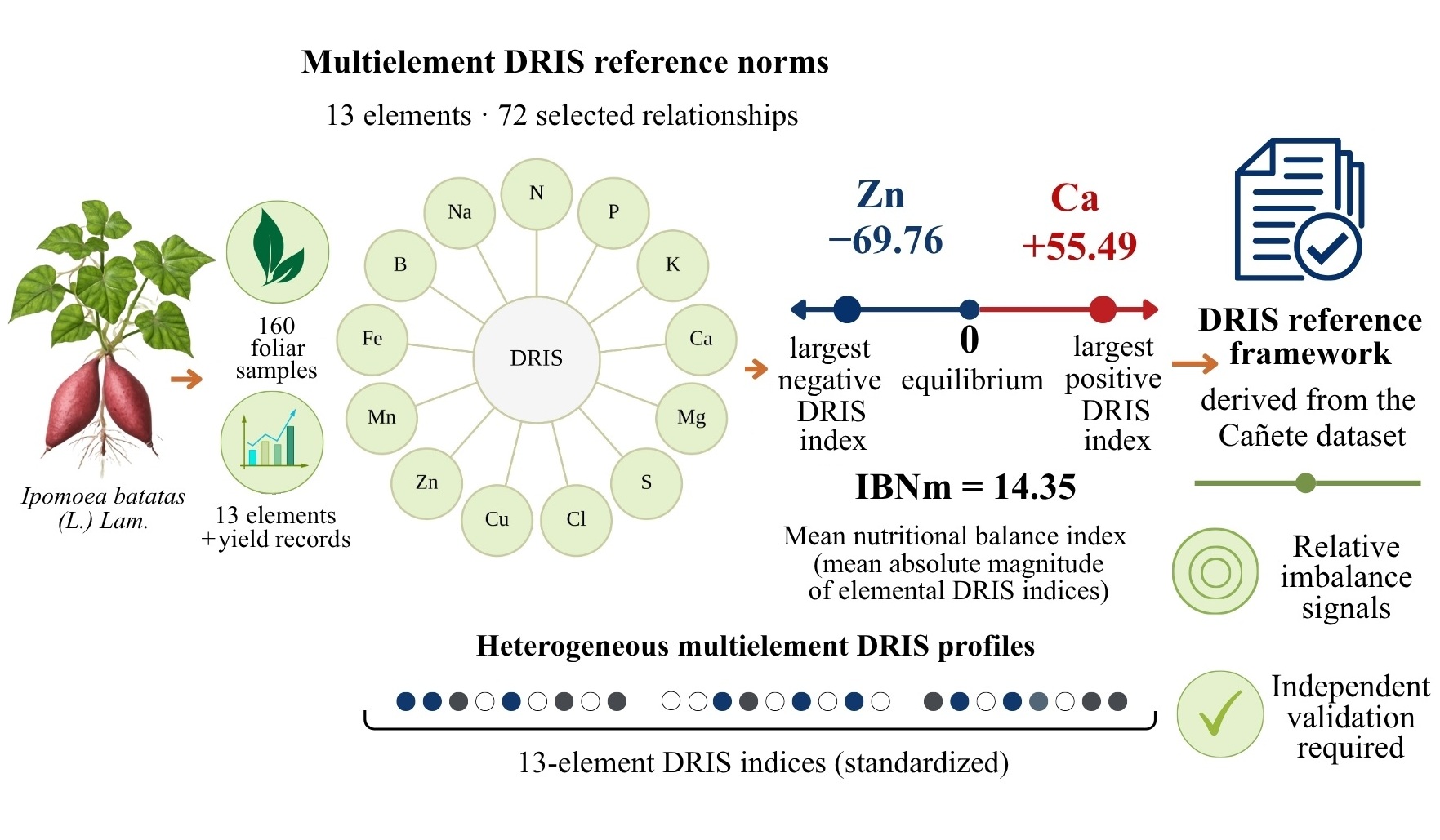
Nutritional balance is a key factor influencing sweet potato productivity, particularly under intensive production systems where multiple nutrient interactions may affect crop performance. Reliable foliar diagnostic approaches are therefore needed to assess these interactions and identify nutritional imbalances associated with yield. This study aimed to develop Diagnosis and Recommendation Integrated System (DRIS) norms and characterize multielement nutritional balance in sweet potato using a yield-linked foliar database from Cañete, Lima, Perú. The database comprised 160 foliar samples collected from commercial fields and experimental plots, each associated with a corresponding yield record and analyzed for 13 elements (N, P, K, Ca, Mg, S, Na, Cl, Cu, Zn, Mn, Fe, and B). Following complementary univariate and multivariate screening, 120 observations were retained and stratified by yield, with the high-yield population used as the reference population for norm development. Of the 156 direct and inverse elemental relationships evaluated, 72 were retained as DRIS norms after normality screening and subsequent selection based on the variance-ratio criterion. The mean DRIS profile of the low-yield population showed pronounced differences in the direction and magnitude of the elemental indices, with Zn showing the largest negative mean index (−69.76) and Ca the largest positive mean index (+55.49). Associations between individual DRIS indices and yield varied in both direction and magnitude. The resulting norms provide a multielement reference framework for characterizing nutritional balance under the production conditions represented by the Cañete dataset. However, the DRIS indices should be interpreted as indicators of relative nutritional imbalance rather than as experimentally validated nutrient requirements. Therefore, the diagnostic accuracy and transferability of these norms should be evaluated using independent datasets and nutrient-response experiments before they are applied to support nutrient-management recommendations.
Referências
Agbangba, E. C., Yalinkpon, F., Sossa, E. L., Ehnon Gongnet, E., & Glèlè Kakaï, R. (2024). A simulation study on the comparison of Diagnosis and Recommendation Integrated System (DRIS), Modified-DRIS (M-DRIS), and Compositional Nutrient Diagnosis (CND) for pineapple nutrient diagnosis. Agronomy Research, 22(Special Issue 3), 1380–1404. https://doi.org/10.15159/AR.24.101
Bataglia, O. C., Quaggio, J. A., Santos, W. R. dos, & Abreu, M. F. de. (2004). Diagnose nutricional do cafeeiro pelo dris variando-se a constante de sensibilidade dos nutrientes de acordo com a intensidade e freqüência de resposta na produção. Bragantia, 63(2), 253–263. https://doi.org/10.1590/S0006-87052004000200010
Beaufils, E. R., & Sumner, M. E. (1977). Effect of time of sampling on the diagnosis of the N, P, K, Ca, and Mg requirements of sugarcane by the DRIS approach. Proceedings of the South African Sugar Technologists’ Association, 62–67.
Cavalcanti, A. C., Partelli, F. L., Gontijo, I., Dias, J. R. M., Freitas, M. S. M., & de Carvalho, A. J. C. (2021). Establishment of leaf nutrient patterns for the nutritional diagnosis of Urochloa brizantha pastures in two seasons. Acta Scientiarum - Agronomy, 43, e50359. https://doi.org/10.4025/actasciagron.v43i1.50359
Conceição, M. P. da, Rozane, D. E., Pereira, E. F., Oliveira, C. T. de, Lima, J. D., & Lima Neto, A. J. de. (2024). Nutritional reference values using the DRIS method and sample size for peach palm production. Revista Brasileira de Ciencia do Solo, 48, e0230076. https://doi.org/10.36783/18069657rbcs20230076
de Souza, H. A., Rozane, D. E., Vieira, P. F. de M. J., Sagrilo, E., Leite, L. F. C., de Brito, L. C. R., Conceição, M. P., & Ferreira, A. C. M. (2023). Accuracy of DRIS and CND methods and nutrient sufficiency ranges for soybean crops in the Northeast of Brazil. Acta Scientiarum - Agronomy, 45, e59006. https://doi.org/10.4025/actasciagron.v45i1.59006
Escobedo, P. M. T., & Salas, P. M. J. A. (2008). P. Ch. Mahalanobis y las aplicaciones de su distancia estadística. Culcyt, 5(27), 13–20.
Gimenez, M., Nieves, M., Gimeno, H., Martínez, J., & Martínez-Nicolás, J. J. (2021). Nutritional diagnosis norms for three olive tree cultivars in superhigh-density orchards. International Journal of Agriculture and Natural Resources, 48(1), 34–44. https://doi.org/10.7764/ijanr.v48i1.2227
He, W., Li, J., Lu, Y., Chen, S., Deng, L., Xu, X., Zhu, Y., Jin, M., Liu, Y., Lu, G., & Lv, Z. (2023). Development of critical K dilution curves for diagnosing sweetpotato K status. Frontiers in Plant Science, 14, 1124328. https://doi.org/10.3389/fpls.2023.1124328
Liu, B. K., Xv, B. J., Si, C. C., Shi, W. Q., Ding, G. Z., Tang, L. X., Xv, M., Shi, C. Y., & Liu, H. J. (2023). Effect of potassium fertilization on storage root number, yield, and appearance quality of sweet potato (Ipomoea batatas L.). Frontiers in Plant Science, 14, 1298739. https://doi.org/10.3389/fpls.2023.1298739
MIDAGRI. (2024). Análisis de la tendencia comercial del camote. Ministerio de Desarrollo Agrario y Riego.
Parent, L. E., & Dafir, M. (1992). A theoretical concept of compositional nutrient diagnosis. Journal of the American Society for Horticultural Science, 117(2), 239-242. https://doi.org/10.21273/JASHS.117.2.239
Pereira, A., Marchetti, M. E., Bungenstab, D. J., Gonçalves da Silva, M. A., Pereira Serra, R., Nunes Guimarães, F. C., Do Amaral Conrad, V., & de Morais, H. S. (2013). Diagnosis and Recommendation Integrated System (DRIS) to assess the nutritional state of plants. In M. D. Matovic (Ed.), Biomass now - Sustainable growth and use (pp. 129-146). IntechOpen. https://doi.org/10.5772/54576
Ramakrishna, A., Bailey, J. S., & Kirchhof, G. (2009). A preliminary diagnosis and recommendation integrated system (DRIS) model for diagnosing the nutrient status of sweet potato (Ipomoea batatas). Plant and Soil, 316(1–2), 107–116. https://doi.org/10.1007/s11104-008-9763-5
Reis Junior, R. dos A., & Monnerat, P. H. (2003). Norms establishment of the Diagnosis and Recommendation Integrated System (DRIS) for nutritional diagnosis of sugarcane. Pesquisa Agropecuária Brasileira, 38(2), 277–282. https://doi.org/10.1590/S0100-204X2003000200015
Shehu, B. M., Garba, I. I., Jibrin, J. M., Kamara, A. Y., Adam, A. M., Craufurd, P., Aliyu, K. T., Rurinda, J., & Merckx, R. (2023). Compositional nutrient diagnosis and associated yield predictions in maize: A case study in the northern Guinea savanna of Nigeria. Soil Science Society of America Journal, 87(1), 63–81. https://doi.org/10.1002/saj2.20472
Shu, X., Jin, M., Wang, S., Xu, X., Deng, L., Zhang, Z., Zhao, X., Yu, J., Zhu, Y., Lu, G., & Lv, Z. (2024). The effect of nitrogen and potassium interaction on the leaf physiological characteristics, yield, and quality of sweet potato. Agronomy, 14(10), 2319. https://doi.org/10.3390/agronomy14102319
Tanaka, M., Ishiguro, K., Oki, T., & Okuno, S. (2017). Functional components in sweetpotato and their genetic improvement. Breeding Science, 67(1), 52–61. https://doi.org/10.1270/jsbbs.16125
Teixeira, M. B., Donato, S. L. R., Da Silva, J. A., & Rodrigues Onato, P. E. (2019). Establishment of DRIS norms for cactus pear grown under organic fertilization in semiarid conditions. Revista Caatinga, 32(4), 952–959. https://doi.org/10.1590/1983-21252019v32n411rc
Thornthwaite, C. W., & Mather, J. R. (1955). The water balance. Publications in Climatology, 8(1), 1–104. Drexel Institute of Technology, Laboratory of Climatology.
Villaseñor-Ortiz, D., de Mello Prado, R., Pereira da Silva, G., & Lata-Tenesaca, L. F. (2022). Applicability of DRIS in bananas based on the accuracy of nutritional diagnoses for nitrogen and potassium. Scientific Reports, 12(1), 18718. https://doi.org/10.1038/s41598-022-22554-w
Walworth, J. L., & Sumner, M. E. (1987). The Diagnosis and Recommendation Integrated System DRIS. In B. A. Stewart (Ed.), Advances in Soil Science (Vol. 6, pp. 149-188). Springer. https://doi.org/10.1007/978-1-4612-4682-4_4
Zhao, X., Wang, S., Qiu, X., Liu, J., Bai, J., Zhang, Z., Xu, X., Zhu, Y., Lu, G., & Lv, Z. (2026). The development of a N/K ratio model for diagnosing the nitrogen–potassium balance of sweet potato. Agriculture, 16(8), 836. https://doi.org/10.3390/agriculture16080836
Zhao, Z., Bai, B., Qie, Z., He, Z., Zhang, S., Zhang, X., Li, Y., & Hou, W. (2025). Effects of nitrogen, phosphorus, and potassium fertilizers on storage root yield, nutrient use efficiency, and soil nutrient balance of sweetpotato. BMC Plant Biology, 25(1). https://doi.org/10.1186/s12870-025-07503-9
Downloads
Publicado
Edição
Seção
Licença
Direitos autorais (c) 2026 Scientia Agropecuaria

Este trabalho está licenciado sob uma licença Creative Commons Attribution-NonCommercial 4.0 International License.
The authors who publish in this journal accept the following conditions:
a. The authors retain the copyright and assign to the magazine the right of the first publication, with the work registered with the Creative Commons attribution license, which allows third parties to use the published information whenever they mention the authorship of the work and the First publication in this journal.
b. Authors may make other independent and additional contractual arrangements for non-exclusive distribution of the version of the article published in this journal (eg, include it in an institutional repository or publish it in a book) as long as it clearly indicates that the work Was first published in this journal.
c. Authors are encouraged to publish their work on the Internet (for example, on institutional or personal pages) before and during the review and publication process, as it can lead to productive exchanges and a greater and faster dissemination of work Published (see The Effect of Open Access).