
Análisis molecular de la diversidad de bacterias fijadoras de nitrógeno y solubilizadoras de fosfato en Neltuma pallida (Humb. & Bonpl. ex Willd.) C.E.Hughes & G.P.Lewis
DOI:
https://doi.org/10.17268/sci.agropecu.2026.045Palavras-chave:
Rizobacterias, PGPR, Fijación de nitrógeno, Solubilización de fosfatoResumo
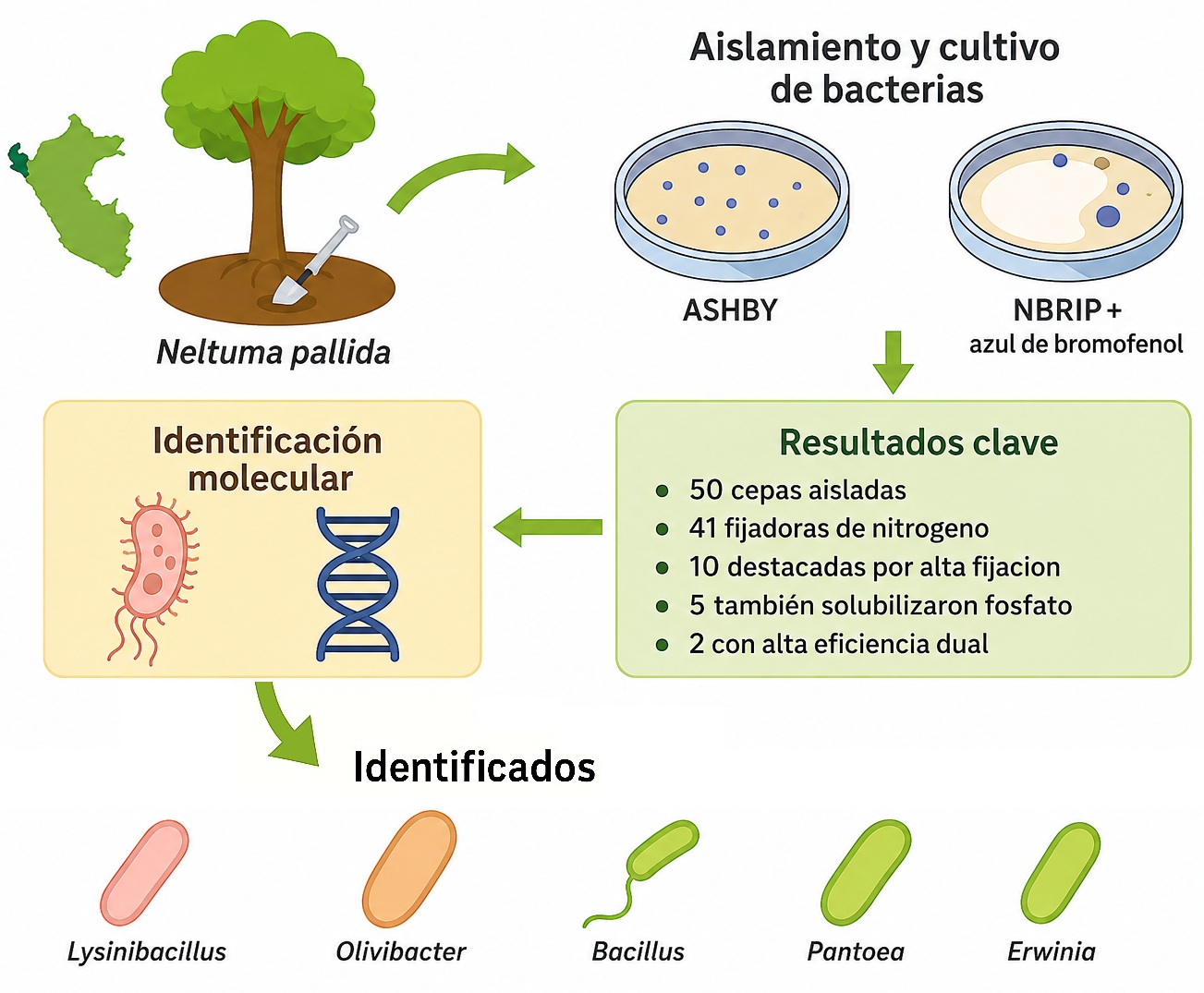
La identificación de bacterias fijadoras de nitrógeno y solubilizadoras de fosfato atmosféricas emerge como una alternativa de fertilización sostenible al uso de agroquímicos que contaminan el medio ambiente. El objetivo de esta investigación fue analizar molecularmente la diversidad de bacterias fijadoras de nitrógeno y solubilizadoras de fosfato en Neltuma pallida. Se recolectaron muestras de suelo rizosférico de árboles jóvenes de Neltuma pallida ubicados en el campo de prácticas del programa de Ingeniería Forestal y Ambiental de la Universidad Nacional de Tumbes, en la localidad de Garbanzal. Las bacterias se aislaron del suelo, se caracterizaron morfológicamente y se evaluaron en ensayos de fijación de nitrógeno inoculando 5 µL de suspensiones bacterianas (1×10⁸ UFC/mL) por triplicado en medio de cultivo ASHBY. Posteriormente, se seleccionaron los aislados con mayor fijación de nitrógeno para ensayos de solubilización de fosfato, los cuales se inocularon en medio NBRIP suplementado con azul de bromofenol (25 ppm), utilizando la misma concentración bacteriana. El análisis de datos se realizó con el software R Studio. Finalmente, se realizó la identificación de los aislados mediante la secuenciación del gen 16S rRNA y se establecieron las relaciones evolutivas a través de un árbol filogenético. En total, se aislaron 50 cepas bacterianas, de las cuales 41 tenían la capacidad de fijar nitrógeno atmosférico. Entre estas, 10 destacaron por su alta eficiencia de fijación y, de estas, cinco también mostraron la capacidad de solubilizar fosfato. Sin embargo, solo dos cepas exhibieron alta eficiencia en ambas funciones. Las relaciones filogenéticas agruparon las especies en tres clados (Firmicutes, Proteobacteria y Bacteroidetes). Las especies identificadas con doble capacidad (fijación de nitrógeno y solubilización de fosfato) fueron Bacillus megaterium, Erwinia spp., Bacillus flexus, Bacillus amyloliquefaciens y Pantoea spp., mientras que aquellas que solo fijaban nitrógeno incluían Bacillus endophyticus, Olivibacter spp., Pantoea septica y Lysinibacillus xylanilyticus.
Referências
Abd‐Alla, M. H., Al-Amri, S., & El-Enany, A. E. (2023). Improving the symbiosis between rhizobia and legumes and reducing the use of nitrogen fertilizers are possible options to mitigate climate change. Agriculture, 13(11), 2092. https://doi.org/10.3390/agriculture13112092
Ariza, S., González, O., & López, J. (2020). Evaluación de fijadores biológicos de nitrógeno libres sobre el crecimiento de gramíneas en suelo degradado. Revista Colombiana de Biotecnología, 22(1), 87-97. https://doi.org/10.15446/rev.colomb.biote.v22n1.78019
Ávila, E.G., Lizarazo, L. M., & Cortés, F. (2015). Promoción del crecimiento de baccharis macrantha (Asteraceae) con bacterias solubilizadoras de fosfatos asociadas a su rizosfera. Acta Biologica Colombiana, 20(3), 121-131. https://doi.org/10.15446/abc.v20n3.44742
Bhattacharyya, P. N., & Jha, D. K. (2012). Plant growth-promoting rhizobacteria (PGPR): emergence in agriculture. World Journal of Microbiology and Biotechnology, 28(2012), 1327-1350. https://doi.org/10.1007/s11274-011-0979-9
Bechtaoui, N., Raklami, A., Tahiri, A., Benidire, L., Göttfert, M. & Oufdou, K. (2024). Rizobacterias solubilizadoras de fosfato y sus efectos en el crecimiento y la absorción de fósforo por las plantas de trigo. Journal of Plant Nutrition, 47, 2811-2823. https://doi.org/10.1080/01904167.2024.2369069
Bakhora, D., Sokhibjon, A., Vyacheslav, S., Dilfuza, J., Bakhora, T., Guzal, K. y Kakhramon, D., (2024). Bacterias asociadas a la rizosfera de la vid (Vitis vinifera L.) y su eficacia en la promoción del crecimiento vegetal. Plant Science Today, 1(4): 1739-1746. https://doi.org/10.14719/pst.3338
Celandroni, F., Vecchione, A., Cara, A., Mazzantini, D., Lupetti, A., & Ghelardi E. (2019). Identification of Bacillus species: Implication on the quality of probiotic formulations. PLOS ONE, 14(5), e0217021. https://doi.org/10.1371/journal.pone.0217021
Celestino Aguilar, R., Herrera, R., Causadías, J. L., Bernal, B., Chavarría, O., González, C., Góndola, J., Moreno, A., & Martínez, A. A. (2025). "Genomic Insights into Plant Growth-Promoting Traits of Lysinibacillus fusiformis and Bacillus cereus from Rice Fields in Panama." Microbiology Research, 16(5), 95. https://doi.org/10.3390/microbiolres16050095
Chen, K., Tang, S. K., Wang, G. L., Nie, G. X., Li, Q. F., Zhang, J. D., Li, W. J., & Li, S. P. (2013). Olivibacter jilunii sp. nov., isolated from DDT-contaminated soil. International Journal Systematic Evolutionary Microbiology, 63(3), 1083–1088. https://doi.org/10.1099/ijs.0.042416-0
Choudhury, D., Tarafdar, S., & Dutta, S. (2022). Plant growth promoting rhizobacteria (PGPR) and their eco-friendly strategies for plant growth regulation: A review. Plant Science Today, 9(3), 524–537. https://doi.org/10.14719/pst.1604
Cordero, I., Ruiz, B., Balaguer, L., Richter, A., Pueyo, J. J., & Rincón, A. (2017). Rhizospheric microbial community of Caesalpinia spinosa (Mol.) Kuntze in conserved and deforested zones of the Atiquipa fog forest in Peru. Applied Soil Ecology, 114(2017), 132-141. https://doi.org/10.1016/J.APSOIL.2017.02.015.
Cordero, I., Pueyo, J. J., & Rincón, A. (2024). Bio-fertilisation with native plant growth promoting rhizobacteria increases the tolerance of the neotropical legume tree Caesalpinia spinosa to water deficit. Forest Ecology and Management. Ecología y Gestión Forestal, 558, 121786. https://doi.org/10.1016/j.foreco.2024.121786
Dao-Jun, G., Singh, R., Singh, P., Dong-ping, L., Sharma, A., Xing, Y., Xiu-peng, S., Li-Tao, Y., & Yang-Rui, L. (2020). Secuencia completa del genoma de Enterobacter roggenkampii ED5, una bacteria endófita fijadora de nitrógeno promotora del crecimiento vegetal con propiedades de biocontrol y tolerancia al estrés, aislada de la raíz de la caña de azúcar. Frontiers in Microbiology, 11, 580081. https://doi.org/10.3389/fmicb.2020.580081
da Rosa, E. D. F. F., do Nascimento Andrade, C., da Luz, S., Kaseker, J. F., Nohatto, M. A., & Nagel, L. E. T. (2024). Avaliação da interação entre bactérias solubilizadoras de fosfato e micorrizas, com doses de fósforo na cultura do milho. Revista de Ciências Agroveterinárias, 23(2), 265-275. https://doi.org/10.5965/223811712322024265
Daraz, U., Li, Y., Sun, Q., Zhang, M., & Ahmad, I. (2021). Inoculation of Bacillus spp. Modulate the soil bacterial communities and available nutrients in the rhizosphere of vetiver plant irrigated with acid mine drainage. Chemosphere, 263, 128345. https://doi.org/10.1016/J.CHEMOSPHERE.2020.128345
Galagarza, O. A., Ramirez-Hernandez, A., Oliver, H., Álvarez Rodríguez, M. V., Valdez Ortiz, M. C., Pachari Vera, E., Cereceda, Y., Diaz-Valencia, Y. K., & Deering, A. (2021). Occurrence of chemical contaminants in Peruvian produce: A food-safety perspective. Foods, 10(7), 1461. https://doi.org/10.3390/foods10071461
Gonçalves, J., Freitas, J., Fernandes, I., & Silva, P. (2023). Microalgae as biofertilizers: A sustainable way to improve soil fertility and plant growth. Sustainability, 15(16), 12413. https://doi.org/10.3390/su151612413
Gómez, V., Molina-Roco, M., Chichipe, E., & Rojas, E. (2023). Trace elements in fertilizers used in Peru. OnLine Journal of Biological Sciences, 23,219–225. https://doi.org/10.3844/ojbsci.2023.219.225
Gu, Y., Dong, K., Geisen, S., Yang, W., Yan, Y., Gu, D., Liu, N., Borisjuk, N., Luo, Y., & Friman, V. (2020). The effect of microbial inoculant origin on the rhizosphere bacterial community composition and plant growth-promotion. Plant and Soil, 452,105-117. https://doi.org/10.1007/s11104-020-04545-w
Gupta, G., Parihar, S. S., Ahirwar, N. K., Snehi, S. K., & Singh, V. (2015). Plant growth promoting rhizobacteria (PGPR): current and future prospects for development of sustainable agriculture. Journal of Microbial & Biochemical Technology, 7(2),096-102. https://doi.org/10.4172/1948-5948.1000188
Hughes, C. E., Ringelberg, J. J., Lewis, G. P., & Catalano, S. A. (2022) Disintegration of the genus Prosopis L. (Leguminosae, Caesalpinioideae, mimosoid clade). In: Hughes CE, de Queiroz LP, Lewis GP (Eds) Advances in Legume Systematics 14. Classification of Caesalpinioideae Part 1: New generic delimitations. PhytoKeys, 205, 147-189. https://doi.org/10.3897/phytokeys.205.75379
Izadi, Z., Fekrat, L., Baghaee Ravari, S. y ZakiAghl, M. (2026). Bacterias intestinales cultivables asociadas con la polilla de la algarroba, Ectomyelois ceratoniae (Zeller, 1839) (Lep.: Pyralidae). Investigación agrícola de Irán, 45 (2), 12-19. https://doi.org/10.22099/iar.2026.55185.1732
Jwaideh, M., Sutanudjaja, E., & Dalin, C. (2022). Global impacts of nitrogen and phosphorus fertiliser use for major crops on aquatic biodiversity. Revista Internacional de Evaluación del Ciclo de Vida, 27, 1058-1080. https://doi.org/10.1007/s11367-022-02078-1
Jiménez, D., Montaña, J., & Martínez, M. (2011). Characterization of free nitrogen fixing bacteria of the genus Azotobacter in organic vegetable-grown Colombian soils. Brazilian Journal of Microbiology, 42(3), 846-858. https://doi.org/10.1590/S1517-83822011000300003
Kumar, S., Diksha, Sindhu, S., & Kumar, R. (2021). Biofertilizers: An ecofriendly technology for nutrient recycling and environmental sustainability. Current Research in Microbial Sciences, 3, 100094. https://doi.org/10.1016/j.crmicr.2021.100094
Khan, Q., Huang, X., He, Z., Wang, H., Chen, Y., Xia, G., & Zhang, Y. (2024). Una perspectiva sobre el conflicto y la colaboración entre plantas y microorganismos. Chemical and Biological Technologies in Agriculture, 11, 161. https://doi.org/10.1186/s40538-024-00684-9
Iqbal, Z., Ahmad, M., Raza, M., Hilger, T., & Rasche, F. (2024). Phosphate-Solubilizing Bacillus sp. Modulate Soil Exoenzyme Activities and Improve Wheat Growth. Microbial Ecology, Microb Ecol, 87, 31.https://doi.org/10.1007/s00248-023-02340-5
Mahdi, I., Fahsi, N., Hafidi, M., Allaoui, A., & Biskri, L. (2020). Plant Growth Enhancement using Rhizospheric Halotolerant Phosphate Solubilizing Bacterium Bacillus licheniformis QA1 and Enterobacter asburiae QF11 Isolated from Chenopodium quinoa Willd. Microorganisms, 8(6), 948. https://doi.org/10.3390/microorganisms8060948
Merino-Rafael, F. A., & Jaramillo-Calle, L. P. (2024). Evaluación de la capacidad promotora del crecimiento vegetal de las rizobacterias de Neltuma pallida en el bosque seco de Piura, Perú: pruebas en laboratorio y efecto en la germinación de semillas. Bosque (Valdivia), 45(2), 337-345. https://doi.org/10.4067/S0717-92002024000200337
Mosquera Espinosa, A. T., Taborda Gálvez, D., Suárez Rendón, G., Rivera, J., Rodas, P. P., Cárdenas Varón, R., Garcés Sanmartín, S., García Marulanda, Z., Ñuscua Otero, A., Rodríguez Parra, D., & Suárez-Barón, H. (2024). Biodisponibilidad del fósforo en la rizosfera de café y cultivos alimentarios por actividad bacteriana. Temas Agrarios, 29(1), 22-39. https://doi.org/10.21897/v2m77468
Muleta, D., Assefa, F., Börjesson, E., & Granhall, U. (2013). Phosphate-solubilising rhizobacteria associated with Coffea arabica L. in natural coffee forests of southwestern Ethiopia. Journal of the Saudi Society of Agricultural Sciences, 12(1), 73–84. https://doi.org/10.1016/j.jssas.2012.07.002
Nascimento, F., Hernández, A., Glick, B., & Rossi, M. (2020). The extreme plant-growth promoting properties of Pantoea phytobeneficialis MSR2 revealed by functional and genomic analysis. Environmental microbiology, 22(4):1341-1355. https://doi.org/10.1111/1462-2920.14946
Nghia, N., Oanh, N., Thanh, N., Xa, L., Vien, D. & Thy, C. (2022). Isolation and selection of salt-tolerant bacterial strains capable of solubilizing phosphorus and synthesizing phosphatase enzyme from rice-shrimp soil in Mekong River Delta, Vietnam. Applied Environmental Biotechnology, 7(2): 5-14. http://doi.org/10.26789/AEB.2022.02.002
Ngoc, K. & Trung, M. (2025). Evaluación estadística del impacto de los fertilizantes agrícolas en la calidad del agua y la sostenibilidad ambiental. Heritage and Sustainable Development, 7(1), 401–414. https://doi.org/10.37868/hsd.v7i1.1217
Ntougias, S., Fasseas, C., & Zervakis, G. I. (2007). Olivibacter sitiensis gen. nov., sp. nov., isolated from alkaline olive-oil mill wastes in the region of Sitia, Crete. International Journal Systematic Evolutionary Microbiology, 57(2), 398–404. https://doi.org/10.1099/ijs.0.64561-0
Pasiecznik, N. M., Felker, P., Harris, P. J. C., Harsh, L. N., Cruz, G., Tewari, J. C., Cadoret, K. & Maldonado, L. J. (2001) The Prosopis juliflora - Prosopis pallida Complex: A Monograph. HDRA, Coventry, UK. pp.172.
Palmer, C., & Fletcher, S. (2003). Matemáticas prácticas. 2da Edición, Reverté.
Pedrinho, A., Mendes, L. W., Barros, F. M. do R., Merloti, L. F., Martins, M. M., & Cotta, S. R., (2023). Impacts of deforestation and forest regeneration on soil bacterial communities associated with phosphorus transformation processes in the Brazilian Amazon region. Ecological Indicators, 146, 109779. https://doi.org/10.1016/j.ecolind.2022.109779
Rawat, P., Das, S., Shankhdhar, D. & Shankhdhar, S. (2020). Phosphate-Solubilizing Microorganisms: Mechanism and Their Role in Phosphate Solubilization and Uptake. Journal of Soil Science and Plant Nutrition, 21, 49 - 68. . https://doi.org/10.1007/s42729-020-00342-7
Saeid, A., Prochownik, E., & Dobrowolska-Iwanek, J., (2018). Phosphorus Solubilization by Bacillus Species. Molecules, 23(2897), 4-18. https://doi.org/10.3390/molecules23112897
Saitou, N., & Nei, M. (1987). The neighbor-joining method: A new method for reconstructing phylogenetic trees. Mol Biol Evol, 4(4):406-25. https://doi.org/10.1093/oxfordjournals.molbev.a040454
Shamem, R., J, M., Kumar, P., Rangasamy, G., Gayathri, K., & Parthasarathy, V. (2022). Rhizobium mayense sp. Nov., an efficient plant growth-promoting nitrogen-fixing bacteria isolated from rhizosphere soil. Environmental research, 220, 115200. https://doi.org/10.1016/j.envres.2022.115200
Siddiqi, M. Z., Liu, Q., Lee, S. Y., Choi, K. D. & Im, W. R. (2018). Olivibacter ginsenosidimutans sp nov., with ginsenoside converting activity isolated from compost, and reclassification of Pseudo Sphingobacterium domesticum as Olivibacter domesticus comb, nov. International Journal Systematic Evolutionary Microbiology, 68(8), 2509–2514, https://doi.org/10.1099/ijsem.0.002819
Shih-Yao, L., Asif, H., Kai-Yeh, C., You-Cheng, L., Yi-Han, H., Wei-An, L. & Chiu-Chung, Y. (2017). Olivibacter composti sp. nov., isolated from compost collected at a greenhouse. International Journal Systematic Evolutionary Microbiology, 67(2017), 148–152, https://doi.org/10.1099/ijsem.0.001593
Shiqi Wu, Na Lv, Y. Zhou & Xiufen Li. (2023). Eliminación simultánea de nitrógeno mediante nitrificación heterotrófica y desnitrificación aeróbica por un nuevo Lysinibacillus fusiformis B301. Water Environment Research, 95(3), e10850. https://doi.org/10.1002/wer.10850
Seaton, F., George, P., Lebron, I., Jones, D., Creer, S., & Robinson, D. (2020). Soil textural heterogeneity impacts bacterial but not fungal diversity. Soil Biology and Biochemistry, 144, 107766. https://doi.org/10.1016/j.soilbio.2020.107766
Servicio Nacional de Meteorología e Hidrología del Perú. (2018). Estudios de Perú. SENAMHI. https://www.senamhi.gob.pe/main.php?dp=estaciones
Suarez-Silva, R., Saucedo-Bazalar, M., Ramirez Saenz, M., et al. (2026). Exploring the Algarrobo decline in the Pómac Forest: Unraveling the relationship between the endomicrobiome of Neltuma pallida and Enallodiplosis discordis. Microbial Ecology, 89, 74. https://doi.org/10.1007/s00248-026-02711-8
Sun, Y., Tang, L., Cui, Y., Yang, D., Gao, H., Chen, J., Zheng, Z., & Guo, C. (2025). Inoculation of plant growth-promoting rhizobacteria and rhizobia changes the protist community of alfalfa rhizosphere soil under saline-alkali environment. Applied Soil Ecology, 206, 105775. https://doi.org/10.1016/j.apsoil.2024.105775
Szabo, I., Szoboszlay, S., Kriszt, N., Hahn, J., Harkai, P., Baka, E., Tancsics, A., Kaszab, E., Privler, Z., & Kukolya, J. (2011). Olivibacter oleidegradans sp. nov., a hydrocarbon- degrading bacterium isolated from a biofilter clean-up facility on a hydrocarbon-contaminated site. International Journal Systematic Evolutionary Microbiology, 61(12), 2861–2865, https://doi.org/10.1099/ijs.0.026641-0
Tang, A., Haruna, A., Majid, N. & Jalloh, M. (2020). Posibles propiedades PGPR de bacterias celulolíticas, fijadoras de nitrógeno y solubilizadoras de fosfato en suelos de bosques tropicales rehabilitados. Microorganisms, 8(3), 442. https://doi.org/10.3390/microorganisms8030442
Tejera, B., Heydrich, M. & Rojas, M. (2013). Aislamiento de Bacillus solubilizadores de fosfatos asociados al cultivo del arroz. Agronomía Mesoamericana, 24(2), 357-364.
Timofeeva, A., Galyamova, M. & Sedykh, S. (2023). Bacterias del suelo promotoras del crecimiento vegetal: fijación de nitrógeno, solubilización de fosfato, producción de sideróforos y otras actividades biológicas. Plants, 12(24) https://doi.org/10.3390/plants12244074
Tamura, K. (1992). Estimation of the number of nucleotide substitutions when there are strong transition-transversion and G + C-content biases. Mol Biolo Evo, 9(4):678-687. doi: https://doi.org/10.1093/oxfordjournals.molbev.a040752
Zuberer, D. A. (2021). Biological dinitrogen (N2) fixation: introduction and nonsymbiotic. 3era Edición. In Principles and applications of soil microbiology. Elsevier, 423-453. https://doi.org/10.1016/B978-0-12-820202-9.00016-2
Downloads
Publicado
Edição
Seção
Licença
Direitos autorais (c) 2026 Scientia Agropecuaria

Este trabalho está licenciado sob uma licença Creative Commons Attribution-NonCommercial 4.0 International License.
The authors who publish in this journal accept the following conditions:
a. The authors retain the copyright and assign to the magazine the right of the first publication, with the work registered with the Creative Commons attribution license, which allows third parties to use the published information whenever they mention the authorship of the work and the First publication in this journal.
b. Authors may make other independent and additional contractual arrangements for non-exclusive distribution of the version of the article published in this journal (eg, include it in an institutional repository or publish it in a book) as long as it clearly indicates that the work Was first published in this journal.
c. Authors are encouraged to publish their work on the Internet (for example, on institutional or personal pages) before and during the review and publication process, as it can lead to productive exchanges and a greater and faster dissemination of work Published (see The Effect of Open Access).