Near Infrared Spectroscopy Combined with Chemometrics and Supervised Machine Learning for Detection of Water Adulteration in Raw Bovine Milk
DOI:
https://doi.org/10.17268/sci.agropecu.2026.51Palabras clave:
milk, adulteration, classification, regression, algorithms, machine learningResumen
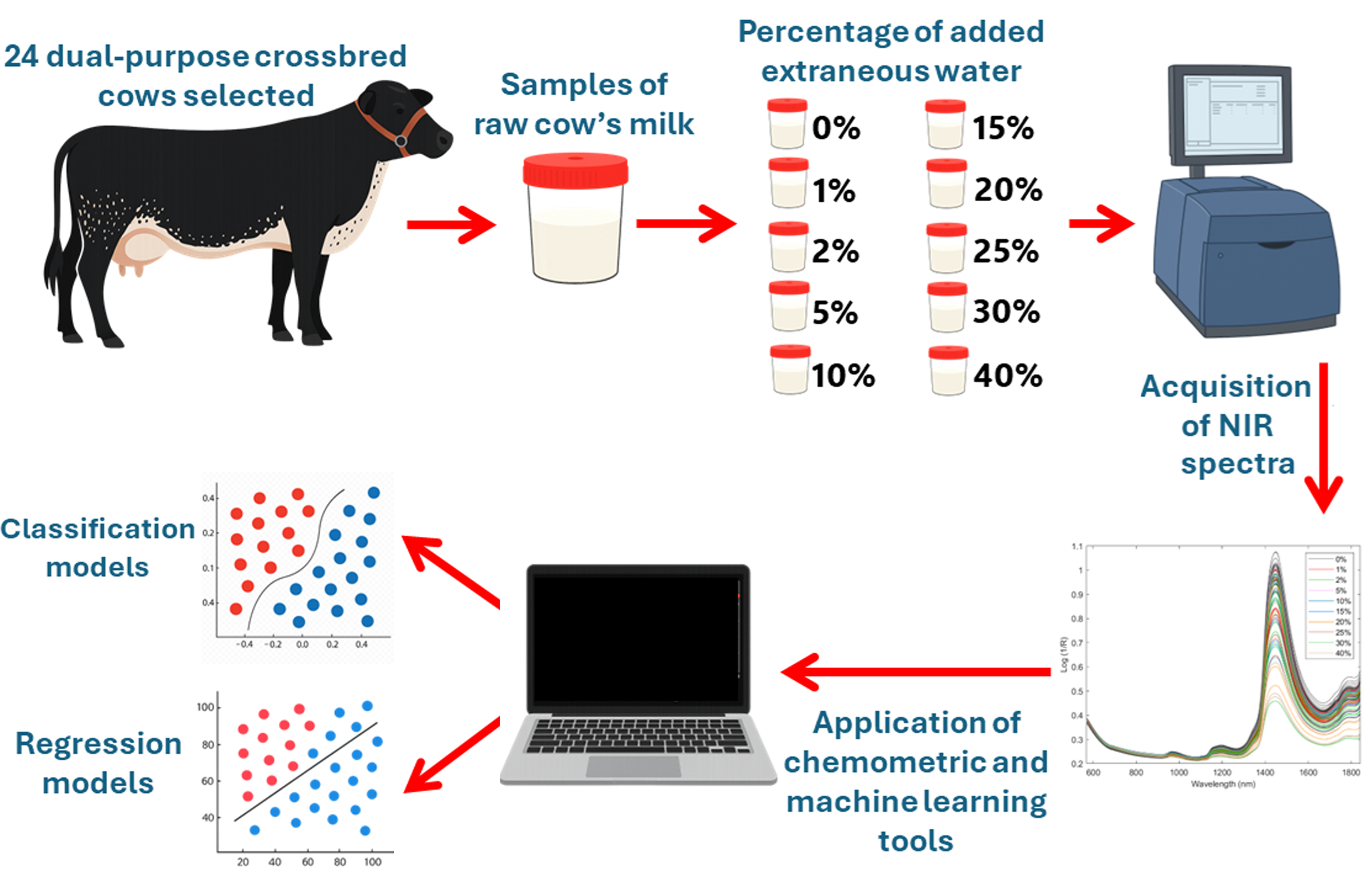
Spectroscopic methods and chemometrics/machine learning offer a fast, easy, and simple approach to detect adulteration in milk. The aim of this study was to evaluate the performance of several commonly used classification and regression algorithms for detecting milk adulteration, using added water as the adulterant, based on near-infrared (NIR) spectroscopy. Different water/milk mixtures containing 1% to 40% added water were prepared and analyzed. Supervised classification algorithms such as linear discriminant analysis (LDA), partial least squares discriminant analysis (PLS-DA), and support vector machines discriminant analysis (SVM-DA) were applied. Subsequently, supervised regression algorithms for quantitative detection, such as partial least squares regression (PLSR) and support vector regression (SVR), were evaluated. The PLS-DA models using autoscaling (AS) and standard normal variate (SNV) showed the best performance for validation in terms of sensitivity (SEN), specificity (SPE), accuracy (ACC), and error with values of 0.953, 0.850, 0.920, 0.098, and 0.930, 0.950, 0.937, 0.060, respectively. For quantitative determination, the best performance was achieved using partial least squares regression (PLSR) combined with standard normal variate (SNV) preprocessing of the spectral data. This model exhibited a validation root mean square error (RMSECV) of 3.912, a prediction Root Mean Square Error (RMSEP) of 2.117, a residual predictive deviation (RPD) of 6.15, and a coefficient of determination for prediction (R²P) of 0.972. These results demonstrate that the combination of NIR spectroscopy with chemometric and machine learning techniques, such as PLSR, is suitable for the quantification of added water in raw milk samples.
Referencias
Allende-Prieto, C., Fernández, L., Rodríguez-Gonzálvez, P., Martínez, B., García, P., & Rodríguez, A. (2025). Portable optical instrument for detection and quantification of milk adulteration: A study on mixtures from different species and water dilution. International Dairy Journal, 164. https://doi.org/10.1016/j.idairyj.2025.106186
Aslam, R., Sharma, S. R., Kaur, J., Panayampadan, A. S., & Dar, O. I. (2023). A systematic account of food adulteration and recent trends in the non-destructive analysis of food fraud detection. Journal of Food Measurement and Characterization, 17(3), 3094–3114. https://doi.org/10.1007/s11694-023-01846-3
Azad, T., & Ahmed, S. (2016). Common milk adulteration and their detection techniques. International Journal of Food Conta-mination, 3(1). https://doi.org/10.1186/s40550-016-0045-3
Behkami, S., Zain, S. M., Gholami, M., & Khir, M. F. A. (2019). Classification of cow milk using artificial neural network developed from the spectral data of single- and three-detector spectrophotometers. Food Chemistry, 294, 309–315. https://doi.org/10.1016/j.foodchem.2019.05.060
Biancolillo, A., Marini, F., Ruckebusch, C., & Vitale, R. (2020). Chemometric Strategies for Spectroscopy-Based Food Authentication. Applied Sciences, 10(18), 6544. https://doi.org/10.3390/app10186544
Boateng, A. A., Sumaila, S., Lartey, M., Oppong, M. B., Opuni, K. F. M., & Adutwum, L. A. (2022). Evaluation of chemometric classification and regression models for the detection of syrup adulteration in honey. LWT, 163. https://doi.org/10.1016/j.lwt.2022.113498
Calle, J. L. P., Ferreiro-González, M., Ruiz-Rodríguez, A., Fernández, D., & Palma, M. (2022). Detection of Adulterations in Fruit Juices Using Machine Learning Methods over FT-IR Spectroscopic Data. Agronomy, 12(3), 1–14. https://doi.org/10.3390/agronomy12030683
Chen, C., Zhang, J., & Delaurentis, T. (2014). Quality control in food supply chain management: An analytical model and case study of the adulterated milk incident in China. International Journal of Production Economics, 152, 188–199. https://doi.org/10.1016/j.ijpe.2013.12.016
Chen, Y., Li, S., Jia, J., Sun, C., Cui, E., Xu, Y., Shi, F., & Tang, A. (2024). FT-NIR combined with machine learning was used to rapidly detect the adulteration of pericarpium citri reticulatae (chenpi) and predict the adulteration concentration. Food Chemistry: X, 24. https://doi.org/10.1016/j.fochx.2024.101798
Chi, S.-X., Liu, B.-H., Zhang, B., Wang, B.-R., Zhou, J., Li, L., Zhang, Y.-H., & Mu, Z. (2024). Development of an ELISA method to determine adulterated cow milk in camel milk. International Dairy Journal, 155, 105953. https://doi.org/10.1016/j.idairyj.2024.105953
Çolak, S. (2025). Simultaneous Raman and FTIR-ATR Spectroscopy Techniques Combined with Chemometrics: Characterization and Comparison of Donkey Milk Adulteration. Journal of Raman Spectroscopy, 56(7), 598–608. https://doi.org/10.1002/jrs.6812
Ehsani, S., Dastgerdy, E. M., Yazdanpanah, H., & Parastar, H. (2023). Ensemble classification and regression techniques combined with portable near infrared spectroscopy for facile and rapid detection of water adulteration in bovine raw milk. Journal of Chemometrics, 37(1). https://doi.org/10.1002/cem.3395
El Ouaddari, A., El Amrani, A., Jamal Eddine, J., & Antonio Cayuela-Sánchez, J. (2022). Rapid prediction of essential oils major components by Vis/NIRS models using compositional methods. Results in Chemistry, 4. https://doi.org/10.1016/j.rechem.2022.100562
Fakayode, S. O., Baker, G. A., Bwambok, D. K., Bhawawet, N., Elzey, B., Siraj, N., Macchi, S., Pollard, D. A., Perez, R. L., Duncan, A. V., & Warner, I. M. (2020). Molecular (Raman, NIR, and FTIR) spectroscopy and multivariate analysis in consumable products analysis. Applied Spectroscopy Reviews, 55(8), 647–723. https://doi.org/10.1080/05704928.2019.1631176
Ferreira, M. M., Marins-Gonçalves, L., & De Souza, D. (2024). An integrative review of analytical techniques used in food authentication: A detailed description for milk and dairy products. Food Chemistry, 457. https://doi.org/10.1016/j.foodchem.2024.140206
Goyal, R., Singha, P., & Singh, S. K. (2024). Spectroscopic food adulteration detection using machine learning: Current challenges and future prospects. Trends in Food Science & Technology, 146, 104377. https://doi.org/10.1016/j.tifs.2024.104377
Handford, C. E., Campbell, K., & Elliott, C. T. (2016). Impacts of Milk Fraud on Food Safety and Nutrition with Special Emphasis on Developing Countries. Comprehensive Reviews in Food Science and Food Safety, 15(1), 130–142. https://doi.org/10.1111/1541-4337.12181
Hellberg, R. S., Sklare, S. A., & Everstine, K. (2020). Food Fraud: A Global Threat with Public Health and Economic Consequences. In Food Fraud: A Global Threat with Public Health and Economic Consequences. Elsevier. https://doi.org/10.1016/B978-0-12-817242-1.00020-8
Himshweta, & Singh, M. (2023). Nanosensor platforms for detection of milk adulterants. Sensors and Actuators Reports, 5, 100159. https://doi.org/10.1016/j.snr.2023.100159
Ionescu, A. D., Cîrîc, A. I., & Begea, M. (2023). A Review of Milk Frauds and Adulterations from a Technological Perspective. Applied Sciences, 13(17). https://doi.org/10.3390/app13179821
Ivanova, A. S., Merkuleva, A. D., Andreev, S. V., & Sakharov, K. A. (2019). Method for determination of hydrogen peroxide in adulterated milk using high performance liquid chromatography. Food Chemistry, 283, 431–436. https://doi.org/10.1016/j.foodchem.2019.01.051
Kasemsumran, S., Thanapase, W., & Kiatsoonthon, A. (2007). Feasibility of near-infrared spectroscopy to detect and to quantify adulterants in cow milk. Analytical Sciences, 23(7), 907–910. https://doi.org/10.2116/analsci.23.907
Kourti, D., Angelopoulou, M., Misiakos, K., Makarona, E., Economou, A., Petrou, P., & Kakabakos, S. (2023). Detection of Adulteration of Milk from Other Species with Cow Milk through an Immersible Photonic Immunosensor. Engineering Proceedings, 35(1). https://doi.org/10.3390/IECB2023-14582
Lanjewar, M. G., Parab, J. S., & Kamat, R. K. (2024). Machine learning based technique to predict the water adulterant in milk using portable near infrared spectroscopy. Journal of Food Composition and Analysis, 131. https://doi.org/10.1016/j.jfca.2024.106270
Li, B., Yu, M., Xu, W., Chen, L., & Han, J. (2023). Comparison of PCR Techniques in Adulteration Identification of Dairy Products. Agriculture,13(7). https://doi.org/10.3390/agriculture13071450
Liang, Q., Xia, Y. F., Che, J. K., Liu, Y., Zhang, H., Guo, J. C., Xu, Q., & Xue, H. N. (2025). Detection of water adulteration levels in milk using near-infrared spectroscopy combined with chemometrics. Journal of Dairy Science, 108(7), 6852–6866. https://doi.org/10.3168/jds.2025-26631
Mohammadi, N., Esteki, M., & Simal-Gandara, J. (2024). Machine learning for authentication of black tea from narrow-geographic origins: Combination of PCA and PLS with LDA and SVM classifiers. LWT, 203. https://doi.org/10.1016/j.lwt.2024.116401
Mohammed, A. M., & Shuming, Y. (2021). Detection and quantification of cow milk adulteration using portable near-infrared spectroscopy combined with chemometrics. African Journal of Agricultural Research, 17(2), 198–207. https://doi.org/10.5897/ajar2020.15321
Musa, M. A. (2022). Evaluation of portable NIR assay for detection of milk adulteration with water. Advances in Dairy Research, 10(1). https://doi.org/10.35248/2329-888X.22.10.599
Othman, S., Mavani, N. R., Hussain, M. A., Rahman, N. A., & Mohd Ali, J. (2023). Artificial intelligence-based techniques for adulteration and defect detections in food and agricultural industry: A review. Journal of Agriculture and Food Research, 12. https://doi.org/10.1016/j.jafr.2023.100590
Patil, G. B., Wani, S. P., Bafna, P. S., Bagul, V. S., Kalaskar, M. G., & Mutha, R. E. (2024). Milk adulteration: From detection to health impact. Food and Humanity, 3, 100339. https://doi.org/10.1016/j.foohum.2024.100339
Poonia, A., Jha, A., Sharma, R., Singh, H. B., Rai, A. K., & Sharma, N. (2017). Detection of adulteration in milk: A review. International Journal of Dairy Technology, 70(1), 23–42. https://doi.org/10.1111/1471-0307.12274
Qi, W., & Jiang, Q. (2025). Enhanced near-infrared spectroscopy for rapid and sensitive detection of melamine in milk: a novel methodological approach. Chemical and Biological Technologies in Agriculture, 12(1). https://doi.org/10.1186/s40538-025-00863-2
Sarang, P. (2023). Support Vector Machines. In Thinking Data Science (pp. 153–165). Springer, Cham. https://doi.org/10.1007/978-3-031-02363-7_8
Sitorus, A., & Lapcharoensuk, R. (2024). Development of automatic tuning for combined preprocessing and hyperparameters of machine learning and its application to NIR spectral data of coconut milk adulteration. Food Chemistry, 457, 140108. https://doi.org/10.1016/j.foodchem.2024.140108
Tian, H., Chen, S., Li, D., Lou, X., Chen, C., & Yu, H. (2022). Simultaneous detection for adulterations of maltodextrin, sodium carbonate, and whey in raw milk using Raman spectroscopy and chemometrics. Journal of Dairy Science, 105(9), 7242–7252. https://doi.org/10.3168/jds.2021-21082
Tian, H., Xiong, J., Chen, S., Yu, H., Chen, C., Huang, J., Yuan, H., & Lou, X. (2023). Rapid identification of adulteration in raw bovine milk with soymilk by electronic nose and headspace-gas chromatography ion-mobility spectrometry. Food Chemistry: X, 18. https://doi.org/10.1016/j.fochx.2023.100696
Tirado-Kulieva, V. A., Gonzales-Malca, J. A., Seminario-Sanz, R. S., & Castro, W. (2026). A systematic review and critical analysis of the combination of near-infrared spectroscopy and chemometrics for milk quality assessment. Applied Food Research, 6(2). https://doi.org/10.1016/j.afres.2026.102372
Vega, A., Reyes, S. M., & Troestch, J. (2025). Physicochemical Parameters and Multivariate Analysis to Predict the Sensory Quality in Specialty Coffee from Panama. ACS Omega, 10(13), 13251–13259. https://doi.org/10.1021/acsomega.4c10914
Descargas
Publicado
Número
Sección
Licencia
Derechos de autor 2026 Scientia Agropecuaria

Esta obra está bajo una licencia internacional Creative Commons Atribución-NoComercial 4.0.
Los autores que publican en esta revista aceptan los siguientes términos:
a. Los autores conservan los derechos de autor y conceden a la revista el derecho publicación, simultáneamente licenciada bajo una licencia de Creative Commons que permite a otros compartir el trabajo, pero citando la publicación inicial en esta revista.
b. Los autores pueden celebrar acuerdos contractuales adicionales separados para la distribución no exclusiva de la versión publicada de la obra de la revista (por ejemplo, publicarla en un repositorio institucional o publicarla en un libro), pero citando la publicación inicial en esta revista.
c. Se permite y anima a los autores a publicar su trabajo en línea (por ejemplo, en repositorios institucionales o en su sitio web) antes y durante el proceso de presentación, ya que puede conducir a intercambios productivos, así como una mayor citación del trabajo publicado (ver efecto del acceso abierto).