
Identificación de genotipos de camu camu estables y de alto rendimiento mediante el índice de estabilidad de rasgos fenotípicos múltiples
DOI:
https://doi.org/10.17268/sci.agropecu.2026.043Palabras clave:
Rasgos múltiples, WAASB, Accesiones promisorias, Myrciaria dubiaResumen
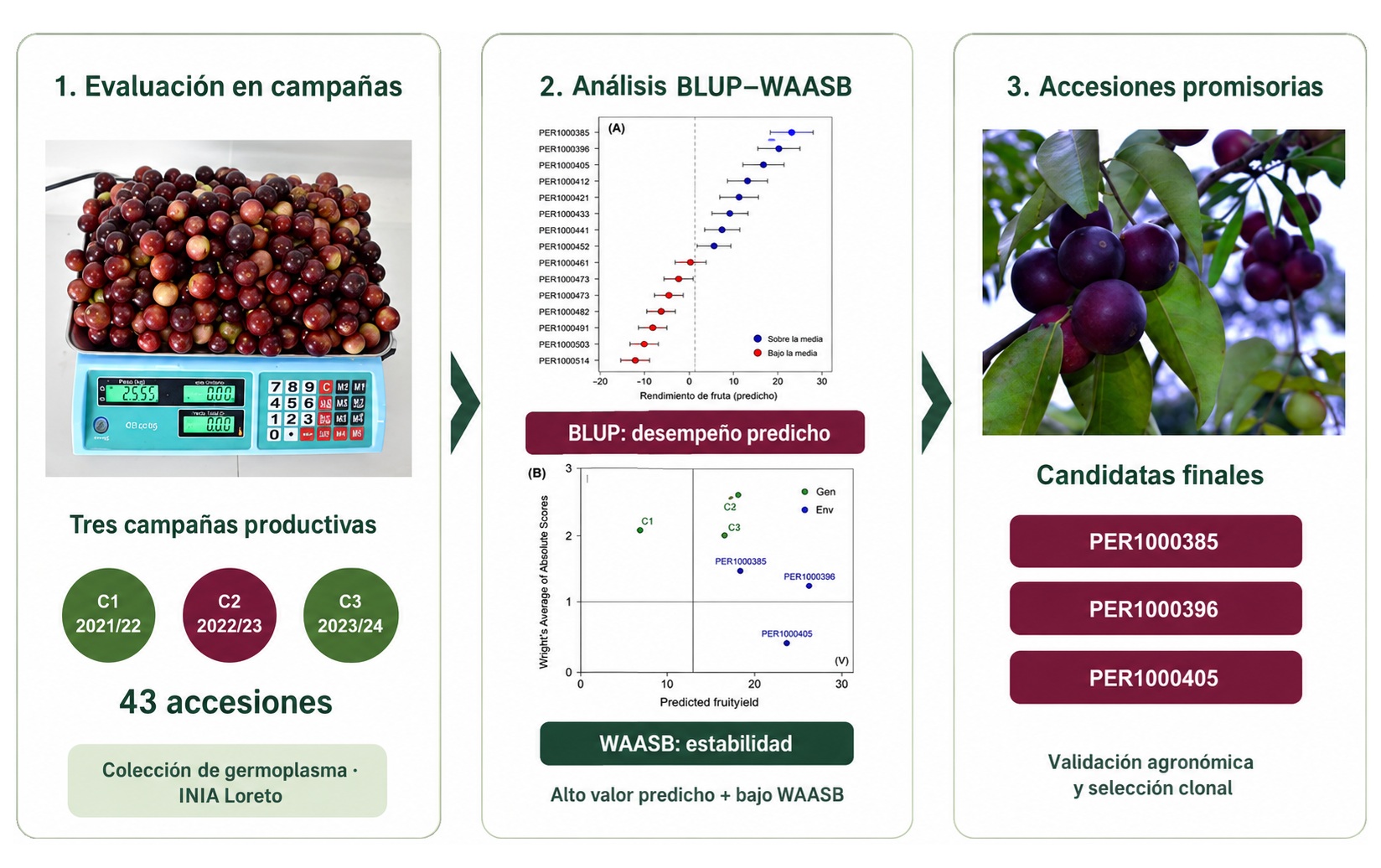
El camu camu es un arbusto frutal amazónico de la familia Myrtaceae que crece de forma natural en zonas inundables de la cuenca del Amazonas. Su importancia radica en la producción de frutos con altos contenidos de vitamina C y sus componentes bioactivos. El objetivo de este estudio fue identificar genotipos estables y de alto rendimiento en la colección de germoplasma de camu camu en la Amazonía peruana, evaluando múltiples características morfológicas y alta estabilidad fenotípica en diferentes campañas. En este estudio, se evaluó un plantel de 215 individuos de 43 accesiones en tres campañas de cultivo de 2021/2022; 2022/2023 y 2023/2024, para identificar accesiones estables. Se consideraron 26 descriptores cuantitativos, que incluyeron características de hojas, flores, frutos y semillas, y rendimiento de frutos por planta. Se utilizaron el biplot de promedio ponderado de puntuaciones absolutas (WAASB), basado en las mejores predicciones lineales insesgadas (BLUPs) de la interacción genotipo-ambiente para determinar la estabilidad de las accesiones en las tres campañas productivas y el análisis factorial para identificar relaciones entre múltiples variables. Los efectos de la interacción genotipo x ambiente (GEI) fueron significativos para todos los descriptores, excepto para ºBrix. Asimismo, el efecto del ambiente resultó significativo en la mayoría de los descriptores. La varianza acumulada fue de 74% explicada en ocho componentes principales. El análisis BLUP e índice WAASB permitió identificar accesiones estables de camu camu con altos valores agromorfológicos, resaltando su contribución a la variabilidad genética de la colección. Además, la evaluación METs (ensayos multiambientales) permitió seleccionar diez accesiones con múltiples características adaptadas a diferentes ambientes temporales. Los resultados destacan la eficacia de BLUP y WAASB en la evaluación de estabilidad genotípica, optimización de recursos y sostenibilidad de los programas de mejoramiento genético.
Referencias
Abdelghany, A. M., Zhang, S., Azam, M., Shaibu, A. S., Feng, Y., Qi, J., Li, J., Li, Y., Tian, Y., Hong, H., Lamlom, S. F., Li, B., & Sun, J. (2021). Exploring the phenotypic stability of soybean seed compositions using multi-trait stability index approach. Agronomy, 11(11), 1–13. https://doi.org/10.3390/agronomy11112200
Aguirre-Neira, J. C., dos Reis, M. S., Cardozo, M. A. R., Raz, L., & Clement, C. R. (2020). Physical and chemical variability of CAMU-CAMU fruits in cultivated and uncultivated areas of the Colombian Amazon. Revista Brasileira de Fruticultura, 42(2), 1–9. https://doi.org/10.1590/0100-29452020545
Amin, A., Christopher, J., Cooper, M., Collins, B., Voss-Fels, K., Hickey, L., & Chenu, K. (2025). Envirotyping facilitates understanding of genotype × environment interactions and highlights the potential of stay-green traits in wheat. Field Crops Research, 331. https://doi.org/10.1016/j.fcr.2025.109940
Argaw, T., Fenta, B. A., Zegeye, H., Azmach, G., & Funga, A. (2025). Multi-environment trials data analysis: linear mixed model-based approaches using spatial and factor analytic models. Frontiers in Research Metrics and Analytics, 10. https://doi.org/10.3389/frma.2025.1472282
Basnet, B. (2024). Deciphering genetic variability and phenotype expression, assessing drought stress tolerance and multi-trait stability index of (Vigna radiata) genotypes in Chitwan, Nepal. Cogent Food and Agriculture, 10(1), 1–23. https://doi.org/10.1080/23311932.2024.2417843
Bustamante-González, C., Pérez Díaz, A., Rivera Espinosa, R., Martín Alonso, G. M., & Viñals Núñez, R. (2015). Influencia de las precipitaciones en el rendimiento de Coffea canephora Pierre ex Froehner cultivado en suelos Pardos de la región oriental de Cuba. Cultivos Tropicales, 36(4), 21–27.
Cárdenas-González, J. H., Zapata-Henao, S., & Sánchez-Torres, J. D. (2017). Análisis productivo de plátano en alta densidad y su relación con la precipitación en Urabá. Revista Politécnica, 13(24), 27–35.
Chagas, E. A., Lozano, R. M. B., Chagas, P. C., Bacelar-Lima, C. G., Garcia, M. I. R., Oliveira, J. V., Souza, O. M., Morais, B. S., & Araújo, M. da C. da R. (2015). Variabilidade intraespecífica de frutos de camu-camu em populações nativas na amazônia setentrional. Crop Breeding and Applied Biotechnology, 15(4), 265–271. https://doi.org/10.1590/1984-70332015v15n4a44
Costa, R. B. da, Resende, M. D. V. de, Contini, A. Z., Rego, F. L. H., Roa, R. A. R., & Martins, W. J. (2005). Avaliação genética de indivíduos de erva-mate (Ilex paraguariensis St. Hil.) na região de Caarapó, MS, pelo procedimento REML/BLUP. Ciência Florestal, 15(4), 371–376.
Fidelis, M., do Carmo, M. A. V., da Cruz, T. M., Azevedo, L., Myoda, T., Miranda Furtado, M., Boscacci Marques, M., Sant’Ana, A. S., Inês Genovese, M., Young Oh, W., Wen, M., Shahidi, F., Zhang, L., Franchin, M., de Alencar, S. M., Luiz Rosalen, P., & Granato, D. (2020). Camu-camu seed (Myrciaria dubia) – From side stream to an antioxidant, antihyperglycemic, antiproliferative, antimicrobial, antihemolytic, anti-inflammatory, and antihypertensive ingredient. Food Chemistry, 310, 125909. https://doi.org/10.1016/j.foodchem.2019.125909
Garay-Peralta, I., Villarruel-Fuentes, M., Díaz-Peón, A. L., Chávez-Morales, R., & Herrera-Alarcón, J. (2024). Factores climáticos en el desarrollo y producción de cacao en Úrsulo Galván, Veracruz, México. Agronomía Mesoamericana, 35(1), 54337. https://doi.org/10.15517/am.2024.54337
Guimarães, P. V. P., Durigan, M. F. B., Chagas, E. A., Grigio, M. L., Silva, T. Í. N. da, Filho, A. A. de M., Marques, C. S., & Mattioni, J. A. M. (2023). Camu-Camu Flour Processed in Conventional Oven and Solar Dryer: Quality Product and Accessible Low Technology Products as an Opportunity to Family Agriculture. Journal of Agricultural Science, 15(6), 1. https://doi.org/10.5539/jas.v15n6p1
Gutiérrez Cáceres, J. C., Blancas Lopez, P. C. L., Gaviria Huanio, R. E., Ayra Apac, N. C., Panduro Padilla, E., & Agurto Cherre, C. A. (2025). Automated measurement of ascorbic acid levels in camu-camu using Vision Transformer. Frontiers in Plant Science, 16. https://doi.org/10.3389/fpls.2025.1540535
Hair, J. F., Black, W. C., Babin, B. J., & Anderson, R. E. (2019). Multivariate data analysis. www.cengage.com/highered
Hernández, M. S., Carrillo, M., Barrera, J., & Fernández-Trujillo, J. P. (2011). Camu-camu (Myrciaria dubia Kunth McVaugh). In Postharvest Biology and Technology of Tropical and Subtropical Fruits. Woodhead Publishing Limited. https://doi.org/10.1533/9780857092762.352
Imán Correa, S., & Melchor Aldana, M. (2007). Tecnología para la producción del camu camu Myrciaria dubia (H.B.K.) Mc Vaugh. In INIA (Ed.), Serie Manual. N° 01-07. INIA. (Primera, Vol. 1, Number 7). Instituto Nacional de Innovación Agraria.
Imán, C. S., Bravo, Z. L., Sotero, S. V., & Oliva, C. C. (2011a). Vitamin C content in fruits of camu camu Myrciaria dubia (H.B.K) Mc Vaugh, in four states of maturation, coming from the Collection of Germoplasma of the INIA Loreto, Peru. Scientia Agropecuaria, 2, 123–130. https://doi.org/10.17268/sci.agropecu.2011.03.01
Imán, C. S., Pinedo, F. S., & Melchor, A. M. (2011b). Caracterización morfológica y evaluación de la colección nacional de germoplasma de camu camu Myrciaria dubia (H.B.K) Mc Vaugh del INIA Loreto-Perú. Scientia Agropecuaria, 2(4), 189–201.
Imán, S., Chuquizuta, B., Samanamud, A., & Ochoa, M. (2022). Descriptores para camu camu Myrciaria dubia (Kunth) Mc Vaugh (INIA (ed.)).
Imán, S., & Samanamud, A. (2021). Guía técnica para el Cultivo de Camu Camu en la Amazonia Peruana. Instituto Nacional de Innovación Agraria - INIA. Perú.
Imán, S. A., Samanamud, A. F., Ramirez, J. F., Cobos, M., & Castro, J. C. (2025). Phenotypic characterization of wild Myrciaria dubia (Kunth) McVaugh ex situ germplasm bank for breeding, conservation, and sustainable development in the Peruvian Amazon. Frontiers in Conservation Science, 6. https://doi.org/10.3389/fcosc.2025.1623515
Kirouani, A., Boukhalfoun, L., Ouldkiar, R., & Bouzerzour, H. (2023). Analysis of the effect of GE interaction on the grain yield and its related traits in rainfed Algerian durum wheat (Triticum turgidum L. var. durum) grown in contrasting environments. Revista Facultad Nacional de Agronomia Medellin, 76(2), 10297–10308. https://doi.org/10.15446/rfnam.v76n2.102517
Londoño-Hernández, L., Montalvo Rodriguez, C., Arroyave Sierra, O. J., & Garcia Gonzalez, E. (2022). Uso potencial del camu-camu (Myrciaria dubia) en el desarrollo de alimentos funcionales. Revista Colombiana de Investigaciones Agroindustriales, 9(2), 26–41. https://doi.org/10.23850/24220582.4863
Martin, M. P., Peters, C. M., & Ashton, M. S. (2014). Revisiting Camu-camu (Myrciaria dubia): Twenty-seven Years of Fruit Collection and Flooding at an Oxbow Lake in Peruvian Amazonia. Economic Botany, 68(2), 169–176. https://doi.org/10.1007/s12231-014-9269-4
Maqsood, S., Arshad, M. T., Ikram, A., & Gnedeka, K. T. (2025). Nutritional Composition, Pharmacological Properties, and Industrial Applications of Myrciaria dubia: An Undiscovered Superfruit. In Food Science and Nutrition, 13(6), e70331. https://doi.org/10.1002/fsn3.70331
Megerssa, S. H., Ishetu, Y. S., Hailu, M., & Lemma, A. Z. (2024). Genotype by environment interaction and stability analyses of durum wheat elite lines evaluated in Ethiopia. Crop Breeding and Applied Biotechnology, 24(1), 1–9. https://doi.org/10.1590/1984-70332024v24n1a07
Mejia de Loayza, E., Estivals, G., Castro-Ruiz, D., Chota-Macuyama, W., Angulo-Chavez, C., Corazon-Guivin, M., Rodriguez del Castillo, Á., Alvarado Reategui, J., Angulo-Villacorta, C., Mejia, K., Del Castillo Torres, D., & García-Dávila, C. (2026). Genetic diversity and population structure of Myrciaria dubia from the Peruvian Amazon: implications for germplasm conservation and crop improvement. Genetic Resources and Crop Evolution, 73(4). https://doi.org/10.1007/s10722-026-02787-8
Mu, H., Liu, Y., Wang, F., Zhang, Z., Wang, J., & Yang, Y. (2024). Genetic Parameters and Selection of Clones and Families of Pinus koraiensis Using Principal Components and Multi-Trait Method. Forests, 15(12), 1–20. https://doi.org/10.3390/f15122259
Oliva Cruz, C., & Resende, M. D. V. de. (2008). Mejoramiento genético y taza de autofecundación del camu camu arbustivo en la Amazonía Peruana. Revista Brasileira de Fruticultura, 30(2), 450–454. https://doi.org/10.1590/S0100-29452008000200031
Olivoto, T., & Lucio, A. D. (2020). Methods Ecol Evol - 2020 - Olivoto - metan An R package for multi‐environment trial analysis.pdf. Methods in Ecology and Evolution, 11(6), 697–789. https://doi.org/10.1111/2041-210X.13384
Olivoto, T., Lúcio, A. D. C., da Silva, J. A. G., Marchioro, V. S., de Souza, V. Q., & Jost, E. (2019a). Mean Performance and Stability in Multi‐Environment Trials I: Combining Features of AMMI and BLUP Techniques. Agronomy Journal, 111(6), 2949–2960. https://doi.org/10.2134/agronj2019.03.0220
Olivoto, T., Lúcio, A. D. C., da Silva, J. A. G., Sari, B. G., & Diel, M. I. (2019b). Mean performance and stability in multi-environment trials II: Selection based on multiple traits. Agronomy Journal, 111(6), 2961–2969. https://doi.org/10.2134/agronj2019.03.0221
Pinedo-Panduro, M., Paredes-Dávila, E., Abanto-Rodriguez, C., Bardaes-Lozano, R., & Alves-Chagas, E. (2014). Selección temprana de plantas de (Myrciaria dubia H.B.K Mc VAUGH) camu camu, en un ensayo de progenies de polinización abierta. Folia Amazónica, 23(1), 39. https://doi.org/10.24841/fa.v23i1.6
Pinedo-Panduro, M. H. (2010). Evaluación y Selección de Colecciones Básicas del Germoplasma de Camu-camu. Instituto de Investigaciones de la Amazonía Peruana, Programa Manejo Integral del Bosque y Servicios Ambientales. 53 p.
Pinedo-Panduro, M. H. (2017). Seleção de Genótipos superiores em coleções ex situ de Camu-Camu [Myrciaria dubia (Kunth) McVaugh] da Amazônia Peruana. [Thesis, Universidade Federal de Roraima].
Pour-Aboughadareh, A., Jadidi, O., Jamshidi, B., Bocianowski, J., & Niemann, J. (2025a). Cross-talk between stability parameters and selection models: a new procedure for improving the identification of the superior genotypes in multi-environment trials. BMC Research Notes, 18, 306. https://doi.org/10.1186/s13104-025-07366-1
Pour-Aboughadareh, A., Jamshidi, B., Jadidi, O., Bocianowski, J., & Niemann, J. (2025b). Multi-trait stability index in the selection of high-yielding and stable barley genotypes. Journal Applied Genetics, 67, 317–323. https://doi.org/10.1007/s13353-025-00998-w
R Core Team. (2023). R: A language and environment for statistical computing. (4.2.2). R Foundation for Statistical Computing. https://www.r-project.org/.
Rajaprakasam, S., Jafarullakhan, S. S., Vijayakumar, V., Saravanan, N. A., Rathinavelu, S., Kannan, B., Chockalingam, V., Muthurajan, R., & Kanagarajan, S. (2025). Multi-model-based validation of multi-environment trial results in horse gram (Macrotyloma uniflorum Lam. Verdc.). Scientific Reports, 15(1). https://doi.org/10.1038/s41598-025-25093-2
Ribeiro, J. P. O., de Sousa, D. J. P., de Carvalho, C. G., Willmann, G. O., Dias, D. C. F. D. S., & Nardino, M. (2024). Wheat genotypes selection via multi-trait for abiotic stresses. Ciencia Rural, 54(11). https://doi.org/10.1590/0103-8478cr20230280
Santos, I. L., Miranda, L. C. F., da Cruz Rodrigues, A. M., da Silva, L. H. M., & Amante, E. R. (2022). Camu-camu [Myrciaria dubia (HBK) McVaugh]: A review of properties and proposals of pro-ducts for integral valorization of raw material. Food Chemistry, 372, 131290. https://doi.org/10.1016/j.foodchem.2021.131290
SENAMHI. (2025). Servicio Nacional de Meteorología e Hidrología del Perú (Senamhi). https://www.senamhi.gob.pe/main.php?dp=loreto&p=estaciones
Seyum, E. G., Bille, N. H., Abtew, W. G., Munyengwa, N., Bell, J. M., & Cros, D. (2022). Genomic selection in tropical perennial crops and plantation trees: a review. Molecular Breeding, 42(10). https://doi.org/10.1007/s11032-022-01326-4
Tabachnick, B. G., & Fidell, L. S. (2013). Using multivariate statistics. (Pearson education (Ed); 8th ed.) Boston, 983
Verma, A., & Singh, G. P. (2021). Stability, Adaptability Analysis of Wheat Genotypes by AMMI with BLUP for Restricted Irrigated Multi Location Trials in Peninsular Zone of India. Agricultural Sciences, 12(03), 198–212. https://doi.org/10.4236/as.2021.123013
Wickham, H. (2016). ggplot2: Elegant Graphics for Data Analysis. (Springer-Verlag (ed.)). https://ggplot2.tidyverse.org.
Xavier, A., Runcie, D., & Habier, D. (2025). Megavariate methods capture complex genotype-by-environment interactions. Genetics, 229(4). https://doi.org/10.1093/genetics/iyae179
Yan, W., & Kang, M. S. (2002). GGE biplot analysis: A graphical tool for breeders, geneticists, and agronomists. (CRC PRESS, Ed.; 1st ed., Number 1).
Zhang, P. P., Song, H., Ke, X. W., Jin, X. J., Yin, L. H., Liu, Y., Qu, Y., Su, W., Feng, N. J., Zheng, D. F., & Feng, B. L. (2016). GGE biplot analysis of yield stability and test location representativeness in proso millet (Panicum miliaceum L.) genotypes. Journal of Integrative Agriculture, 15(6), 1218–1227. https://doi.org/10.1016/S2095-3119(15)61157-1
Zhang, S., Huang, G., Zhang, J., Huang, L., Cheng, M., Wang, Z., Zhang, Y., Wang, C., Zhu, P., Yu, X., Tao, K., Hu, J., Yang, F., Qi, H., Li, X., Liu, S., Yang, R., Long, Y., Harnpichitvitaya, D., Wade, L., Hu, F. (2019). Genotype by environment interactions for performance of perennial rice genotypes (Oryza sativa L. / Oryza longistaminata) relative to annual rice genotypes over regrowth cycles and locations in southern China. Field Crops Research, 241, 107556. https://doi.org/10.1016/j.fcr.2019.107556
Descargas
Publicado
Número
Sección
Licencia
Derechos de autor 2026 Scientia Agropecuaria

Esta obra está bajo una licencia internacional Creative Commons Atribución-NoComercial 4.0.
Los autores que publican en esta revista aceptan los siguientes términos:
a. Los autores conservan los derechos de autor y conceden a la revista el derecho publicación, simultáneamente licenciada bajo una licencia de Creative Commons que permite a otros compartir el trabajo, pero citando la publicación inicial en esta revista.
b. Los autores pueden celebrar acuerdos contractuales adicionales separados para la distribución no exclusiva de la versión publicada de la obra de la revista (por ejemplo, publicarla en un repositorio institucional o publicarla en un libro), pero citando la publicación inicial en esta revista.
c. Se permite y anima a los autores a publicar su trabajo en línea (por ejemplo, en repositorios institucionales o en su sitio web) antes y durante el proceso de presentación, ya que puede conducir a intercambios productivos, así como una mayor citación del trabajo publicado (ver efecto del acceso abierto).