Groundwater quality and irrigation suitability assessment in a semi-arid agricultural aquifer of northern Peru
DOI:
https://doi.org/10.17268/sci.agropecu.2025.061Palabras clave:
Groundwater mineralization, ionic ratios, Water Quality Index, multivariate analysis, manganese, irrigation suitability, semi-arid aquifer, SullanaResumen
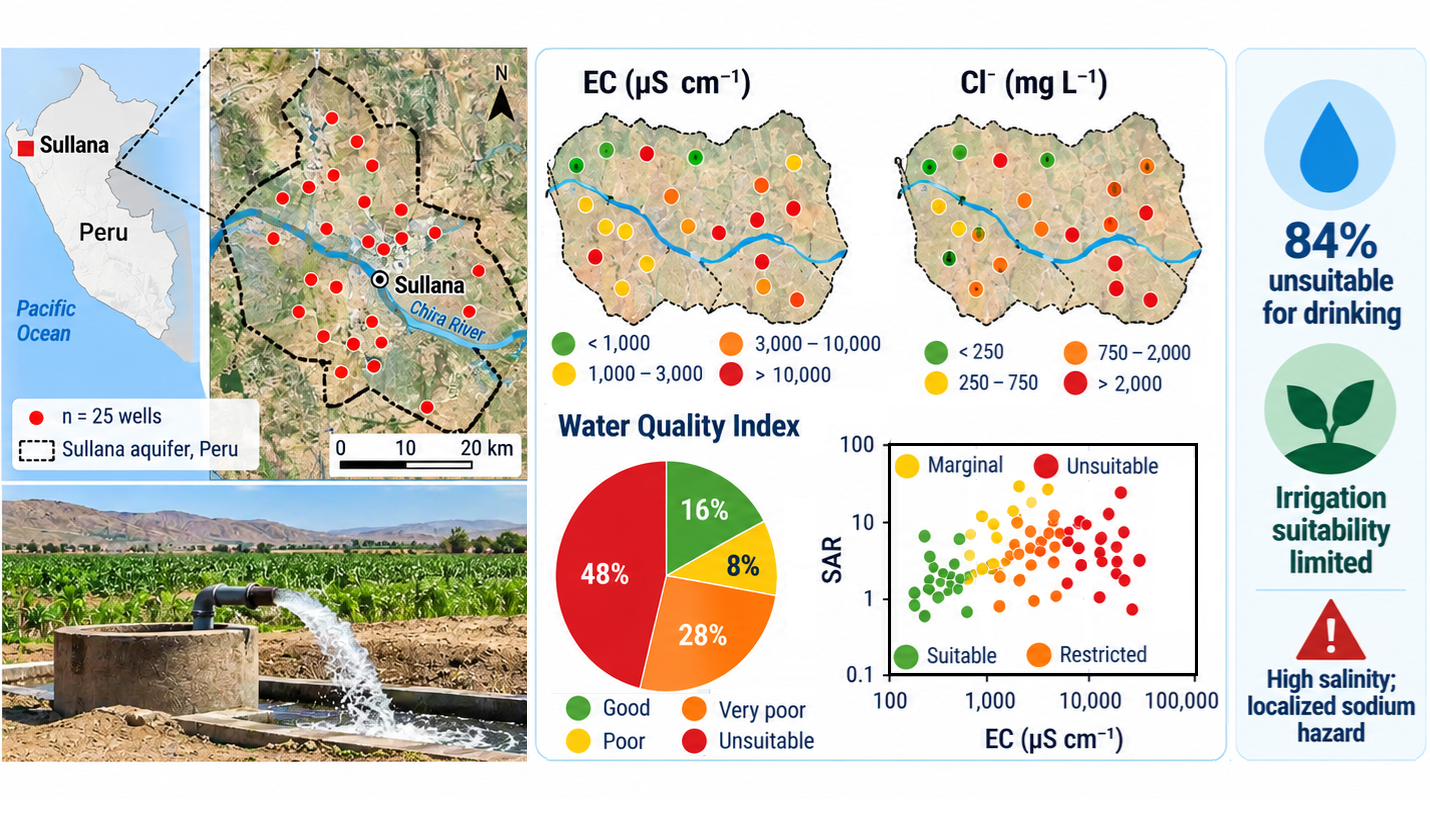
In semi-arid coastal regions, groundwater mineralization limits water-usage opportunities because of the intersection of natural hydrogeochemical processes with agricultural and urban pressures. The present study analyzed groundwater quality in 25 wells of the Sullana aquifer in northern Peru, within the context of a dry-season campaign. Physicochemical characterization incorporated ionic ratios, the cationic Gibbs relationship, principal component analysis, hierarchical cluster analysis, a weighted arithmetic Water Quality Index, irrigation indicators, and spatial analysis on GIS. Results of our study showed the electric conductivity in the range of 656 - 17290 µS/cm and total chloride amounts of up to 4522.60 mg/L. Comparison data on the electric conductivity showed exceedance for 44% of wells, 40% for total dissolved solids, 88% for chloride levels, and 56% for sulfate levels. The total variance is accounted for by two primary components at 78.46%, where major-ion mineralization is demarcated from Fe–Mn variability. The Water Quality Index labels some 84% of wells either poorly, very poorly, or unsuitable for drinking water due to untreated conditions. Manganese was present in three wells at over 0.40 mg/L, while certain As, Pb, Cd, and Cu findings remain uncertain and need confirmation through calculations based on laboratory reporting parameters, detection parameters, and quantification parameters, Major-ion mineralization and localized manganese accumulation remained as the two main issues regarding the quality of groundwater, causing the necessity for seasonal tracking, hydro-geological monitoring, and more hydrochemical analysis or isotopic tracing for better understanding of salinity origins and leading the way to sustainable extraction of ground waters in the future.
Referencias
Alexakis, D. E. (2022). Applying factor analysis and the CCME Water Quality Index for assessing groundwater quality of an Aegean Island, Rhodes, Greece. Geosciences, 12(10), 384. https://doi.org/10.3390/geosciences12100384
Alsabti, B., Sabarathinam, C., & Dhanu Radha, S. V. V. (2023). Identification of high nitrate concentration in shallow groundwater of an arid region: A case study of South Kuwait’s Bay. Environmental Monitoring and Assessment, 195, 143. https://doi.org/10.1007/s10661-022-10698-1
Appelo, C. A. J., & Postma, D. (2005). Geochemistry, groundwater and pollution (2nd ed.). CRC Press/Balkema.
Autoridad Nacional del Agua. (2015). Plan de gestión de los recursos hídricos de la cuenca Chira-Piura. Autoridad Nacional del Agua.
Araújo, A. M., dos Santos, L. L., Kozłowska, B., Walencik-Łata, A., de Aragão, R., de Paiva, W., Pereira Sousa, A. A., Silveira, T. N., Carvalho, A. K. N., Souza, E. S., dos Santos Filho, J. I., & Lalic, S. S. (2026). Integrated hydrochemical and radiological assessment of groundwater in the Seridó crystalline basement, Brazil: Evidence of geogenic influences on Ra and trace elements. Journal of Environmental Radioactivity, 293, 107877. https://doi.org/10.1016/j.jenvrad.2025.107877
Awasthi, A., Rishi, M. S., Khosla, A., & Panjgotra, S. (2023). Geographic information system-based groundwater quality assessment for drinking and irrigation purposes in transboundary aquifers of River Ravi, India. Environmental Science and Pollution Research, 30, 34536–34552. https://doi.org/10.1007/s11356-022-24642-w
Azari, T., & Tabari, M. M. R. (2024). An integrated approach based on HFE-D, GIS techniques, GQI-SWI, and statistical analysis for the assessment of potential seawater intrusion: Coastal multilayered aquifer of Ghaemshahr-Juybar, Mazandaran, Iran. Environmental Science and Pollution Research, 31, 13335–13371. https://doi.org/10.1007/s11356-024-31967-1
Benaafi, M., Abba, S. I., Tawabini, B., Abdulazeez, I., Salhi, B., Usman, J., & Aljundi, I. H. (2023). Integrated clustering analysis for delineating seawater intrusion and heavy metals in Arabian Gulf coastal groundwater of Saudi Arabia. Heliyon, 9, e19784. https://doi.org/10.1016/j.heliyon.2023.e19784
Cantwell, H. (Ed.). (2025). The fitness for purpose of analytical methods: A laboratory guide to method validation and related topics (3rd ed.). Eurachem.
Consorcio ATA–UNP–UNL. (2005). Caracterización hídrica y adecuación entre la oferta y la demanda en el ámbito de la cuenca binacional Catamayo-Chira. Proyecto Binacional Catamayo-Chira.
Dhakate, R. (2024). Characterization of groundwater salinity by hydrogeochemical and multivariate statistical analysis in the coastal aquifer of Nagapattinam District, Southern India. Heliyon, 10, e32396. https://doi.org/10.1016/j.heliyon.2024.e32396
Dougha, M., Selmane, T., Ahmed, A. A., Arafat, A. A., Ghoneim, S. S. M., Egbueri, J. C., Seraiche, L., & Hussein, E. E. (2026). A hybrid expert-PCA-ANN framework for hydrogeochemical optimization of the Water Quality Index in a semi-arid aquifer. Physics and Chemistry of the Earth, 144, 104657. https://doi.org/10.1016/j.pce.2026.104657
El Mountassir, O., & Bahir, M. (2023). The assessment of groundwater quality in the coastal aquifers of the Essaouira Basin, southwestern Morocco, using hydrogeochemistry and isotopic signatures. Water, 15, 1769. https://doi.org/10.3390/w15091769
Gomes, L. A., Barbosa, N. S., Debruyne, D., Barbosa, N., Moitinho, D. E. R., Peixoto, R., Santos, C. B., & Peixinho, M. A. L. (2023). Hydrogeochemical processes and groundwater evolution of the São Sebastião-Marizal aquifer system in the Tucano Central Basin, Bahia, Brazil. Journal of South American Earth Sciences, 127, 104413. https://doi.org/10.1016/j.jsames.2023.104413
Guo, X., Yang, Z., Li, C., Xiong, H., & Ma, C. (2023). Combining the classic vulnerability index and affinity propagation clustering algorithm to assess the intrinsic aquifer vulnerability of coastal aquifers on an integrated scale. Environmental Research, 217, 114877. https://doi.org/10.1016/j.envres.2022.114877
Ha, Q. K., Tran, B. L., & Lai, V. Q. (2026). Groundwater salinization and anthropogenic pollution imprints revealed by unsupervised learning in Ho Chi Minh City. Groundwater for Sustainable Development, 33, 101589. https://doi.org/10.1016/j.gsd.2026.101589
Hamma, B., Bekkouche, M. F., Bouaicha, F., Elnagdy, K. A., Alzaed, A., Barkat, A., Randazzo, A., Andualem, M. S., & Hussein, E. E. (2025). Hydrogeochemical assessment of groundwater for agricultural suitability in the Ksour Mountains, Algeria. Scientific Reports, 15, 36441. https://doi.org/10.1038/s41598-025-20352-8
Haritha, V. K., Raicy, M. C., & Elango, L. (2025). Enhancing groundwater quality in a saline coastal aquifer through managed aquifer recharge: A comprehensive study by long-term groundwater level and hydrochemical monitoring. Groundwater for Sustainable Development, 30, 101480. https://doi.org/10.1016/j.gsd.2025.101480
Hou, Z., Huang, L., Zhang, S., Han, X., Xu, J., & Li, Y. (2024). Identification of groundwater hydrogeochemistry and the hydraulic connections of aquifers in a complex coal mine. Journal of Hydrology, 628, 130496. https://doi.org/10.1016/j.jhydrol.2023.130496
International Organization for Standardization. (2009). ISO 5667-11:2009: Water quality: Sampling: Part 11: Guidance on sampling of groundwaters. ISO.
International Organization for Standardization. (2017). ISO/IEC 17025:2017: General requirements for the competence of testing and calibration laboratories. ISO.
International Organization for Standardization. (2024). ISO 5667-3:2024: Water quality: Sampling: Part 3: Preservation and handling of water samples. ISO.
Ji, D., Ma, J., Xue, J., Wu, X., Wang, Z., & Wei, S. (2024). Identifying groundwater characteristics and controlling factors in Jiaozhou Bay’s northern coastal region, China: A combined approach of multivariate statistics, isotope analysis, and field empirical investigations. Scientific Reports, 14, 23856. https://doi.org/10.1038/s41598-024-75425-x
Jiang, L., Sui, H., Kang, F., Li, C., Wei, S., Yu, L., & Li, Y. (2023). Hydrogeochemical characteristics and formation mechanism of the karst thermal reservoir at the northern edge of the Luzhong Uplift. Carsologica Sinica, 42(5), 1005–1026. https://doi.org/10.11932/karst20230514
Liang, C.-P., Lin, T.-C., Suk, H., Wang, C.-H., Liu, C.-W., Chang, T.-W., & Chen, J.-S. (2022). Comprehensive assessment of the impact of land use and hydrogeological properties on groundwater quality in Taiwan using factor and cluster analyses. Science of the Total Environment, 851, 158135. https://doi.org/10.1016/j.scitotenv.2022.158135
Lipps, W. C., Braun-Howland, E. B., & Baxter, T. E. (Eds.). (2023). Standard methods for the examination of water and wastewater (24th ed.). APHA Press.
Maman Hassan, A., & Fırat Ersoy, A. (2022). Statistical assessment of seasonal variation of groundwater quality in Çarşamba coastal plain, Samsun, Turkey. Environmental Monitoring and Assessment, 194, 135. https://doi.org/10.1007/s10661-022-09791-2
Manu, E., Loh, Y. S. A., Obiri-Nyarko, F., Afrifa, G. Y., & Karikari, A. Y. (2026). Groundwater quality and hydrogeochemical controls in crystalline basement and Neoproterozoic Voltaian sedimentary aquifers of central Ghana. Groundwater for Sustainable Development, 34, 101656. https://doi.org/10.1016/j.gsd.2026.101656
Mêlo, F. E. L. de, Peixoto, F. da S., Morais, C. C. de O., Gomes, M. da C. R., & Dias, G. H. (2023). Coastal aquifer water quality for domestic supply of small communities in the semiarid Potiguar, Brazilian Northeast. Journal of South American Earth Sciences, 132, 104633. https://doi.org/10.1016/j.jsames.2023.104633
Mester, T., Szabó, G., Kiss, E., & Balla, D. (2026). Hydrochemical assessment of shallow groundwater in a rural settlement following sewerage network development. Water, 18, 1559. https://doi.org/10.3390/w18131559
Ministerio de Salud. (2010). Reglamento de la calidad del agua para consumo humano: Decreto Supremo N.° 031-2010-SA. Dirección General de Salud Ambiental, Ministerio de Salud del Perú.
Ministerio del Ambiente. (2017). Decreto Supremo N.° 004-2017-MINAM: Aprueban Estándares de Calidad Ambiental para Agua y establecen disposiciones complementarias. Ministerio del Ambiente del Perú.
Missaoui, R., Gentilucci, M., Hamed, Y., Hadji, R., Bouri, S., & Pambianchi, G. (2026). Irrigation-driven groundwater recharge and quality degradation in semi-arid regions: Hydrochemical, GIS-based, and explainable machine learning assessment in Central Tunisia. Applied Sciences, 16, 7014. https://doi.org/10.3390/app16147014
Mukherjee, I., & Singh, U. K. (2022). Hydrogeochemical characterizations and quality evaluation of groundwater in the major river basins of a geologically and anthropogenically driven semi-arid tract of India. Science of the Total Environment, 805, 150323. https://doi.org/10.1016/j.scitotenv.2021.150323
Narvaez-Montoya, C., Mahlknecht, J., Torres-Martínez, J. A., Mora, A., & Pino-Vargas, E. (2024). FlowSOM clustering: A novel pattern recognition approach for water research: Application to a hyper-arid coastal aquifer system. Science of the Total Environment, 915, 169988. https://doi.org/10.1016/j.scitotenv.2024.169988
Nefla, L., Bergal, A., Boumaraf, W., Soukeur, A., Abukhadra, M. R., Bin-Jumah, M., Allam, A. A., Mikita, V., Szűcs, P., & Eid, M. H. (2026). Severe groundwater contamination in an industrialized coastal aquifer of northeastern Algeria: Integrated hydrogeochemical characterization and assessment of environmental and human health risks. Journal of Hydrology: Regional Studies, 67, 103833. https://doi.org/10.1016/j.ejrh.2026.103833
Ohmer, M., Liesch, T., Goeppert, N., & Goldscheider, N. (2019). On the optimal selection of interpolation methods for groundwater-quality mapping. Hydrogeology Journal, 27, 2901–2918. https://doi.org/10.1007/s10040-019-02028-4
Omena, A. L., Ihimekpen, N. I., & Okonofua, S. E. (2025). Principal component analysis of hydrochemical parameters in hydrocarbon-affected groundwater at Otorogu, Delta State, Nigeria. Nigerian Journal of Environmental Sciences and Technology, 9(2), 149–163. https://doi.org/10.36263/nijest.2025.02.63
Pitchaimani, V. S., Aswin, S. K., Sidhu, N., Sharma, S., Promilton, A. A. A., Abishek, R. A. S., & Joe, R. J. J. (2026). Seasonal hydrogeochemical signatures of seawater intrusion and salinity stress in a coastal aquifer system of southern Tamil Nadu, India. Journal of Trace Elements and Minerals, 18, 100324. https://doi.org/10.1016/j.jtemin.2026.100324
Proyecto Especial Chira Piura. (2021, 16 de agosto). Nota de prensa: El PECHP informa. Plataforma Digital Única del Estado Peruano. https://www.gob.pe/institucion/pechp/noticias/623998-nota-de-prensa-el-pechp-informa
Sadeghi-Lari, A., Bahrami, M., & Dastandaz, T. (2024). Temporal and spatial variations of groundwater quantity and quality for drinking and irrigation purposes in the arid and hot weather of Southern Iran. Physics and Chemistry of the Earth, 134, 103582. https://doi.org/10.1016/j.pce.2024.103582
Salman, S. A., Abou El-Anwar, E. A., Aita, S. K., & Elnazer, A. A. (2024). Geo-environmental factors controlling groundwater hydrogeochemistry, salinization and quality in El Qaa Plain coastal aquifer, Southwest Sinai, Egypt. Environment, Development and Sustainability, 26, 28591–28609. https://doi.org/10.1007/s10668-023-03830-9
Sanad, H., Moussadek, R., Zouahri, A., Oueld Lhaj, M., Mouhir, L., & Dakak, H. (2025). Machine learning-integrated hydrogeochemical and spatial modeling of groundwater quality indices for seawater intrusion and irrigation sustainability in coastal agroecosystems of Skhirat Region, Morocco. Journal of Hydrology: Regional Studies, 62, Article 102848. https://doi.org/10.1016/j.ejrh.2025.102848
Slama, F., Nasri, N., & Bouhlila, R. (2022). Delineating the origins and processes of groundwater salinization and quality degradation in a coastal irrigated plain, Korba, northeastern Tunisia. Marine Pollution Bulletin, 181, 113914. https://doi.org/10.1016/j.marpolbul.2022.113914
Sugumaran, S., Kulandaisamy, P., Rajendran, M., Karthikeyan, S., Senapathi, V., Thangaraj, K., & Ramanathan, S. (2026). Heavy metal behavior in semi-arid groundwater systems of Tiruchirappalli, Tamil Nadu: Environmental insights. Water, Air, & Soil Pollution, 237, 539. https://doi.org/10.1007/s11270-026-09193-x
Tziritis, E., Sachsamanoglou, E., & Güler, C. (2024). Evaluating spatiotemporal groundwater quality changes in the Rhodope coastal aquifer system, NE Greece, employing a GIS-assisted hybrid approach of multivariate statistics and inverse geochemical modeling. Science of the Total Environment, 947, 174676. https://doi.org/10.1016/j.scitotenv.2024.174676
Voutchkova, D. D., Ernstsen, V., Schullehner, J., Hinsby, K., Thorling, L., & Hansen, B. (2021). Roadmap for determining natural background levels of trace metals in groundwater. Water, 13(9), 1267. https://doi.org/10.3390/w13091267
Wang, Y., Yin, Z., Sun, X., Zheng, E., Pan, J., Wu, J., & Wu, J. (2026). From sources to risks: A multi-method approach to groundwater hydrogeochemical evolution in the Hotan Oasis of an arid inland river basin, Northwest China. Journal of Hydrology, 675, 135641. https://doi.org/10.1016/j.jhydrol.2026.135641
WHO (World Health Organization). (2026). Guidelines for drinking-water quality: Fourth edition incorporating the first, second and third addenda. World Health Organization.
Wurl, J., Imaz-Lamadrid, M. A., Mendez-Rodriguez, L. C., & Hernández-Morales, P. (2023). Hydrochemical indicator analysis of seawater intrusion into coastal aquifers of semiarid areas. Resources, 12(4), 47. https://doi.org/10.3390/resources12040047
Ximenes, M., Pratas, J. A. M. S., De Azevedo, J. M. M., Figueiredo, F. P. O. O., & Currell, M. (2026). Identification of hydrochemical processes and assessment of groundwater quality: A case study of the intergranular aquifer in Dili City, Timor-Leste. Geology, Ecology, and Landscapes, 10(1), 238–260. https://doi.org/10.1080/24749508.2025.2449622
Zeng, Y., Wu, Q., Mei, A., Wang, L., Yin, W., Yang, L., Zhao, D., Meng, S., & Gao, H. (2024). Hydrogeochemical process and coal mining-motivated effect on hydrochemistry of the groundwater system in a mining area of Western China. Journal of Geochemical Exploration, 263, 107516. https://doi.org/10.1016/j.gexplo.2024.107516
Zhang, C., Li, X., Wang, Z., Hou, X., Ma, J., Gao, M., Bai, Z., Fu, C., Gui, C., & Zuo, X. (2023). Combining stable isotopes (2H,18O, and 87Sr/86Sr) and hydrochemistryto understand hydrogeochemical processes in a karst groundwater system, Xin’an, northern China. Environmental Earth Sciences, 82, 224. https://doi.org/10.1007/s12665-023-10906-2
Zhi, C., Cao, W., Wang, Z., Li, Z., & Ren, Y. (2022). Genesis of As in groundwater with extremely high salinity in the Yellow River Delta, China. Applied Geochemistry, 139, 105229. https://doi.org/10.1016/j.apgeochem.2022.105229
Zhou, J., Wu, Q., Gao, S., Zhang, X., Wang, Z., Wu, P., & Zeng, J. (2023). Coupled controls of river infiltration, urban activities, and carbonate on trace elements in a karst groundwater system from Guiyang, Southwest China. Ecotoxicology and Environmental Safety, 249, 114424. https://doi.org/10.1016/j.ecoenv.2022.114424
Descargas
Publicado
Número
Sección
Licencia
Derechos de autor 2026 Scientia Agropecuaria

Esta obra está bajo una licencia internacional Creative Commons Atribución-NoComercial 4.0.
Los autores que publican en esta revista aceptan los siguientes términos:
a. Los autores conservan los derechos de autor y conceden a la revista el derecho publicación, simultáneamente licenciada bajo una licencia de Creative Commons que permite a otros compartir el trabajo, pero citando la publicación inicial en esta revista.
b. Los autores pueden celebrar acuerdos contractuales adicionales separados para la distribución no exclusiva de la versión publicada de la obra de la revista (por ejemplo, publicarla en un repositorio institucional o publicarla en un libro), pero citando la publicación inicial en esta revista.
c. Se permite y anima a los autores a publicar su trabajo en línea (por ejemplo, en repositorios institucionales o en su sitio web) antes y durante el proceso de presentación, ya que puede conducir a intercambios productivos, así como una mayor citación del trabajo publicado (ver efecto del acceso abierto).