Cleistocalyx operculatus (Roxb.) Merr. & Perry: Phytochemistry, biological activities, and potential applications
DOI:
https://doi.org/10.17268/sci.agropecu.2026.046Palabras clave:
Cleistocalyx operculatus, phytochemistry, biological activities, flavonoids, DMC, medicinal plant, nanoparticles, functional foodResumen
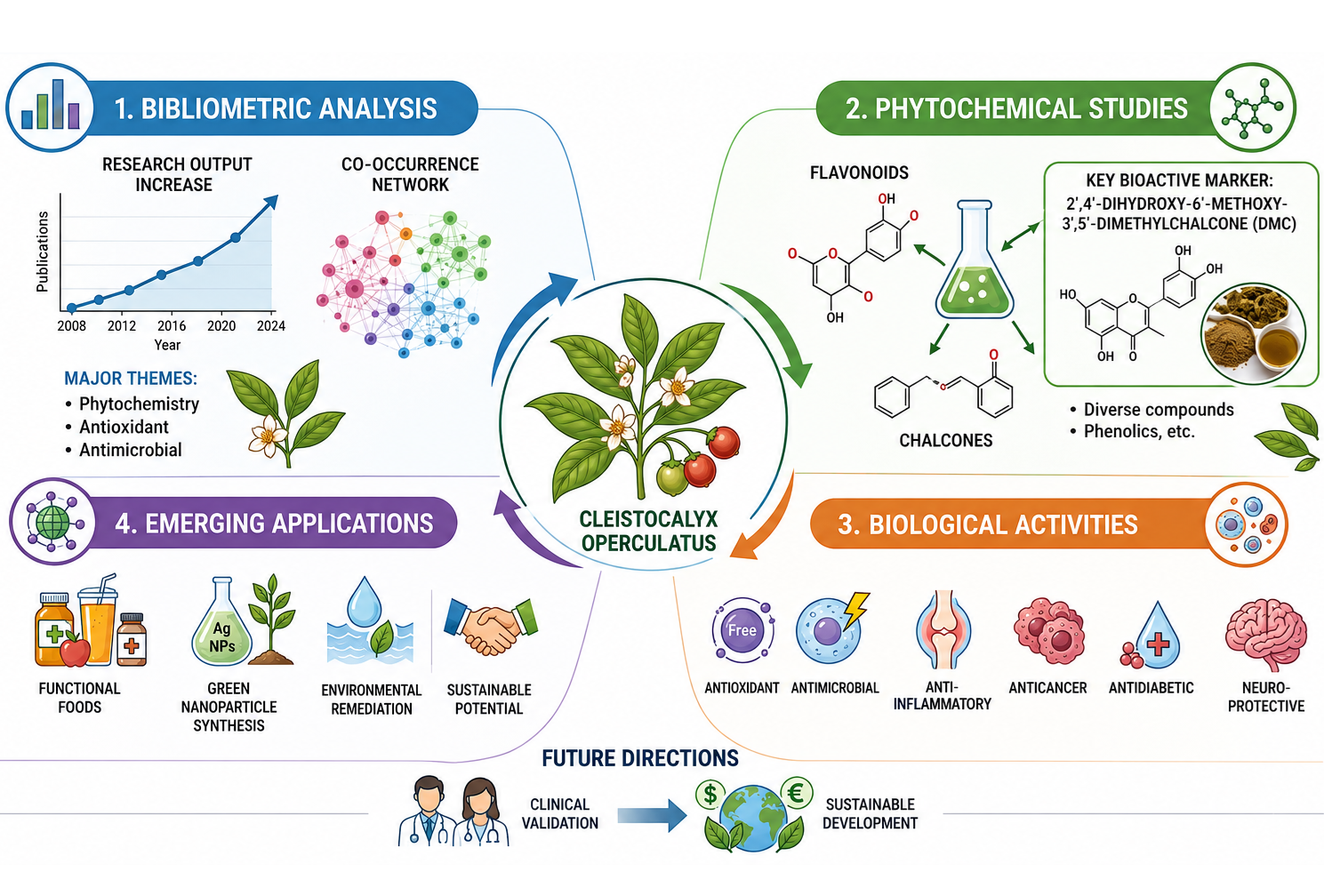
Cleistocalyx operculatus (Roxb.) Merr. & Perry is a medicinal plant widely distributed in Vietnam and several Asian countries, traditionally used in herbal tea and folk medicine. Owing to the growing scientific interest in this species, this study combines bibliometric analysis and a comprehensive literature review to evaluate research trends, phytochemical constituents, biological activities, and potential applications of C. operculatus. Bibliometric analysis of scientific publications revealed a marked increase in research output during the last decade, with phytochemistry, antioxidant activity, antimicrobial effects, and bioactive compounds emerging as major research themes. Published studies have identified a wide range of phytochemicals, including flavonoids, chalcones, terpenoids, phenolic compounds, phloroglucinol derivatives, and essential oils. Among them, 2′,4′-dihydroxy-6′-methoxy-3′,5′-dimethylchalcone (DMC) has been recognized as a key bioactive compound responsible for several pharmacological effects. Extracts and isolated compounds from C. operculatus exhibit diverse biological activities, including antioxidant, antimicrobial, antiviral, anti-inflammatory, antidiabetic, anti-obesity, anticancer, hepatoprotective, nephroprotective, and neuroprotective properties in both in vitro and in vivo studies. Furthermore, the plant shows promising applications in functional foods, edible coatings, green synthesis of nanoparticles, wastewater treatment, and biomedical materials. Despite these advances, further studies on standardization, toxicity, clinical validation, and large-scale cultivation are required to facilitate industrial and pharmaceutical applications. Overall, C. operculatus represents a valuable natural resource and an emerging research subject with considerable potential for future development in food, pharmaceutical, and biotechnological sectors.
Referencias
Bajpai, V. K., Dung, N. T., Suh, H. J., & Kang, S. C. (2010). Antibacterial activity of essential oil and extracts of Cleistocalyx operculatus buds against the bacteria of Xanthomonas spp. Journal of the American Oil Chemists' Society, 87(11), 1341–1349.
Chariyakornkul, A., Inboot, N., Taya, S., & Wongpoomchai, R. (2021). Low-polar extract from seed of Cleistocalyx nervosum var. paniala modulates initiation and promotion stages of chemically-induced carcinogenesis in rats. Biomedicine & Pharmacotherapy, 133, 110963.
Chariyakornkul, A., Juengwiroj, W., Ruangsuriya, J., & Wongpoomchai, R. (2022). Antioxidant extract from Cleistocalyx nervosum var. paniala pulp ameliorates acetaminophen-induced acute hepatotoxicity in rats. Molecules, 27(2), 553.
Charoensin, S., Taya, S., Wongpornchai, S., & Wongpoomchai, R. (2012). Assessment of genotoxicity and antigenotoxicity of an aqueous extract of Cleistocalyx nervosum var. paniala in in vitro and in vivo models. Interdisciplinary Toxicology, 5(4), 201.
Chukiatsiri, S., Wongsrangsap, N., Ratanabunyong, S., & Choowongkomon, K. (2022). In vitro evaluation of antidiabetic potential of Cleistocalyx nervosum var. paniala fruit extract. Plants, 12(1), 112.
Dao, T. T., Tung, B. T., Nguyen, P. H., Thuong, P. T., Yoo, S. S., Kim, E. H., et al. (2010). C-methylated flavonoids from Cleistocalyx operculatus and their inhibitory effects on novel influenza A (H1N1) neuraminidase. Journal of Natural Products, 73(10), 1636–1642.
Do, N. H., Cao, H. M., Nguyen, H. C., Vo, N. T., Pham, N. T. T., Le, T. P. A., Tran, V. T., Le, K. A., & Le, P. K. (2025). A novel facile fabrication of antibacterial and antioxidant chitosan nanoparticles encapsulating Cleistocalyx operculatus leaf extract. Polymer Bulletin, 82(17), 11839–11855.
Đỗ, T. L. (2004). Những cây thuốc và vị thuốc Việt Nam (p. 423). Hà Nội: NXB Y học. (in Vietnamese).
Dosoky, N. S., Pokharel, S. K., & Setzer, W. N. (2015). Leaf essential oil composition, antimicrobial and cytotoxic activities of Cleistocalyx operculatus from Hetauda, Nepal. American Journal of Essential Oils and Natural Products, 2(5), 34–37.
Gallo, M. (2023). Bioactive compounds from various sources: beneficial effects and technological applications II. Applied Sciences, 13(19), 10816.
Giap, V. D., Duy, V. D., Dung, V. K., & Ha, N. T. H. (2023). Optimal conditions for extracting bioactive compounds from leaves of Cleistocalyx operculatus Roxb using an enzyme cocktail. Journal of Forest Science and Technology, 8(2), 010–018.
Ha, T. K. Q., Dao, T. T., Nguyen, N. H., Kim, J., Kim, E., Cho, T. O., & Oh, W. K. (2016). Antiviral phenolics from the leaves of Cleistocalyx operculatus. Fitoterapia, 110, 135–141.
Hai, N. T., Bui, T. Q., Quy, P. T., Phu, N. V., Thuy, N. T., Nguyen, T. V., et al. (2024). Assessment of antifungal potentials of ethanol extract of Cleistocalyx operculatus Roxb against Cercospora nicotianae for pesticidal applicability: In vitro and in silico screening. Tropical Journal of Natural Product Research, 8(8), 7947.
Hoang, N., Nguyen-Thi, L., Kim, G. M., Dang, T. D., Ngoc Toan, V., & La, D. D. (2022a). Green synthesis of zero-valent iron nanoparticles by Cleistocalyx operculatus leaf extract using microfluidic device for degradation of the rhodamine B dye. Advances in Natural Sciences: Nanoscience and Nanotechnology, 13(4), 045007.
Hoang, N. V., Thi Xuan Quynh, N., Dang, T. D., Nguyen Xuan, T., Ngoc Toan, V., & Duc La, D. (2022b). Green synthesis of Fe/graphene nanocomposite using Cleistocalyx operculatus leaf extract as a reducing agent: Removal of pollutants (RhB dye and Cr⁶⁺ ions) in aqueous media. ChemistrySelect, 7(47), e202203499.
Huang, H. Y., Niu, J. L., & Lu, Y. H. (2012). Multidrug resistance reversal effect of DMC derived from buds of Cleistocalyx operculatus in human hepatocellular tumor xenograft model. Journal of the Science of Food and Agriculture, 92(1), 135–140.
Le, A. V. T., Ngo, L. M., Le, D. N., Le, M. T., Nguyen, S., Le, T. A., Dang, C. M., & Dang, D. M. T. (2026). Sustainable design of multifunctional zinc oxide nanoparticles using Cleistocalyx operculatus for high-efficiency UV-photocatalysis and potent antibacterial applications. Journal of the Indian Chemical Society, 102536.
Le, K. H., La, D. D., Nguyen, P. T. M., Nguyen, M. D. B., Vo, A. T. K., Nguyen, M. T. H., Tran, D. L., Chang, S. W., Nguyen, X. H., & Nguyen, D. D. (2021). Fabrication of Cleistocalyx operculatus extracts/chitosan/gum arabic composite as an edible coating for preservation of banana. Progress in Organic Coatings, 161, 106550.
Le, M. T., Le, A. V. T., Le, D. N., Lam, P. H., Dang, C. M., & Dang, D. M. T. (2025). Optimization of green synthesis parameters for silver nanoparticles using Cleistocalyx operculatus via Box–Behnken design and antibacterial evaluation. Advances in Natural Sciences: Nanoscience and Nanotechnology, 16(4), 045009.
Le, N. T., Dang, T. D., Binh, K. H., Nguyen, T. M., Xuan, T. N., La, D. D., Nadda, A. K., Chang, S. W., & Nguyen, D. D. (2022). Green synthesis of highly stable zero-valent iron nanoparticles for organic dye treatment using Cleistocalyx operculatus leaf extract. Sustainable Chemistry and Pharmacy, 25, 100598.
Le, T. T. H., Ngo, T. T., Nguyen, T. H. H., Pham, T. D., Vu, T. X. H., & Tran, Q. V. (2022). Green nanoarchitectonics using Cleistocalyx operculatus leaf extract in the preparation of multifunctional graphene oxide/Fe₃O₄/Ag nanomaterials for water decontamination and disinfection. Journal of Inorganic and Organometallic Polymers and Materials, 32(2), 547–559.
Lien, G. T. K., & Cuong, Đ. H. (2017). Primary study on chemical compounds of the essential oil and n-hexane extract of Cleistocalyx operculatus from Quangnam Vietnam. Tạp chí Khoa học và Công nghệ - Đại học Đà Nẵng, 104–108.
Mai, T. T., & Chuyen, N. V. (2007). Anti-hyperglycemic activity of an aqueous extract from flower buds of Cleistocalyx operculatus (Roxb.) Merr and Perry. Bioscience, Biotechnology, and Biochemistry, 71(1), 69–76.
Mai, T. T., Fumie, N., & Van Chuyen, N. (2009). Antioxidant activities and hypolipidemic effects of an aqueous extract from flower buds of Cleistocalyx operculatus (Roxb.) Merr. and Perry. Journal of Food Biochemistry, 33(6), 790–807.
Mai, T. T., Yamaguchi, K., Yamanaka, M., Lam, N. T., Otsuka, Y., & Chuyen, N. V. (2010). Protective and anticataract effects of the aqueous extract of Cleistocalyx operculatus flower buds on β-cells of streptozotocin-diabetic rats. Journal of Agricultural and Food Chemistry, 58(7), 4162–4168.
Mai, V. H., Ponce-Zea, J. E., Doan, T. P., Vu, Q. H., Ryu, B., Lee, C. H., & Oh, W. K. (2024). Chalcone-monoterpene derivatives from the buds of Cleistocalyx operculatus and their potential as protein tyrosine phosphatase 1B inhibitors. Journal of Natural Products, 87(8), 1903–1913.
Min, B. S., Cuong, T. D., Lee, J. S., Shin, B. S., Woo, M. H., & Hung, T. M. (2010). Cholinesterase inhibitors from Cleistocalyx operculatus buds. Archives of Pharmacal Research, 33(10), 1665–1670.
Min, B. S., Van Thu, C., Dat, N. T., Dang, N. H., Jang, H. S., & Hung, T. M. (2008). Antioxidative flavonoids from Cleistocalyx operculatus buds. Chemical and Pharmaceutical Bulletin, 56(12), 1725–1728.
Minh, T. T. L., Kieu, L. T. B., Mai, S. T. T., Ngoc, D. L. B., Thuy, L. T. B., Quyen, N. T., Anh, T. T., Huy, L. V., Phong, N. V., Duyen, C. T. M., Minh, N. H., & Eric, G. (2023). Addition of Mentha arvensis in infusions of Cleistocalyx operculatus improves the hedonic score and retains the high antioxidant and anti lipid-peroxidation effects. Applied Sciences, 13(5), 2873.
Narkprasom, N., Narkprasom, K., & Upara, U. (2015). Optimization of total phenolic from Cleistocalyx nervosum by microwave-assisted extraction. American Journal of Engineering and Applied Sciences, 8(3), 302.
Nguyen, T. H., Vu, D. C., Hanh, P. Q., Vo, X. T., Nguyen, V. C., Nguyen, T. N., Nguyen, L. L. P., & Baranyai, L. (2023). Comparative analysis of phenolic content and in vitro bioactivities of Bidens pilosa L. flowers and leaves as affected by extraction solvents. Journal of Agriculture and Food Research, 14, 100879.
Nguyen, N. T., & Nguyen, V. A. (2025). Fabrication of Fe₃O₄ nanoparticles via an eco-friendly sonochemical route utilizing Cleistocalyx operculatus leaf extract: Study of properties and application. Digest Journal of Nanomaterials and Biostructures, 20(2), 559–566.
Nguyen, P. T. H., Nguyen Thi, H. P., Mai, H. T., Panaitescu, C., La, D. D., & Nguyen, D. K. (2025). Green synthesis of biogenic nano zerovalent iron using Cleistocalyx nervosum leaf extract for enhancing peanut seed germination and Basella alba growth. ACS Omega, 10(21), 22137–22145.
Nguyen, P. T. M., Schultze, N., Boger, C., Alresley, Z., Bolhuis, A., & Lindequist, U. (2017). Anticaries and antimicrobial activities of methanolic extract from leaves of Cleistocalyx operculatus L. Asian Pacific Journal of Tropical Biomedicine, 7(1), 43–48.
Nguyen, T. D., Nguyen, H. T., Hoang, Y. H., Tran, H. T., & Thai, N. T. T. (2023). Silver nanoparticles green-synthesized ethanol–water extract of Cleistocalyx operculatus buds and their antimicrobial activities. Chemical Papers, 77(12), 7589–7601.
Nguyen, T. H., Hoang, N. H., Van Tran, C., Nguyen, P. T. M., Dang, T. D., Chung, W. J., Chang, S. W., Chang, S. W., Nguyen, D. D., Kumar, P. S., & La, D. D. (2022). Green synthesis of a photocatalyst Ag/TiO₂ nanocomposite using Cleistocalyx operculatus leaf extract for degradation of organic dyes. Chemosphere, 306, 135474.
Pandey, V., Khanal, S., Shahi, N., Parajuli, R., Adhikari, A., & Pokharel, Y. R. (2025). Anti-inflammatory and anti-proliferative role of essential oil of leaves of Cleistocalyx operculatus (Roxb.) Merr. & Perry. Anti-Cancer Agents in Medicinal Chemistry, 25(4), 232–243.
Panritdum, P., Muangnoi, C., Tuntipopipat, S., Charoenkiatkul, S., & Sukprasansap, M. (2024). Cleistocalyx nervosum var. paniala berry extract and cyanidin-3-glucoside inhibit hepatotoxicity and apoptosis. Food Science & Nutrition, 12(4), 2947–2962.
Pham, T. T., Nguyen, L. L. P., Dam, M. S., & Baranyai, L. (2023). Application of edible coating in extension of fruit shelf life: Review. AgriEngineering, 5(1), 520–536.
Pham, P. A., Doan, T. H., Nguyen, T. N., Nguyen, M. V., Ngo, Q. A., Kulikouskaya, V., & Tran, Q. V. (2024). Synthesis and antibacterial activity of metallic copper-chitosan nanomaterial using environmentally friendly Cleistocalyx operculatus leaf extract as a reducing agent. Vietnam Journal of Chemistry, 62(S1), 139–146.
Ponce-Zea, J. E., Ryu, B., Lee, J. Y., Park, E. J., Mai, V. H., Doan, T. P., Lee, H. J., & Oh, W. K. (2024). In vitro and in silico analysis of PTP1B inhibitors from Cleistocalyx operculatus leaves and their effect on glucose uptake. Nutrients, 16(17), 2839.
Poontawee, W., Natakankitkul, S., & Wongmekiat, O. (2016). Protective effect of Cleistocalyx nervosum var. paniala fruit extract against oxidative renal damage caused by cadmium. Molecules, 21(2), 133.
Prasanth, M. I., Brimson, J. M., Chuchawankul, S., Sukprasansap, M., & Tencomnao, T. (2019). Antiaging, stress resistance, and neuroprotective efficacies of Cleistocalyx nervosum var. paniala fruit extracts using Caenorhabditis elegans model. Oxidative Medicine and Cellular Longevity, 2019(1), 7024785.
Song, J. G., Su, J. C., Song, Q. Y., Huang, R. L., Tang, W., Hu, L. J., Huang, X. J., & Wang, Y. (2019). Cleistocaltones A and B, antiviral phloroglucinol–terpenoid adducts from Cleistocalyx operculatus. Organic Letters, 21(23), 9579–9583.
Song, J., Huang, R., Cai, J., Wu, Z., Hu, L., Sun, W., Huang, X., & Wang, Y. (2024). Targeted isolation of antiviral cinnamoylphloroglucinol-terpene adducts from Cleistocalyx operculatus by building blocks-based molecular networking approach. Acta Pharmaceutica Sinica B, 14(10), 4443–4460.
Su, J. C., Wang, S., Cheng, W., Huang, X. J., Li, M. M., Jiang, R. W., Li, Y. L., Wang, L., Ye, W. Y., & Wang, Y. (2018). Phloroglucinol derivatives with unusual skeletons from Cleistocalyx operculatus and their in vitro antiviral activity. The Journal of Organic Chemistry, 83(15), 8522–8532.
Sukprasansap, M., Chanvorachote, P., & Tencomnao, T. (2017). Cleistocalyx nervosum var. paniala berry fruit protects neurotoxicity against endoplasmic reticulum stress-induced apoptosis. Food and Chemical Toxicology, 103, 279–288.
Taya, S., Punvittayagul, C., & Chewonarin, T. (2009). Effect of aqueous extract from Cleistocalyx nervosum on oxidative status in rat liver. Thai Journal of Toxicology, 24(2), 101.
Taya, S., Punvittayagul, C., Inboot, W., Fukushima, S., & Wongpoomchai, R. (2014). Cleistocalyx nervosum extract ameliorates chemical-induced oxidative stress in early stages of rat hepatocarcinogenesis. Asian Pacific Journal of Cancer Prevention, 15(6), 2825–2830.
Thanh, D. T., Oanh, V. K., Nguyen, H. C., Ngan, L. T. M., & Hieu, T. T. (2024a). Phytochemical composition, antioxidant, antibacterial, and enzyme inhibitory activities of organic extracts from flower buds of Cleistocalyx operculatus (Roxb.) Merr. et Perry. BioTechnologia, 105(2), 137.
Thanh, D. T., Tan, M. T., Thu, N. T. M., Trinh, P. N. P., Thuong, P. T. H., Tuyet, P. T. G., Ngan, L. T. M., & Hieu, T. T. (2024b). Phytochemical composition, antioxidant, anti-Helicobacter pylori, and enzyme inhibitory evaluations of Cleistocalyx operculatus flower bud and leaf fractions. BioTech, 13(4), 42.
Thi, H. P. N., Thi, K. T. P., Nguyen, T. T., Nguyen, P. T., Vu, T. T., Le, H. T., Dang, T. D., Huynh, D. C., Mai, H. T., La, D. D., Chang, S. W., & Nguyen, D. D. (2022). Green synthesis of an Ag nanoparticle-decorated graphene nanoplatelet nanocomposite by using Cleistocalyx operculatus leaf extract for antibacterial applications. Nano-Structures & Nano-Objects, 29, 100810.
Thuy, B. T. P., Hieu, L. T., My, T. T. A., Hai, N. T. T., Loan, H. T. P., Thuy, N. T. T., Triet, N. T., Anh, T. T. V., Dieu, N. T. X., Quy, P. T., Trung, N. V., Quang, D. Q., Huynh, L. K., & Nhung, N. T. A. (2021). Screening for Streptococcus pyogenes antibacterial and Candida albicans antifungal bioactivities of organic compounds in natural essential oils of Piper betle L., Cleistocalyx operculatus L. and Ageratum conyzoides L. Chemical Papers, 75(4), 1507–1519.
Tran, G. B., Le, N. T. T., & Dam, S. M. (2018). Potential use of essential oil isolated from Cleistocalyx operculatus leaves as a topical dermatological agent for treatment of burn wound. Dermatology Research and Practice, 2018(1), 2730169.
Tran, L. T. T., Nguyen, T. K., Pham, T. V., Ha, T. P., Tran, P. T. D., Tam, V. T. T., Dat, T. T. H., Thai, P. H., & Cuong, L. C. V. (2023). Chemical composition, anti-α-glucosidase activity, and molecular modelling studies of Cleistocalyx operculatus essential oil. Applied Sciences, 13(20), 11224.
Tran, P. L., Kim, O., Tran, H. N. K., Tran, M. H., Min, B. S., Hwangbo, C., & Lee, J. H. (2019a). Protective effects of extract of Cleistocalyx operculatus flower buds and its isolated major constituent against LPS-induced endotoxic shock by activating the Nrf2/HO-1 pathway. Food and Chemical Toxicology, 129, 125–137.
Tran, P. T., Ngo, Q. M. T., Lee, S., Kim, O., Tran, H. N. K., Hwangbo, C., Min, B. S., & Lee, J. H. (2019b). Identification of anti-osteoclastogenic compounds from Cleistocalyx operculatus flower buds and their effects on RANKL-induced osteoclastogenesis. Journal of Functional Foods, 60, 103388.
Tuan, H. N., Minh, B. H., Tran, P. T., Lee, J. H., Oanh, H. V., Ngo, Q. M. T., Nguyen, Y. N., Lien, P. T. K., & Tran, M. H. (2019). The effects of 2',4'-dihydroxy-6'-methoxy-3',5'-dimethylchalcone from Cleistocalyx operculatus buds on human pancreatic cancer cell lines. Molecules, 24(14), 2538.
Vu, A. T., & Nguyen, V. D. (2026). Biosorption of Pb²⁺ from wastewater solution using material derived from Cleistocalyx operculatus leaves: Kinetics, isotherms, and thermodynamic studies. Chemistry & Biodiversity, 23(4), e03049.
Vu, T. T., Nguyen, P. T. M., Pham, N. H., Le, T. H., Nguyen, T. H., Do, D. T., & La, D. D. (2022). Green synthesis of selenium nanoparticles using Cleistocalyx operculatus leaf extract and their acute oral toxicity study. Journal of Composites Science, 6(10), 307.
Wang, C., Wu, P., Tian, S., Xue, J., Xu, L., Li, H., & Wei, X. (2016). Bioactive pentacyclic triterpenoids from the leaves of Cleistocalyx operculatus. Journal of Natural Products, 79(11), 2912–2923.
Woo, A. Y., Waye, M. M., Kwan, H. S., Chan, M. C., Chau, C. F., & Cheng, C. H. (2002). Inhibition of ATPases by Cleistocalyx operculatus: A possible mechanism for the cardiotonic actions of the herb. Vascular Pharmacology, 38(3), 163–168.
Ye, C. L., & Lai, Y. F. (2016). 2',4'-Dihydroxy-6'-methoxy-3',5'-dimethylchalcone from buds of Cleistocalyx operculatus induces apoptosis in human hepatoma SMMC-7721 cells through a reactive oxygen species-dependent mechanism. Cytotechnology, 68(2), 331–341.
Ye, C. L., Liu, X. G., & Huang, Q. (2013). Antioxidant activity and protection of human umbilical vein endothelial cells from hydrogen peroxide-induced injury by DMC, a chalcone from buds of Cleistocalyx operculatus. South African Journal of Botany, 86, 36–40.
Ye, C. L., Lu, Y. H., & Wei, D. Z. (2004). Flavonoids from Cleistocalyx operculatus. Phytochemistry, 65(4), 445–447.
Zhang, L., & Lu, Y. (2012). Inhibitory activities of extracts from Cleistocalyx operculatus flower buds on pancreatic lipase and α-amylase. European Food Research and Technology, 235(6), 1133–1139.
Descargas
Publicado
Número
Sección
Licencia
Derechos de autor 2026 Scientia Agropecuaria

Esta obra está bajo una licencia internacional Creative Commons Atribución-NoComercial 4.0.
Los autores que publican en esta revista aceptan los siguientes términos:
a. Los autores conservan los derechos de autor y conceden a la revista el derecho publicación, simultáneamente licenciada bajo una licencia de Creative Commons que permite a otros compartir el trabajo, pero citando la publicación inicial en esta revista.
b. Los autores pueden celebrar acuerdos contractuales adicionales separados para la distribución no exclusiva de la versión publicada de la obra de la revista (por ejemplo, publicarla en un repositorio institucional o publicarla en un libro), pero citando la publicación inicial en esta revista.
c. Se permite y anima a los autores a publicar su trabajo en línea (por ejemplo, en repositorios institucionales o en su sitio web) antes y durante el proceso de presentación, ya que puede conducir a intercambios productivos, así como una mayor citación del trabajo publicado (ver efecto del acceso abierto).