
Superiority of the Bouyoucos method with sand weighing and the Robinson pipette with a dispersant mixture for quantifying clay in variable-charge acid soils
DOI:
https://doi.org/10.17268/sci.agropecu.2026.069Palabras clave:
Texture analysis, Bouyoucos hydrometer, Robinson pipette, chemical dispersants, variable-charge acid soil, clay quantificationResumen
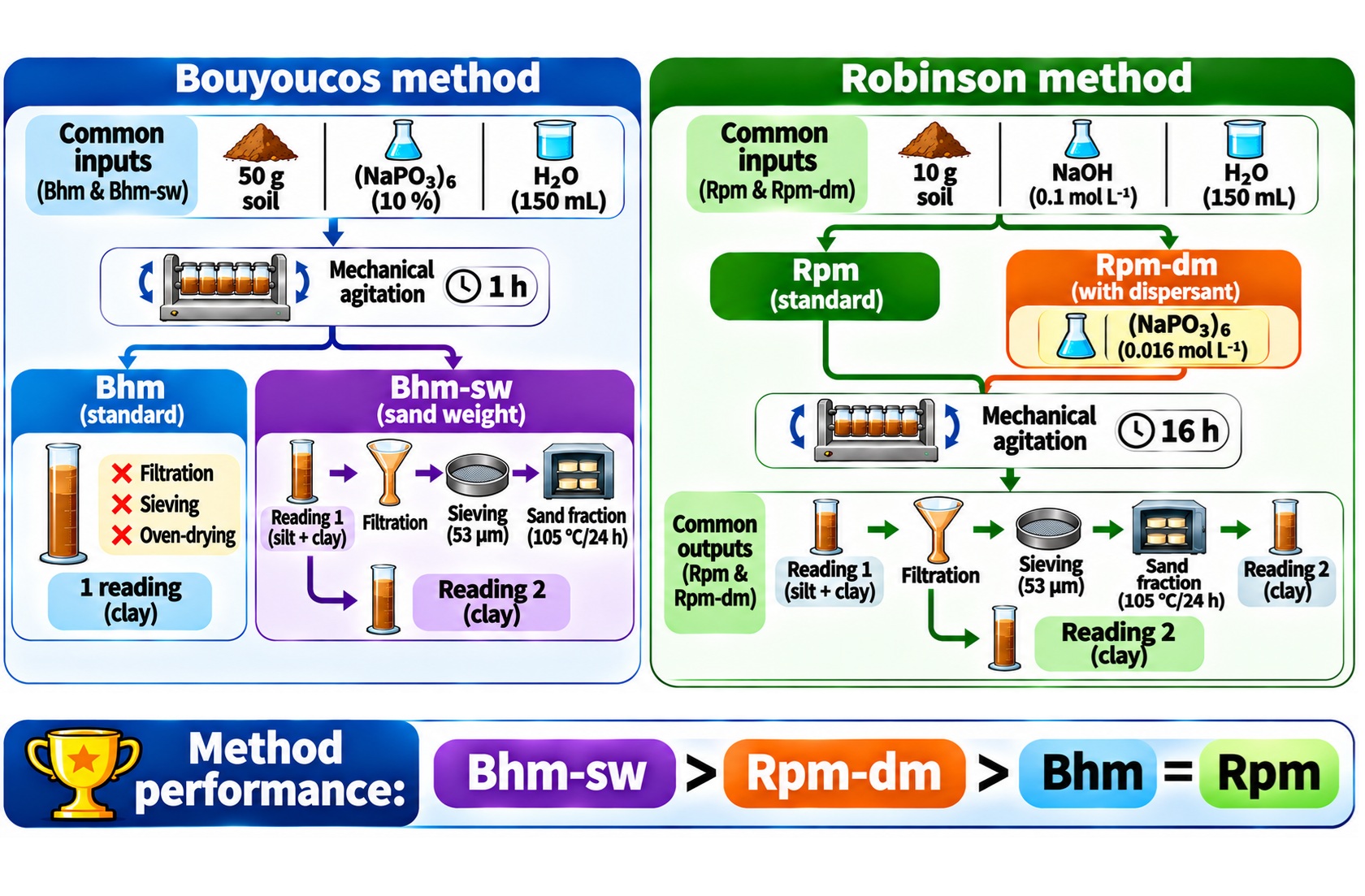
The Bouyoucos hydrometer method is commonly used to determine the proportional sand, silt, and clay fractions in Peruvian soils. However, this approach often yields variable and imprecise results, particularly in acid soils with variable-charge. This study aimed to evaluate the efficiency of three alternative methods, the Bouyoucos hydrometer method including sand weight (Bhm-sw), the Robinson pipette method (Rpm), and the Robinson pipette method using a mixture of dispersing agents (Rpm-md), compared with the standard Bouyoucos hydrometer method (Bhm). Soil samples were collected from the first three horizons of profiles developed on the Sarayaquillo, Chonta, Chambara, and Oriente Group lithostratigraphic formations. The data was first tested for normality using the Shapiro-Wilk test. Non-parametric data were transformed into parametric variables through quantile normalization, then used analysis of variance and Dunnett’s test to compare the alternative methods with the standard method. Method efficiency was assessed by the highest recovery of the clay fraction. The results showed that the standard Bouyoucos hydrometer method was not efficient for clay fraction determination, as Bhm-sw (p < 0.01) and Rpm-md (p < 0.05) significantly outperformed it, increasing the clay fraction by 15.51% and 11.55%, respectively. These findings suggest both methods may be suitable for laboratory use in other soil classes common in the Peruvian Amazon. The efficiency ranking of the evaluated methods was Bhm-sw > Rpm-md > Bhm = Rpm.
Referencias
Acevedo, S. E., Contreras, C. P., Ávila, C. J., & Bonilla, C. A. (2021). Testing the integral suspension pressure method for soil particle size analysis across a range of soil organic matter contents. International Agrophysics, 35(4), 357–363. https://doi.org/10.31545/INTAGR/144387
Alves, M. V., Delazeri, P., Nunes Nesi, C., & Ramos, M. R. (2018). Times of agitation and concentration of NaOH to characterize the soil texture. Revista Agri-Environmental Sciences, 4(2), 34-40. https://doi.org/10.36725/agries.v4i2.907
Ashworth, J., Keyes, D., Kirk, R., & Lessard, R. (2001). Standard procedure in the hydrometer method for particle size analysis. Communications in Soil Science and Plant Analysis, 32(5–6), 633–642. https://doi.org/10.1081/CSS-100103897
Beretta, A. N., Silbermann, A. V., Paladino, L., Torres, D., Bassahun, D., Musselli, R., & García-Lamohte, A. (2014). Soil textura analyses using a hydrometer: modification of the Bouyoucos method. Ciencia e Investigacion Agraria, 41(2), 263–271. https://doi.org/10.4067/S0718-16202014000200013
Borja, M. K., Mercado, L. J., & Combatt, C. E. M. (2015). Chemical dispersants and quantification textural fractions by Bouyoucos and pipette methods. Acta Agronómica, 64(4). https://doi.org/10.15446/acag.v64n4.45722
Callesen, I., Palviainen, M., Armolaitis, K., Rasmussen, C., & Kjønaas, O. J. (2023). Soil texture analysis by laser diffraction and sedimentation and sieving–method and instrument comparison with a focus on Nordic and Baltic forest soils. Frontiers in Forests and Global Change, 6. https://doi.org/10.3389/ffgc.2023.1144845
Callesen, L., Liski, J., Raulund-Rasmussen, K., Olsson, M. T., Tau-Strand, L., Vesterdal, L., & Westman, C. J. (2003). soil carbon stores in Nordic well-drained frorest soil-relationships with climate and texture class. Global Change Biology, 9, 358–370.
Camargo, O. A. de, Moniz, A. C., Jorge, J. A., & Valadares, J. M. A. S. (2009). Métodos de análise química, mineralógica e física de solos do Instituto Agronômico de Campinas. Instituto Agronômico, Boletim Técnico, 106, 77 p. Campinas, Brasil.
Chittleborough, D. J., Walker, P. H., & Oades, J. M. (1984). Textural differentiation in chronosequences from esatern Australia, II. Evidence from particle-size distributions. Geoderma, 32, 203–226.
Combatt-Caballero, E. M., Palencia-L, M., & Borja-M, K. (2018). Particle size distribution by Bouyoucos in slightly alkaline soils from department of Cordoba, Colombia. Acta Agronomica, 67(1). https://doi.org/10.15446/acag.v67n1.60762
Corá, J. E., Fernandes, C., Beraldo, J. M. G., & Marcelo, A. V. (2009). Adição de areia para dispersão de solos na análise granulométrica. R. Bras. Ci. Solo, 33, 255–262.
Cunha, J. C., Freire, M. B. G. dos S., Ruiz, H. A., Fernandes, R. B. A., & Alvarez V., V. H. (2014). Comparação de dispersantes químicos na análise granulométrica de solos do Estado de Pernambuco. Revista Brasileira de Engenharia Agricola e Ambiental, 18(8), 783–789. https://doi.org/10.1590/1807-1929/agriambi.v18n08p783-789
Curcio, D., Ciraolo, G., D’Asaro, F., & Minacapilli, M. (2013). Prediction of Soil Texture Distributions Using VNIR-SWIR Reflectance Spectroscopy. Procedia Environmental Sciences, 19, 494–503. https://doi.org/10.1016/j.proenv.2013.06.056
De Souza, E. S., Fernandes, A. R., De Souza Braz, A. M., De Oliveira, F. J., Alleoni, L. R. F., & Campos, M. C. C. (2018). Physical, chemical, and mineralogical attributes of a representative group of soils from the eastern Amazon region in Brazil. Soil, 4(3), 195–212. https://doi.org/10.5194/soil-4-195-2018
Donagemma, G. K., Ruiz, H. A., Alvarez V., V. H., Ker, J. C., & Fontes, M. P. F. (2008). Fósforo remanescente em argila e silte retirados de Latossolos após pré-tratamentos na análise textural. Revista Brasileira de Ciencia Do Solo, 32(4), 1785–1791. https://doi.org/10.1590/s0100-06832008000400043
Empresa Brasileira de Pesquisa Agropecuaria - EMBRAPA. (2017). Análise granulométrica (Parte I - Análises Físicas). Manual de Métodos de Análise de Solo (Portuguese), 573 p.
Faé, G. S., Montes, F., Bazilevskaya, E., Añó, R. M., & Kemanian, A. R. (2019). Making soil particle size analysis by laser diffraction compatible with standard soil texture determination methods. Soil Science Society of America Journal, 83(4), 1244–1252. https://doi.org/10.2136/sssaj2018.10.0385
Fisher, P., Aumann, C., Chia, K., O’Halloran, N., & Chandra, S. (2017). Adequacy of laser diffraction for soil particle size analysis. PLoS ONE, 12(5). https://doi.org/10.1371/journal.pone.0176510
García, J., Medina, H., & Núñez, D. (2008). El método del hidrómetro: influencia de los tiempos de lecturas en el cálculo de la distribución del tamaño de partículas en suelos de la Habana. Cultivos Tropicales, 29(2), 21–26.
Gee, G. W., & Bauder, J. W. (1979). Particle size analysis by hydrometer: a simplified method for routine textural analysis and a aensitivity test of measurement parameters. Soil Sci. Soc. Am. J., 43, 1004–1007.
Jensen, J. L., Schjønning, P., Watts, C. W., Christensen, B. T., & Munkholm, L. J. (2017). Soil texture analysis revisited: Removal of organic matter matters more than ever. PLoS ONE, 12(5). https://doi.org/10.1371/journal.pone.0178039
Júnior, A. L. N. do, Souza, L. S. da, Silva, E. O. da, Silva, F. T. S. dos, Santos, N. A. C., et al. (2014). Concentrações de dispersantes químicos e tempos de contato na dispersão de solos representativos do estado da Bahia. Magistra, Cruz Das Almas, 26(1), 68–74.
Kalra, Y. P., & Maynard, D. G. (1991). Methods manual for forest soil and plant analysis. Forestry Canada, Northwest Region, Northern Forestry Centre.
Kraemer, F. B., Fernández, P. L., Ceddia, M. B., Chagas, C. I., & Morrás, H. M. J. (2016). Efectividad de distintos pretratamientos en el análisis granulométrico de tres suelos contrastantes de la región pampeana. Ciencia del Suelo, 34(1), 163–172.
Martínez, V. W., Valdivia, F. E. J., & Cuyubamba, P. V. (1998). Geología de los cuadrángulos de Aucayacu, río Santa Ana y Tingo María. Hojas 18-K, 18-I y 19-K (Primera Edición).
Mauri, J., Ruiz, H. A., Fernandes, R. B. A., Ker, J. C., & Rezende, L. R. M. (2011). Dispersantes químicos na análise granulométrica de Latossolos. Rev. Bras. Ciênc. Solo, 35(4), 1577-1284. https://doi.org/10.1590/S0100-06832011000400021
Messing, I., Mingot Soriano, A. M., Nimblad Svensson, D., & Barron, J. (2024). Variability and compatibility in determining soil particle size distribution by sieving, sedimentation and laser diffraction methods. Soil and Tillage Research, 238, Art. 105987. https://doi.org/10.1016/j.still.2023.105987
Mozaffari, H., Moosavi, A. A., Baghernejad, M., & Cornelis, W. (2024). Revisiting soil texture analysis: Introducing a rapid single-reading hydrometer approach. Measurement, 228. Art. 114330. https://doi.org/10.1016/j.measurement.2024.114330
Mwendwa, S. (2022). Revisiting soil texture analysis: Practices towards a more accurate Bouyoucos method. Heliyon, 8(5). https://doi.org/10.1016/j.heliyon.2022.e09395
Oliveira, G. C. de, Júnior, M. S. D. de, Vitorino, A. C. T., Ferrerira, M. M., de Sá, M. A. C., & Lima, J. M. (2002). Agitador horizontal de movimento helicoidal na dispersão mecânica de amostras de três Latossolos do sul e campos das vertentes de Minas Gerais. Ciênc. Agrotec., 26, 881–887.
Owji, A., Esfandiarpour Boroujeni, I., Kamali, A., Hosseinifard, S. J., & Bagheri Bodaghabadi, M. (2014). The effects of hydrometer reading times on the spatial variability of soil textures in southeast Iran. Arabian Journal of Geosciences, 7(4), 1491–1499. https://doi.org/10.1007/s12517-012-0786-0
Pal, D. K. (2021). Clay and other minerals in the formation, management and ecosystem services of Indian tropical soils. The Clay Minerals Society of India - CMSI, 72 p. New Delhi, India.
Papuga, K., Kaszubkiewicz, J., Wilczewski, W., Stas, M., Belowski, J., & Kawałko, D. (2018). Soil grain size analysis by the dynamometer method - A comparison to the pipette and hydrometer method. Soil Science Annual, 69(1), 17–27. https://doi.org/10.2478/ssa-2018-0003
Quesada, C. A., Lloyd, J., Schwarz, M., Patiño, S., Baker, T. R., et al. (2010). Variations in chemical and physical properties of Amazon forest soils in relation to their genesis. Biogeosciences, 7(5), 1515–1541. https://doi.org/10.5194/bg-7-1515-2010
Rodrigues, C., Oliveira, V. A. de, Silveira, P. M. da, & Santos, G. G. (2011). Chemical dispersants and pre-trataments to determine clay in soils with different mineralogy. R. Bras. Ci. Solo, 35(5), 1589–1596. https://doi.org/10.1590/S0100-06832011000500013
Rodríguez, R., Eber, M., Tintaya, C., Sánchez, E., David, C., Farfan, O., Fabian, C., Edwin, Q., & Saldivar, G. (2017). Geología del cuadrángulo de Rioja, Hoja 13i. INGEMMET, Boletín, Serie A: Carta Geológica Nacional, 150, 82 p., 4 mapas (Escala 1:50 000).
Ruiz, H.A. (2003). Física do solo. Universidade Federal de Viçosa. 64 p. Brasil.
Ruiz, H. A. (2005). Incremento da exãtidao da análise granulométrica do solo por meio da coleta da suspensão (silte + argila). R. Bras. Ci. Solo, 29, 297–300.
Schlindwein, J. A., Antonio, A., Ii, M., & Fioreli-Perira, E. C. (2011). Adjustment of the expedite method for clay content determination in Rondônia soils. Ciência Rural, 41, 2096–2100.
Suzuki, L. E. A. S., Reichert, J. M., Albuquerque, J. A., Reinert, D. J., & Kaiser, D. R. (2015). Dispersion and flocculation of Vertisols, Alfisols and Oxisols in southern Brazil. Geoderma Regional, 5, 64–70. https://doi.org/10.1016/j.geodrs.2015.03.005
Tavares-Filho, J., & Magalhães, F. S. de. (2008). Dispersão de amostras de Latossolo Vermelho Eutroférrico influenciadas por pré-tratamento para oxidacão da matéria orgânica e pelo tipo de agitacão mecânica. R. Bras. Ci. Solo, 32, 1429–1435.
Walkley, A., Black, I.A. (1934). An examination of the degtjareff method for determining soil organic matter and a proposed modification of the chromic acid titration method. Soil Science, 37, 29-38. https://doi.org/10.1097/00010694-193401000-00003
Zimmermann, I., & Horn, R. (2020). Impact of sample pretreatment on the results of texture analysis in different soils. Geoderma, 371, Article 114379. https://doi.org/10.1016/j.geoderma.2020.114379
Descargas
Publicado
Número
Sección
Licencia
Derechos de autor 2026 Scientia Agropecuaria

Esta obra está bajo una licencia internacional Creative Commons Atribución-NoComercial 4.0.
Los autores que publican en esta revista aceptan los siguientes términos:
a. Los autores conservan los derechos de autor y conceden a la revista el derecho publicación, simultáneamente licenciada bajo una licencia de Creative Commons que permite a otros compartir el trabajo, pero citando la publicación inicial en esta revista.
b. Los autores pueden celebrar acuerdos contractuales adicionales separados para la distribución no exclusiva de la versión publicada de la obra de la revista (por ejemplo, publicarla en un repositorio institucional o publicarla en un libro), pero citando la publicación inicial en esta revista.
c. Se permite y anima a los autores a publicar su trabajo en línea (por ejemplo, en repositorios institucionales o en su sitio web) antes y durante el proceso de presentación, ya que puede conducir a intercambios productivos, así como una mayor citación del trabajo publicado (ver efecto del acceso abierto).