
Soil fertility response to land-use changes in agroforestry and silvopastoral systems of the Ecuadorian Amazon: A multivariate and stratification ratio approach
DOI:
https://doi.org/10.17268/sci.agropecu.2026.068Palabras clave:
Soil fertility, land-use change, silvopastoral systems, stratification ratio, multivariate analysis, Ecuadorian AmazonResumen
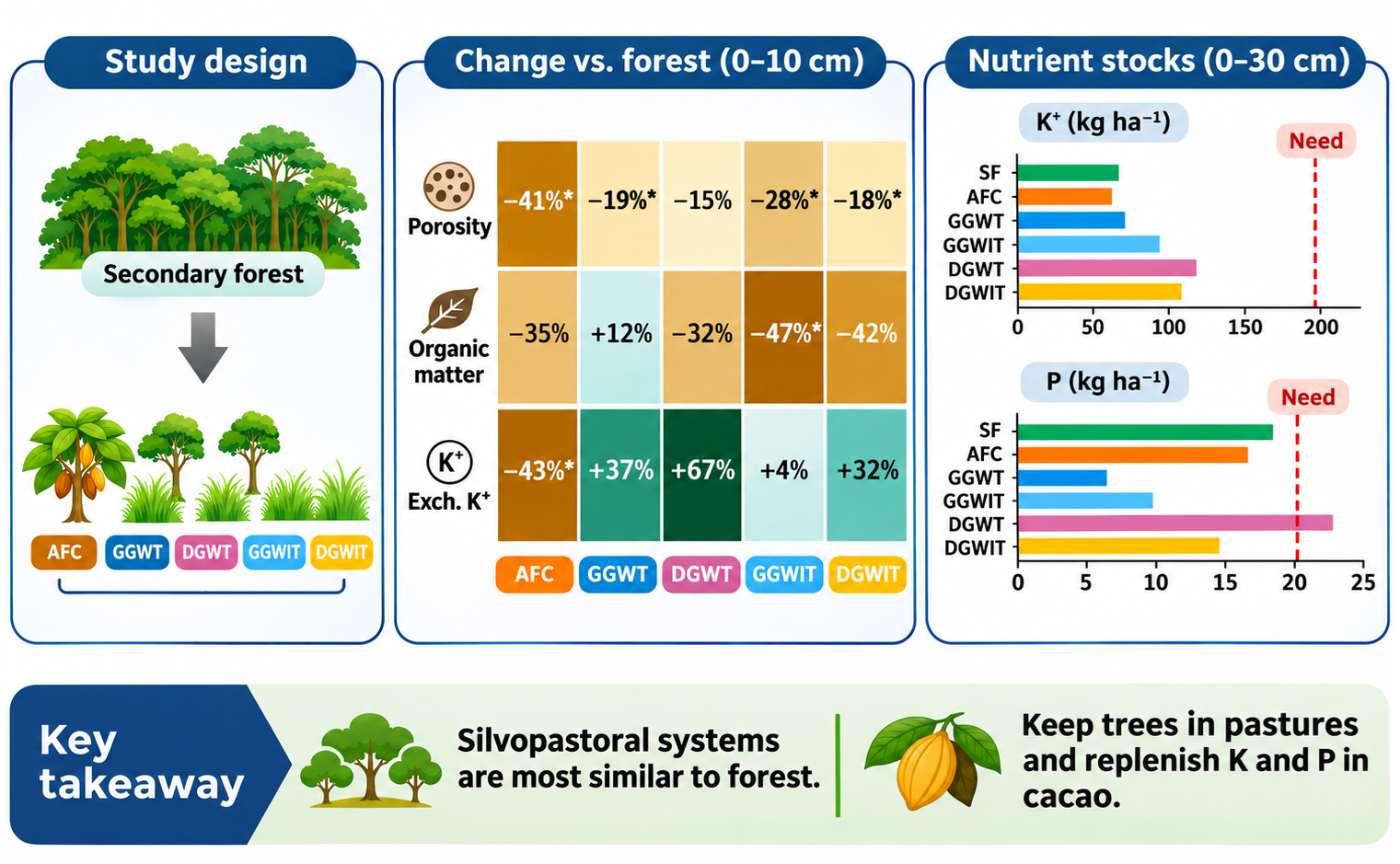
El cambio en el uso del suelo en regiones tropicales, particularmente la conversión de bosques en pastizales y sistemas agrícolas, es un factor principal en la disminución de la fertilidad del suelo. Este estudio evaluó el impacto de los sistemas agroforestales y los pastizales en las propiedades físicas y químicas del suelo relacionadas con la fertilidad en la Amazonía ecuatoriana. Analizamos la densidad aparente, la conductividad hidráulica saturada, la porosidad total, de aireación y de retención, así como el nitrógeno total, el carbono orgánico del suelo, el fósforo disponible, las bases intercambiables y los micronutrientes en sistemas agroforestales de cacao, sistemas silvopastoriles, pastizales sin árboles y bosques secundarios. La porosidad de aireación y la conductividad hidráulica saturada fueron identificadas como los indicadores físicos más sensibles al cambio en el uso del suelo, reflejando su fuerte dependencia de la materia orgánica del suelo y su papel en la regulación de la infiltración de agua e intercambio de gases.Los sistemas silvopastoriles y los bosques secundarios mostraron una mayor fertilidad del suelo, con niveles y reservas aumentadas de carbono orgánico del suelo, nitrógeno total, amonio, fósforo disponible, potasio y magnesio, lo que indica un ciclo y retención de nutrientes mejorados. En contraste, los sistemas agroforestales de cacao exhibieron menores reservas de nutrientes, aunque los niveles más altos de Ca²⁺ sugirieron la influencia de prácticas de manejo específicas. La relación de estratificación y el porcentaje de respuesta al cambio de uso del suelo demostraron ser indicadores eficaces de la distribución vertical de nutrientes y la sensibilidad del suelo a la perturbación. El análisis multivariante identificó cuatro componentes principales que explicaron la variabilidad de la fertilidad del suelo y agruparon los usos del suelo según sus similitudes funcionales.
Referencias
Álvarez, F., Casanoves, F., & Suárez, J. C. (2021). Influence of scattered trees in grazing areas on soil properties in the Piedmont region of the Colombian Amazon. PLoS ONE, 16(12), Article e0261612. https://doi.org/10.1371/journal.pone.0261612
Bahr, E., Chamba Zaragocin, D., & Makeschin, F. (2014). Soil nutrient stock dynamics and land-use management of annuals, perennials and pastures after slash-and-burn in the Southern Ecuadorian Andes. Agriculture, Ecosystems & Environment, 188, 275–288. https://doi.org/10.1016/j.agee.2014.03.005
Bates, D., Mächler, M., Bolker, B., & Walker, S. (2015). Fitting linear mixed-effects models using lme4. Journal of Statistical Software, 67(1), 1–48. https://doi.org/10.18637/jss.v067.i01
Blake, G. R., & Hartge, K. H. (1986). Bulk density. In A. Klute (Ed.), Methods of soil analysis: Part 1. Physical and mineralogical methods (2nd ed., pp. 363–375). American Society of Agronomy; Soil Science Society of America. https://doi.org/10.2136/sssabookser5.1.2ed.c13
Blanco-Canqui, H., & Ruis, S. J. (2018). No-tillage and soil physical environment. Geoderma, 326, 164–200. https://doi.org/10.1016/j.geoderma.2018.03.011
Bond, W. J. (2010). Do nutrient-poor soils inhibit development of forests? A nutrient stock analysis. Plant and Soil, 334(1), 47–60. https://doi.org/10.1007/s11104-010-0440-0
Bravo-Medina, C., Goyes-Vera, F., Arteaga-Crespo, Y., García-Quintana, Y., & Changoluisa, D. (2021). A soil quality index for seven productive landscapes in the Andean-Amazonian foothills of Ecuador. Land Degradation & Development, 32(6), 2226–2241. https://doi.org/10.1002/ldr.3897
Bravo-Medina, C., Marín, H., Marrero-Labrador, P., Ruiz, M. E., Torres-Navarrete, B., Navarrete-Alvarado, H., Durazno-Alvarado, G., & Changoluisa-Vargas, D. (2017). Evaluación de la sustentabilidad mediante indicadores en unidades de producción de la provincia de Napo, Amazonia Ecuatoriana. Bioagro, 29(1), 23–36.
Bravo-Medina, C., Sarabia-Guevara, D., & Sancho-Aguilera, D. (2024). Changes in soil quality indicators in response to land use based on a minimum data set. Scientia Agropecuaria, 15(4), 525–535. https://doi.org/10.17268/sci.agropecu.2024.039
Bravo-Medina, C., Torres-Navarrete, B., Arteaga-Crespo, Y., García-Quintana, Y., Reyes-Morán, H., Changoluisa-Vargas, D., & Paguay-Sayay, D. (2023). Soil properties variation in a small-scale altitudinal gradient of an evergreen foothills forest, Ecuadorian Amazon region. European Journal of Forest Research, 142(6), 1325–1339. https://doi.org/10.1007/s10342-023-01593-6
Coq-Huelva, D., Higuchi, A., Alfalla-Luque, R., Burgos-Morán, R., & Arias-Gutiérrez, R. (2017). Co-evolution and bio-social construction: The Kichwa agroforestry systems (chakras) in the Ecuadorian Amazonia. Sustainability, 9(10), Article 1920. https://doi.org/10.3390/su9101920
Custode, E., & Sourdat, M. (1986). Paisajes y suelos de la Amazonía ecuatoriana: Entre la conservación y la explotación. Cultura, 325–338.
Espinosa, J., Moreno, J., & Bernal, G. (Eds.). (2018). The soils of Ecuador. Springer. https://doi.org/10.1007/978-3-319-25319-0
Ewunetu, T., Selassie, Y. G., Molla, E., Admase, H., & Gezahegn, A. (2025). Soil properties under different land uses and slope gradients: Implications for sustainable land management in the Tach Karnuary watershed, Northwestern Ethiopia. Frontiers in Environmental Science, 13, Article 1518068. https://doi.org/10.3389/fenvs.2025.1518068
Garcia, L., Dubeux, J. C. B., Sollenberger, L. E., Vendramini, J. M. B., DiLorenzo, N., Santos, E. R. S., Jaramillo, D. M., & Ruiz-Moreno, M. (2021). Nutrient excretion from cattle grazing nitrogen-fertilized grass or grass–legume pastures. Agronomy Journal, 113(4), 3110–3123. https://doi.org/10.1002/agj2.20675
Guillaume, T., Maranguit, D., Murtilaksono, K., & Kuzyakov, Y. (2016). Sensitivity and resistance of soil fertility indicators to land-use changes: New concept and examples from conversion of Indonesian rainforest to plantations. Ecological Indicators, 67, 49–57. https://doi.org/10.1016/j.ecolind.2016.02.039
Hartemink, A. E. (2005). Nutrient stocks, nutrient cycling, and soil changes in cocoa ecosystems: A review. Advances in Agronomy, 86, 227–253. https://doi.org/10.1016/S0065-2113(05)86005-5
Horneck, D. A., Sullivan, D. M., Owen, J. S., & Hart, J. M. (2011). Soil test interpretation guide (EC 1478). Oregon State University Extension Service.
Huera-Lucero, T., Lopez-Piñeiro, A., & Bravo-Medina, C. (2025). Soil quality indicators for different land uses in the Ecuadorian Amazon rainforest. Forests, 16(8), Article 1275. https://doi.org/10.3390/f16081275
Huera-Lucero, T., Lopez-Piñeiro, A., Torres, B., & Bravo-Medina, C. (2024). Biodiversity and carbon sequestration in chakra-type agroforestry systems and humid tropical forests of the Ecuadorian Amazon. Forests, 15(3), Article 557. https://doi.org/10.3390/f15030557
Jiménez, L., Carrera, R., Fierro, N., Lasso, J., Roa, J., Ochoa, P., Loján, C., Donoso, R., & Capa-Mora, D. (2026). Tree-based production systems and their relationships with topsoil fertility and carbon storage in tropical regions. Journal of Agriculture and Food Research, 31, Article 103350. https://doi.org/10.1016/j.jafr.2026.103350
Kuznetsova, A., Brockhoff, P. B., & Christensen, R. H. B. (2017). lmerTest package: Tests in linear mixed effects models. Journal of Statistical Software, 82(13), 1–26. https://doi.org/10.18637/jss.v082.i13
Lal, R., Negassa, W., & Lorenz, K. (2015). Carbon sequestration in soil. Current Opinion in Environmental Sustainability, 15, 79–86. https://doi.org/10.1016/j.cosust.2015.09.002
Lenth, R. V. (2024). emmeans: Estimated marginal means, aka least-squares means (R package version 1.10.0). https://CRAN.R-project.org/package=emmeans
Mainville, N., Webb, J., Lucotte, M., Davidson, R., Betancourt, O., Cueva, E., & Mergler, D. (2006). Decrease of soil fertility and release of mercury following deforestation in the Andean Amazon, Napo River Valley, Ecuador. Science of the Total Environment, 368(1), 88–98. https://doi.org/10.1016/j.scitotenv.2005.09.064
McGrath, J. M., Spargo, J., & Penn, C. J. (2014). Soil fertility and plant nutrition. In N. K. Van Alfen (Ed.), Encyclopedia of agriculture and food systems (Vol. 5, pp. 166–184). Elsevier. https://doi.org/10.1016/B978-0-444-52512-3.00249-7
McLean, E. O. (1965). Aluminum. In C. A. Black (Ed.), Methods of soil analysis: Part 2. Chemical and microbiological properties (Agronomy Monograph 9, pp. 978–998). American Society of Agronomy. https://doi.org/10.2134/agronmonogr9.2.c16
Melkani, S., Singh, V., & Bhadha, J. H. (2024). Quantifying the impact of different agroforestry systems on soil carbon fractions lability and long-term carbon sequestration in Central Himalayas. Soil Use and Management, 40(1), Article e13012. https://doi.org/10.1111/sum.13012
Murgueitio, E., Calle, Z., Uribe, F., Calle, A., & Solorio, B. (2011). Native trees and shrubs for the productive rehabilitation of tropical cattle ranching lands. Forest Ecology and Management, 261(10), 1654–1663. https://doi.org/10.1016/j.foreco.2010.09.027
Nascimento, C. M., de Sousa Mendes, W., Quiñonez Silvero, N. E., Poppiel, R. R., Sayão, V. M., et al. (2024). Nitrogen, phosphorus, and potassium cycling in pasture ecosystems. Brazilian Animal Science, 25, Article e-76743E. https://doi.org/10.1590/1809-6891v25e-76743E
Nelson, D. W., & Sommers, L. E. (1982). Total carbon, organic carbon, and organic matter. In A. L. Page, R. H. Miller, & D. R. Keeney (Eds.), Methods of soil analysis: Part 2. Chemical and microbiological properties (2nd ed., Agronomy Monograph 9, pp. 539–579). American Society of Agronomy; Soil Science Society of America. https://doi.org/10.2134/agronmonogr9.2.2ed.c29
Nieto, C., & Caicedo, C. (2012). Análisis reflexivo sobre el desarrollo agropecuario sostenible en la Amazonía Ecuatoriana (Publicación Miscelánea No. 405). Instituto Nacional Autónomo de Investigaciones Agropecuarias (INIAP).
Okalebo, J. R., Gathua, K. W., & Woomer, P. L. (2002). Laboratory methods of soil and plant analysis: A working manual (2nd ed.). SACRED Africa.
Olaya-Montes, A., Llanos-Cabrera, M. P., Cherubin, M. R., Herrera-Valencia, W., Ortiz-Morea, F. A., & Silva-Olaya, A. M. (2021). Restoring soil carbon and chemical properties through silvopastoral adoption in the Colombian Amazon region. Land Degradation & Development, 32(13), 3720–3730. https://doi.org/10.1002/ldr.3832
Pla, I. (2010a). Medición y evaluación de propiedades físicas de los suelos: Dificultades y errores más frecuentes. II. Propiedades hidrológicas. Suelos Ecuatoriales, 40(2), 94–127.
Pla, I. (2010b). Medición y evaluación de propiedades físicas de los suelos: Dificultades y errores más frecuentes. I. Propiedades mecánicas. Suelos Ecuatoriales, 40(2), 75–92.
Quesada, C. A., Lloyd, J., Anderson, L. O., Fyllas, N. M., Schwarz, M., & Czimczik, C. I. (2011). Soils of Amazonia with particular reference to the RAINFOR sites. Biogeosciences, 8(6), 1415–1440. https://doi.org/10.5194/bg-8-1415-2011
R Core Team. (2024). R: A language and environment for statistical computing (Version 4.3.3). R Foundation for Statistical Computing. https://www.R-project.org/
Rabot, E., Wiesmeier, M., Schlüter, S., & Vogel, H.-J. (2018). Soil structure as an indicator of soil functions: A review. Geoderma, 314, 122–137. https://doi.org/10.1016/j.geoderma.2017.11.009
Reynolds, W. D., Drury, C. F., Tan, C. S., Fox, C. A., & Yang, X. M. (2009). Use of indicators and pore volume-function characteristics to quantify soil physical quality. Geoderma, 152(3–4), 252–263. https://doi.org/10.1016/j.geoderma.2009.06.009
Torres, B., Bravo, C., Torres, A., Tipán-Torres, C., Vargas, J. C., et al. (2023). Carbon stock assessment in silvopastoral systems along an elevational gradient: A study from cattle producers in the Sumaco Biosphere Reserve, Ecuadorian Amazon. Sustainability, 15(1), Article 449. https://doi.org/10.3390/su15010449
Torres, B., Herrera-Feijoo, R. J., Torres-Navarrete, A., Bravo, C., & García, A. (2024). Tree diversity and its ecological importance value in silvopastoral systems: A study along elevational gradients in the Sumaco Biosphere Reserve, Ecuadorian Amazon. Land, 13(3), Article 281. https://doi.org/10.3390/land13030281
Torres, V., Ramos, N., Lizazo, D., Monteagudo, F., & Noda, A. (2008). Modelo estadístico para la medición del impacto de la innovación o transferencia tecnológica en la rama agropecuaria. Revista Cubana de Ciencia Agrícola, 42(2).
Trujillo-González, J. M., Silva-Parra, A., & Torres-Mora, M. A. (2026). Soil fertility and carbon stocks in contrasting tropical grazing systems on Oxisols of the Colombian Llanos piedmont. Agroforestry Systems, 100(5), Article 130. https://doi.org/10.1007/s10457-026-01503-w
Unger, M., Leuschner, C., & Homeier, J. (2010). Variability of indices of macronutrient availability in soils at different spatial scales along an elevation transect in tropical moist forests (NE Ecuador). Plant and Soil, 336(1), 443–458. https://doi.org/10.1007/s11104-010-0494-z
Uvidia, H., Ramírez, J. L., Leonard, I., Vargas, J. C., Verdecia, D., & Andino, M. (2015). Inventario de la sucesión vegetal secundaria en la provincia Pastaza, Ecuador. REDVET. Revista Electrónica de Veterinaria, 16(11).
Viana, R. M., Ferraz, J. B. S., Neves, A. F., Vieira, G., & Pereira, B. F. F. (2014). Soil quality indicators for different restoration stages on Amazon rainforest. Soil and Tillage Research, 140, 1–7. https://doi.org/10.1016/j.still.2014.01.005
Wilcke, W., Oelmann, Y., Schmitt, A., Valarezo, C., Zech, W., & Homeier, J. (2008). Soil properties and tree growth along an altitudinal transect in Ecuadorian tropical montane forest. Journal of Plant Nutrition and Soil Science, 171(2), 220–230. https://doi.org/10.1002/jpln.200625210
Zhang, Y., Xu, X., Li, Z., Liu, M., Xu, C., Zhang, R., & Luo, W. (2019). Effects of vegetation restoration on soil quality in degraded karst landscapes of southwest China. Science of the Total Environment, 650, 2657–2665. https://doi.org/10.1016/j.scitotenv.2018.09.372
Descargas
Publicado
Número
Sección
Licencia
Derechos de autor 2026 Scientia Agropecuaria

Esta obra está bajo una licencia internacional Creative Commons Atribución-NoComercial 4.0.
Los autores que publican en esta revista aceptan los siguientes términos:
a. Los autores conservan los derechos de autor y conceden a la revista el derecho publicación, simultáneamente licenciada bajo una licencia de Creative Commons que permite a otros compartir el trabajo, pero citando la publicación inicial en esta revista.
b. Los autores pueden celebrar acuerdos contractuales adicionales separados para la distribución no exclusiva de la versión publicada de la obra de la revista (por ejemplo, publicarla en un repositorio institucional o publicarla en un libro), pero citando la publicación inicial en esta revista.
c. Se permite y anima a los autores a publicar su trabajo en línea (por ejemplo, en repositorios institucionales o en su sitio web) antes y durante el proceso de presentación, ya que puede conducir a intercambios productivos, así como una mayor citación del trabajo publicado (ver efecto del acceso abierto).