Pesticides in the control of Brevicoryne brassicae (L.) and their impact on the productivity of broccoli, Brassica oleracea L. var. italica
Plaguicidas en el control de Brevicoryne brassicae (L.) y su impacto en la productividad de brócoli, Brassica oleracea L. var. italica
Luis Chanaluisa1; Dorys T. Chirinos2 *; Tannya Llanos3; Rossana Castro4
1 Maestría en Sanidad Vegetal, Posgrado, Universidad Técnica de Cotopaxi, Latacunga, Cotopaxi, Ecuador.
2 Facultad de Ingenierías Agroambientales, Universidad Técnica de Manabí, Portoviejo, Ecuador.
3 Laboratorio de Microbiología 1, Facultad de Ciencias de la Ingeniería y Aplicadas. Universidad Técnica de Cotopaxi, Latacunga, Cotopaxi, Ecuador.
4 Facultad de Ciencias Agrarias, Instituto de Investigación, Universidad Agraria del Ecuador, Guayaquil, Ecuador.
ORCID de los autores:
L. Chanaluisa: https://orcid.org/0009-0008-7484-7614 D. T. Chirinos: https://orcid.org/0000-0001-8125-5862
T. Llanos: https://orcid.org/0009-0004-1721-9751 R. Castro: https://orcid.org/0000-0003-3116-131X
RESUMEN
El pulgón de la col, Brevicoryne brassicae (L.), es una plaga relevante del brócoli, Brassica oleracea L. var. italica, debido al daño causado por la succión de la savia y la transmisión de virus, lo que puede provocar pérdidas de rendimiento. Se evaluó el efecto de tratamientos con plaguicidas sobre B. brassicae y el rendimiento de dos genotipos de brócoli (variedad Steel e híbrido Avenger) en condiciones de campo. Los tratamientos evaluados fueron: T1. Imidacloprid + Lambdacialotrina (IL); T2. Lambdacialotrina + extracto de Allium sativum + extracto de Capsicum sp. (L+AE+CE); T3. Extracto de A. sativum + extracto de Capsicum sp. + extracto de alcaloide de Argemone mexicana (AE+CE+AE); y T4. Control sin tratamiento. Para el análisis se utilizó un diseño de bloques completos aleatorizados con un arreglo factorial de 2 × 4. El IL registró las poblaciones de pulgones más bajas (6,7 individuos∙planta-1) y el rendimiento más alto (20,4 t∙ha-¹), sin diferencias significativas con L+AE+CE (18,7 t∙ha-¹). El híbrido Avenger mostró mayor susceptibilidad a B. brassicae. La mayor utilidad marginal se obtuvo con la aplicación de IL ($2626 ha-¹) seguida de L+AE+CE ($2115 ha-¹). Los resultados demostraron la viabilidad económica del control químico de plagas. Sin embargo, el efecto ambiental del insecticida organosintético sugiere que la combinación de este con extractos vegetales (L+AE+CE) representaría una alternativa económicamente viable dentro del manejo sostenible de plagas en brócoli.
Palabras clave: Aphididae; control químico; extractos botánicos; productividad.
ABSTRACT
The cabbage aphid, Brevicoryne brassicae (L.) is a relevant pest of broccoli, Brassica oleracea L. var. italica, due to damage caused by sap sucking and virus transmission, which can lead to yield losses. The effect of pesticide treatments on B. brassicae and the yield of two broccoli genotypes (Steel variety and Avenger hybrid) was evaluated under field conditions. The treatments evaluated were: T1. Imidacloprid + Lambdacyhalothrin (IL); T2. Lambdacyhalothrin + Allium sativum extract + Capsicum sp. extract (L+AE+CE); T3. A. sativum extract + Capsicum sp. extract + Argemone mexicana alkaloid extract (AE+CE+AE); and T4. Untreated control. A Randomized Complete Block Design with a 2 × 4 factorial arrangement was used for analysis. The IL recorded the lowest aphid populations (6.7 individuals∙plant-1) and the highest yield (20.4 t∙ha-¹), without significant differences from L+AE+CE (18.7 t∙ha-¹). The Avenger hybrid showed greater susceptibility to B. brassicae. The greatest marginal utility was obtained when IL was applied ($2626 ha-¹) followed by L+AE+CE ($2115 ha-¹). The results showed the economic feasibility of chemical pest control. However, the environmental effect of organosynthetic insecticide suggests that the combination of this with plant extracts (L+AE+CE) would represent an economically feasible alternative within sustainable pest management in broccoli.
Keywords: Aphididae; chemical control; botanical extracts; productivity.
1. Introduction
Broccoli (Brassica oleracea L. var. italica) (Brassicaceae) is a vegetable of great nutritional value, due to its high content of vitamins A, B, C, and K, and folic acid, as well as bioactive compounds with anticancer properties such as glucosinolates (Shubha et al., 2020; Li et al., 2022). Globally, broccoli production in 2024 exceeded 25 million tons, with China, India, and Mexico being the main producers (Food and Agriculture Organization of the United Nations [FAO], 2026). In Ecuador, cultivation is concentrated in the highland provinces, with Cotopaxi (73%) and Tungurahua (25%) standing out (Ministerio de Agricultura, Ganadería y Pesca [MAGAP], 2024), where agroecological conditions of altitude and temperature favor its development and production.
Ecuador allocates approximately 9963 ha to broccoli cultivation, with average yields of 7 to 14 t∙ha⁻¹, being one of the main exporters of frozen broccoli in Latin America (MAGAP, 2024). The crop represents an important source of income for small and medium-sized farmers in the Ecuadorian highlands, and its production is linked to both the domestic market and exports, mainly to Japan, Europe, and the United States (MAGAP, 2024; Velez & Alava, 2021).
Among the main phytosanitary problems of the crop, the cabbage aphid, Brevicoryne brassicae (L.) (Hemiptera: Aphididae), constitutes one of the most relevant pests (Panwar et al., 2023). This aphid preferentially colonizes the underside of leaves and inflorescences, causing chlorosis, leaf deformation, reduction of photosynthetic capacity, and yield losses that in severe attacks can exceed 40% (Deol et al., 2014). Additionally, it vectors several species of phytopathogenic viruses, which considerably increases its economic impact (Slavíková et al., 2024).
Pest control in broccoli has traditionally been based on the use of synthetic insecticides, among which neonicotinoids (such as imida-cloprid) and pyrethroids (e.g., lambdacyhalothrin) have shown high effectiveness in aphid control (Mpumi et al., 2020; Falcon-Alvarado et al., 2023). However, the intensive use of these products has led to the development of resistance in B. brassicae populations, negative impacts on pollinators and other beneficial organisms, as well as soil and water contamination, and risk to human health (Goulson, 2013; Auteri et al., 2017; Falcon-Alvarado et al., 2023).
Given this situation, plant extracts can be considered sustainable alternatives within Inte-grated Pest Management programs. Garlic (Allium sativum L.) and chili peppers (Capsicum spp.) possess bioactive compounds, such as allicin, capsaicin, and derivatives, with repellent and insecticidal properties that have been referred against aphids (Baidoo & Mochiah, 2016; Abate, 2025). For their part, the alkaloids of Ghamoya (Argemone mexicana L.) have shown insecticidal activity against some agricultural pests (Sharma et al., 2016; Delgado-Ortiz et al., 2023; Mlombo et al., 2025).
Regarding commercial genotypes, the Avenger hybrid and the Steel variety are broccoli plant materials widely used in the Ecuadorian highlands due to their adaptation to high-altitude conditions and their commercial demand. However, the differential susceptibility of these genotypes to B. brassicae populations under different control strategies has been scarcely studied under the agroecological conditions of Cotopaxi.
The objective of this study was to evaluate the effect of three pesticide treatments (one synthetic and two incorporating plant extracts) on B. brassicae populations, the percentage of damaged plants, yield, and profitability of two broccoli varieties under field conditions in Pujilí, Cotopaxi, Ecuador.
2. Methodology
Location and study period
The trial was conducted during the warm season of 2025 in the San Antonio sector, belonging to Pujilí canton, Cotopaxi province, Ecuador (coordinates: 1°03'15.0"S 78°41'26.4"W). The study area has a dry temperate climate, with an annual precipitation of approximately 800 mm. The soils are sandy loam in texture, slightly acidic, suitable for broccoli cultivation. The area is located at an approximate altitude of 2950 m a.s.l., with daily temperatures ranging between 17 °C and 22 °C, favorable conditions for both crop development and the presence of aphids. The life zone corresponds to a humid montane forest (Holdridge, 1967). The precipitation and temperatures recorded during the study period are shown in Table 1.
Table 1
Rainfall (mm) and temperatures (°C), maximums (Tmax), minimums (Tmin) and averages (TA) recorded
Month | Rainfall | Tmax | Tmin | TA |
August | 19.0 | 17.56 | 5.80 | 11.68 |
September | 5.5 | 19.27 | 6.30 | 12.78 |
October | 122.2 | 19.55 | 6.32 | 12.93 |
November | 105.0 | 18.73 | 6.50 | 12.62 |
Commercial broccoli genotypes
Two commercial broccoli genotypes were evalua-ted: the Avenger hybrid (95-day cycle; yield: 18 – 26 t∙ha-1) and the Steel variety (102-day cycle; 15 – 20 t∙ha-1). Transplanting of both genotypes was carried out on August 01, 2025; harvesting of the Avenger hybrid was performed on Nov 4, 2025, and that of the Steel variety on Nov 11, 2025.
Pesticide treatments
Three pesticide treatments and an untreated control (Table 2) were evaluated. Coinciding with the outbreak in B. brassicae populations, sprays began seven weeks after transplanting with weekly frequency, alternating the two pesticides in each treatment, until three weeks before harvest. The doses used corresponded to the recommendations established in the technical data sheet for each pesticide.
Experimental design and trial area
The study was designed in a Randomized Complete Block Design (RCBD) in a factorial arrangement with two commercial broccoli genotypes and four treat-ments with three replications. Each experimental unit consisted of a plot of 4 m × 1.6 m (6.4 m²), with four rows of eight plants each (32 plants plot⁻¹), with planting distances of 1 m between rows and 0.20 m between plants (density: 50,000 seedlings ha⁻¹).
Agronomic management
Before transplanting, poultry manure (20 m³ ha⁻¹) was incorporated as an organic amendment. Mineral fertilization was carried out at three stages of the crop cycle, i.e., at transplanting, at 21 days, and at 45 days with doses of 60-40-15-5 kg ha⁻¹ of N-P₂O₅-K₂O-S, in each application. Irrigation was by sprinkling with frequency and intensity adjusted according to the phenological stage. Weed control combined the application of 0.7 L ha⁻¹ of the post-transplant herbicide based on S-Metolachlor and two manual weedings (35 and 50 days). Disease control was carried out with preventive fungicides captan (1.5 kg ha⁻¹), mancozeb (2 kg ha⁻¹) and systemic fungi-cides, azoxystrobin (0.3 L ha⁻¹), difenoconazole (0.3 L ha⁻¹), kasugamycin (1.5 L ha⁻¹) according to crop needs.
Variables evaluated
Number of B. brassicae individuals: weekly direct count with a pocket magnifier (magnification: 30X) on 16 plants from the central rows of each plot, evaluating leaves from the upper, middle, and lower strata and inflorescences.
Percentage of damaged plants (%): weekly visual evaluation of the presence of B. brassicae on leaves, stems, or inflorescences (damaged plants), calculated (equation 1):
% Damaged plants =  x 100 (1)
For these two variables, 13 and 14 counts were performed on Avenger and Steel, respectively.
Yield (t ha⁻¹): for each treatment per replicate, all heads meeting market quality criteria (size, compaction, and absence of severe damage) were weighed with a calibrated digital scale, and subsequently, the weights were estimated in t ha⁻¹ for each treatment.
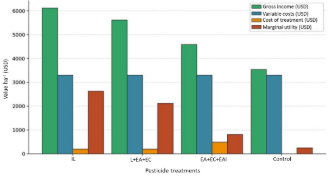
Economic analysis: based on the yield per treatment, broccoli price ($0.30 kg⁻¹), cost of pesticide treatments (Table 4), and fixed variable costs ($3300 ha⁻¹, which include seed, cultural practices, fungicides, and harvest), the marginal utility of broccoli for each treatment was estimated.
Statistical analysis
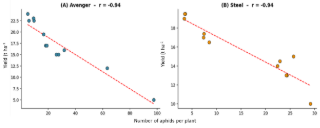
The normality of residuals was corroborated by the Shapiro-Wilk test (p < 0.05). The yield variable met the assumption of normality, while the number of aphids and percentage of damaged plants variables were transformed using Log(x) and √(x+1), respectively. An ANOVA was performed with a randomized block model with a 2 × 4 factorial arrangement considering the two broccoli varieties and four treatments (three with pesticides and the control). Mean comparisons were performed using Tukey's test (p ≤ 0.05). Additionally, a Pearson correlation analysis (p ≤ 0.05) between yield and the number of B. brassicae individuals was performed for the two commercial genotypes to estimate the effect of pest population densities on yield. Statistical analyses were performed in R version 4.3.1 (R Core Team, 2023).
3. Results and discussion
Aphid populations and damaged plants
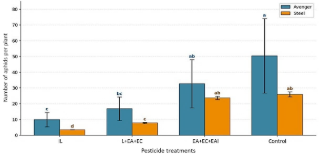
Analysis of variance detected significant differences between treatments for all variables evaluated (p < 0.05). Plots treated with IL recorded the lowest average aphid populations and the lowest percentage of damaged plants, differing significantly from the rest of the treatments (Figure 1, Table 3). The second lowest aphid population was observed when plots were sprayed with L+EA+EC, with an estimated 6.3% of damaged plants. This would represent double the aphid population and damaged plants compared to the chemical treatment. On the other hand, the EA+EC+EAl treatment and the unsprayed control showed the highest aphid infestations, with no statistical differences between them.
Table 3
Average values of the evaluated variables (aphids, damaged plants, and yield: t ha⁻¹) by broccoli variety and pesticide for the control of Brevicoryne brassicae
Factor | Aphids plant-1 | %Damage plants | Yield |
Variety | | | |
Avenger | 27.5 a | 8.7 b | 17.4 |
Steel | 15.2 b | 9.9 a | 15.7 |
Pesticide | | | |
IL | 6.7 c | 3.2 d | 20.4 a |
L+EA+EC | 12.3 b | 6.3 c | 18.7 ab |
EA+EC+EAl | 28.2 a | 10.4 b | 15.3 bc |
Control | 38.1 a | 17.3 a | 11.8 c |
Shapiro-Wilk test | 0.74 | 0.20 | 0.07 |
R² | 0.87 | 0.98 | 0.66 |
CV (%) | 15.5 | 3.9 | 19.8 |
F-value | 10.3 | 90.9 | 3.0 |
p-value | 0.0001 | 0.0001 | 0.03 |
Means with different letters in the same column differ significantly according to Tukey's test (p ≤ 0.05).
The high effectiveness of IL is consistent with previous studies that detected efficacies greater than 85% for imidacloprid and lambdacyhalothrin on B. brassicae population densities when the insecticides were sprayed in the field as separate treatments (Shonga & Getu, 2021; Usha et al., 2024). The L+EA+EC combination showed a high to moderate population reduction, proving promising as a lower environmental impact alternative. In a field trial that tested the effect of A. sativum and Capsicum sp. extracts on B. brassicae populations, a reduction ranging from 30–40% was observed compared to the untreated control (Baidoo & Mochiah, 2016). This is lower than what was detected in this study, probably associated with the fact that these extracts in this treatment were alternated with lambdacyhalothrin.
On the other hand, the action of these extracts together with the alkaloids of A. mexicana (EA+EC+EAl) was insufficient to significantly reduce B. brassicae population densities. Discrepant results regarding the efficacy of A. mexicana have been reported in previous research. Coinciding with what was found here, bioassays also confirmed the low toxicity of aqueous extracts of A. mexicana on the black bean aphid, Aphis craccivora Koch, an aphid species of importance in legumes (Waghmare et al., 2023). The control exerted on Spodoptera frugiperda Smith (Lepidoptera: Noctuidae) by A. mexicana extracts has been reported to be between 30% to 42% population reduction, while when treating stored grain pests, mortalities between 93% to 100% were observed (Mlombo et al., 2025).
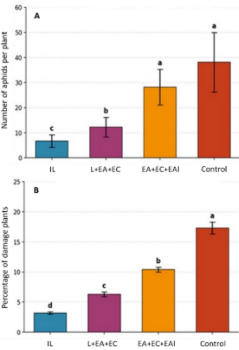
Figure 1. Effect of pesticide treatments on (A) number of aphids and (B) percentage of plants damaged by Brevicoryne brassicae. Bars with different letters differ significantly (Tukey, p ≤ 0.05). Bars = mean ± standard error.
Considering what has been reported in some research, as well as the results obtained here, when botanical extracts have been applied without the inclusion of a synthetic pesticide, the effectiveness in pest control is generally moderate and, in some cases, low. Although botanical pesticides are considered an environmentally compatible alterna-tive for agricultural pest control, factors such as lack of standardization, variability in active ingredient content according to geographical areas, and the rapid degradation of the botanical formulation, which implies the use of high doses, could limit the efficacy of botanical pesticides (Damalas et al., 2020; Sarmah et al., 2025).
Regarding the effect of the commercial plant genotype, Steel showed a lower number of aphids compared to Avenger. However, the Steel variety showed a higher percentage of damaged plants. The variety × pesticide interaction was significant for aphids and damaged plants (Figure 2), with the IL-Steel treatment recording the lowest infestation of B. brassicae. The lower infestation in Steel compared to Avenger could be related to morpho-anatomical characteristics of the variety that prevent or limit colonization by the insect. This could be associated with deterrence or antixenosis strategies (Kogan & Ortman, 1978).
Yield
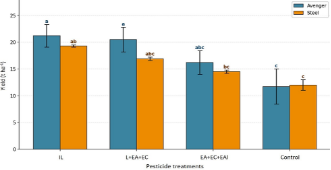
Pesticide treatments significantly affected broccoli yield (p = 0.03). The highest average yield was obtained on plots treated with IL, with no significant differences compared to those treated with L+EA+EC. Although the population of B. brassicae and damaged plants in plots sprayed with IL were half of those observed in L+EA+EC, the yield of 18.7 t ha⁻¹ can be considered high, especially since it did not differ significantly from the yield obtained with IL.
Plots sprayed with EA+EC+EAl and unsprayed plots (control) exhibited lower yields (Figure 3, Table 3). The Steel variety achieved an average yield of 15.7 t ha⁻¹, while the Avenger hybrid's yield was 17.4 t ha⁻¹, with no statistical differences between these commercial genotypes. This was despite the Steel variety having lower B. brassicae infestations compared to the Avenger hybrid. Such differences could be related to the potential yield of each commercial genotype, which is slightly higher in Avenger compared to Steel.
The variety × pesticide interaction showed that the IL-Avenger combination produced the highest yield, with no differences compared to L+EA+EC-Avenger and IL-Steel. The yields observed for IL were higher than the national averages reported by MAGAP (2024) for the area, which may be related to the experimental conditions of this study.
However, among the challenges faced in using plant extracts in integrated pest management are the cost of these extracts and their moderate to low effect in reducing populations of arthropod pest species. Thus, botanical treatment was approximately 2.5 times that of synthetic insecticides, coupled with a limited effect on reducing pest populations. This results in less use of this alternative by farmers, even though its environmental impact is lower. All of this translates into a disruption between short-term economic viability and long-term sustainability, which has been noted for agricultural systems (Bi et al. 2024).
From an economic sustainability perspective, the cost of the EA+EC+EAl treatment (USD 484 ha⁻¹) was 2.5 times that of IL and L+EA+EC (USD 194 and 195 ha⁻¹), without a proportional compensation in B. brassicae control or yield. This is critical for small farmers, for whom access to financial resources is decisive, and thus the decision to adopt alternative inputs fundamentally depends on the cost-benefit-effectiveness relationship. Nevertheless, the L+EA+EC treatment, by combining a synthetic insecticide with plant extracts, managed to halve the use of synthetic pesticides while maintaining a marginal utility of USD 2115 ha⁻¹. This type of alternative could represent a viable starting point for the transition towards sustainable intensification systems (Pretty et al., 2018).
Regarding environmental sustainability, the frequent use of synthetic insecticides such as imidacloprid has been linked to the decline of pollinator populations, particularly honeybees and bumblebees, which compromises the pollination of adjacent crops and the biodiversity of agroecosystems (Auteri et al., 2017; Woodcock et al., 2017). Lambdacyhalothrin, for its part, exhibits high toxicity to aquatic organisms and beneficial entomofauna, which can cause biological imbalances in both agroecosystems and natural ecosystems (Kumar et al., 2008; Gajendiran & Abraham, 2018). In contrast, the evaluated plant extracts show greater selectivity towards non-target arthropods, lower environmental persistence, and faster degradation in the soil, reducing the risk of environmental contamination in agricultural areas (Ngegba et al., 2022; Shouran et al., 2026).
From the social dimension, exposure to synthetic pesticides constitutes a documented occupational risk for farmers and their families, a reality from which Ecuador is not exempt (Lindao, 2017). In Ecuador, studies in horticultural areas of the highlands have pointed to the frequent use of neonicotinoids and pyrethroids, with greater vulnerability among young people participating in field work (Chirinos et al., 2020). In this context, the incorporation of botanical pesticides into pest management programs is an alternative to be considered to reduce the applications of synthetic insecticides in agroecosystems, decreasing the impact on the health of farmers and consumers (Chirinos et al., 2020; López et al., 2022). However, the adoption of these alternatives requires training processes, technical assistance, and incentive policies that facilitate the transition from the conventional paradigm to more sustainable agriculture (Nicholls & Altieri, 2018).
From a systemic point of view, the results of this study suggest that the L+EA+EC treatment could be configured as a strategy that combines agronomic efficiency, economic viability, and lower environmental impact, especially if considered within an alternation scheme with other control methods compatible with integrated pest management. The optimization of botanical extract formulations and dosages, as well as the evaluation of their effect on beneficial entomofauna associated with the crop, constitute priority research lines (Sarmah et al., 2025). All this with the aim of strengthening the sustainability of broccoli production for the Ecuadorian highlands.
4. Conclusions
The IL treatment, which alternated imidacloprid with lambda-cyhalothrin, was the most effective in controlling Brevicoryne brassicae, recording the lowest aphid population and the highest yield, coupled with superior marginal utility. Likewise, the L+EA+EC treatment (lambda-cyhalothrin + extracts of A. sativum and Capsicum sp.) showed good control of this aphid species and a high yield, which could represent an economically feasible alternative within integrated pest management.
The Avenger hybrid can be considered as part of integrated pest management, which, combined with the L+EA+EC treatment, achieved yields as high as the best synthetic treatment, but with less environmental impact by halving the use of these agrochemicals.
Although plant extracts can be considered within an integrated pest management program due to their lower environmental impact, one of the major challenges is their cost compared to synthetic insecticides, as well as improving their effect in reducing pest densities and the consequent effect on yield.
References
Abate, G. A. (2025). Laboratory and field evaluation of selected botanical aqueous extracts against cabbage aphid, Brevicoryne brassicae (Hemiptera: Aphididae). Archives of Phytopathology and Plant Protection, 58(18), 999–1009. https://doi.org/10.1080/03235408.2025.2567674
Auteri, D., Arena, M., Barmaz, S., Ippolito, A., Linguadoca, A., Molnar, T., Sharp, R., Szentes, C., Vagenende, B., & Verani, A. (2017). Neonicotinoids and bees: The case of the European regulatory risk assessment. Science of the Total Environment, 579, 966-971. https://doi.org/10.1016/j.scitotenv.2016.10.158
Baidoo, P. K., & Mochiah, M. B. (2016). Comparing the effectiveness of garlic (Allium sativum L.) and hot pepper (Capsicum frutescens L.) in the management of the major pests of cabbage Brassica oleracea (L.). Sustainable Agriculture Research, 5(2), 83-91. http://dx.doi.org/10.5539/sar.v5n2p83
Bi, A. Z., Umesh, K. B., Abdul, B. M., Sivakuma, D., & Srikanth, P. (2024). Economic and environmental sustainability of agriculture production at the crop level. Global Journal of Environmental Science and Management, 10(3), 1433-1456. https://doi.org/10.22034/gjesm.2024.03.29
Chirinos, D. T., Castro, R., Cun, J., Castro, J., Peñarrieta, S., Solis, L., & Geraud-Pouey, F. (2020). Los insecticidas y el control de plagas agrícolas: la magnitud de su uso en cultivos de algunas provincias de Ecuador. Ciencia y Tecnología Agropecuaria, 21(1), e1276. https://doi.org/10.21930/rcta.vol21_num1_art:1276
Delgado-Ortiz, J. C., López-López, H., Beltrán-Beache, M., Ochoa-Fuentes, Y. M., Cerna-Chávez, E., & Castro del Ángel, E. (2023). Insecticidal effect of the methanolic extract of Argemone mexicana for the control of Bactericera cockerelli (Sulc.) (Hemiptera: Triozidae). Revista bio ciencias, 10, e1404. https://doi.org/10.15741/revbio.10.e1404
Damalas, C. A. & Koutroubas, S. D. (2020). Botanical pesticides for eco-friendly pest management. In Pesticides in Crop Production (eds P.K. Srivastava, V.P. Singh, A. Singh, D.K. Tripathi, S. Singh, S.M. Prasad and D.K. Chauhan). https://doi.org/10.1002/9781119432241.ch10
Deol, G. S., Bhullar, M. B., Gill, H. K., & Dhaliwal, G. S. (2014). Biology and management of cabbage aphid, Brevicoryne brassicae (L.): A review. Indian Journal of Ecology, 41(1), 28–39.
Falcon-Alvarado, J., Valverde-Rodriguez, A., Álvarez-Benaute, L., Briceño-Yen, H. y Campos-Albornoz, M. E. (2023). Extractos vegetales en el control del pulgón (Brevicoryne brassicae L.) en el cultivo de la col (Brassica oleracea var. capitata), en Perú. Manglar, 20(4), 317-323. https://doi.org/10.57188/manglar.2023.036
Food and Agriculture Organization of the United Nations (FAO). (2026). FAOSTAT: Crops and livestock products. https://www.fao.org/faostat
Garain, P.K., Das, K.S., Mondal, S.K. (2025). Innovative Management Practices for Insect Pest and Diseases and to Reconcile the Plant Health in Agro-Ecosystem. In: Singh, A.K., Kumar, P., Singh, S.S. (eds) Sustainable Agriculture Management in Semi-Arid Climates. Springer, Cham. https://doi.org/10.1007/978-3-031-94066-8_12
Holdridge, L. (1967). Life zone ecology. San Jose, Costa Rica: Tropical Science Center.
Kogan, M., & Ortman, E. F. (1978). Antixenosis–a new term proposed to define Painter's “nonpreference” modality of resistance. Bulletin of the Entomological Society of America, 24(2), 175-176. https://doi.org/10.1093/besa/24.2.175
Kumar, A., Sharma, B., Pandey R S. (2008). Cypermethrin and lambdacyhalothrin induced alterations in nucleic acids and protein contents in a freshwater fish, Channa punctatus. Fish Physiology and Biochemistry, 34(4), 331–338. https://doi.org/10.1007/s10695-007-9192-z
Li, H., Xia, Y., Liu, H. Y., Guo, H., He, X. Q., Liu, Y., Wu, D. T., Mai, Y. H., Li, H. B., Zou, L. & Gan, R. Y. (2022). Nutritional values, beneficial effects, and food applications of broccoli (Brassica oleracea var. italica Plenck). Trends in Food Science & Technology, 119, 288-308. https://doi.org/10.1016/j.tifs.2021.12.015
Lindao, V. A., Jave J. L., Retuerto, M. G., Erazo, N. S., & Echeverría, M. M. (2017). Impacto en los niveles de colinesterasa en agricultores de tomate (Solanum lycopersicum L.) en la localidad de San Luis, Chimborazo por efecto del uso de insecticidas organofosforados y carbamatos. Revista del Instituto de Investigación FIGMMG-UNMSM, 20(40), 114-119.
López J, J., Chirinos D, T., Ponce, W, H., Solórzano, R. F., Alarcón, J. P. 2022. Actividad insecticida de formulados botánicos sobre el gusano cogollero, Spodoptera frugiperda (Lepidoptera: Noctuidae). Revista Colombiana de Entomología, 48(1), e11739. https://doi.org/10.25100/socolen.v48i1.11739
Mlombo, N. T., Makhubu, F. N., Dube, Z. P., & Tshikalange, T. E. (2025). Potential use of Argemone ochroleuca Sweet and Argemone mexicana Linn as alternative pesticide: A systematic review on their biological activity and phytochemistry. Physiological and Molecular Plant Pathology, 136, 102534. https://doi.org/10.1016/j.pmpp.2024.102534
Mpumi, N., Machunda, R. S., Mtei, K. M. and Ndakidemi, P. A. (2020). Selected insect pests of economic importance to Brassica oleracea, their control strategies and the potential threat to environmental pollution in Africa. Sustainability, 12(9). https://doi.org/10.3390/su12093824
Panwar, N., Thirumurugan, S., & Kumar, S. (2023). Host plant resistance in Brassicaceae against aphids. p. 1-27. In: Kumar S. (Ed.), Brassica - Recent Advances. IntechOpen. Princes Gate Court, London. https://doi.org/10.5772/57353
Pretty, J., Benton, T. G., Bharucha, Z. P., Dicks, L. V., Flora, C. B., Godfray, H. C. J., Goulson, D., Hartley, S., Lampkin, N., Morris, C., Pierzynski, G., Vara Prasad, P. V., Reganold, J., Rockström, J., Smith, P., Thorne, P., & Wratten, S. (2018). Global assessment of agricultural system redesign for sustainable intensification. Nature Sustainability, 1(8), 441-446. https://doi.org/10.1038/s41893-018-0114-0
R Core Team. (2023). R: A language and environment for statistical computing. R Foundation for Statistical Computing. https://www.R-project.org/
Sarmah, K., Anbalagan, T., Marimuthu, M., Mariappan, P., Angappan, S., & Vaithiyanathan, S. (2025). Innovative formulation strategies for botanical- and essential oil-based insecticides. Journal of Pest Science, 98, 1–30. https://doi.org/10.1007/s10340-024-01846-2
Sharma, C. T., Patil, G. P., Sharma, N. S., & Zambare, S. P. (2016). Effect of Argemone mexicana leaves extract at different solvents on gut of Heliothis armigera (Hub.). International Journal of Life-Sciences Scientific Research 2(3), 1-4.
Shonga, E., & Getu, E. (2021). Efficacy of plant derived and synthetic insecticides against cabbage aphid, Brevicoryne brassicae (L.) (Homoptera: Aphididae) and their effect on coccinellid predators. SINET: Ethiopian Journal of Science, 44(1), 27-37. https://dx.doi.org/10.4314/sinet.v44i1.3
Shouran, S. S. S., Alnzzal, M. M. M., Abuamoud, M. M. M., & Abouhasan, O. M. S. (2026). The Efficacy of botanical extracts as eco-friendly natural alternatives to chemical pesticides. Scientific Journal for Publishing in Health Research and Technology, 2(1), 195-203. https://doi.org/10.65420/sjphrt.v2i1.80
Slavíková, L., Fryč, D., & Kundu, J. K. (2024). Analysis of twenty years of suction trap data on the flight activity of Myzus persicae and Brevicoryne brassicae, two main vectors of oilseed rape infection viruses. Agronomy, 14(9), 1931. https://doi.org/10.3390/agronomy14091931
Ugsha Sabando, J. G., Chirinos, D. T., Granja Guerra, E. y Chuquiana Caiza, M. J. (2024). Efecto de insecticidas sobre el pulgón, Brevicoryne brassicae (L.) y sobre el rendimiento del brócoli en Guaytacama, Cotopaxi, Ecuador. La Técnica, 14(2), 86-94. https://doi.org/10.33936/latecnica.v14i2.6506
Vélez Duque, P. I., & Álava Murillo, A. (2021). Análisis de los canales de comercialización del brócoli en Ecuador. Revista Tecnológica - ESPOL, 33(3), 181-201. https://doi.org/10.37815/rte.v33n3.857
Waghmare, K., Ghayal, N., Shindikar, M., & Jadhav, R. (2023). Evaluation of efficacy of phytochemicals from invasive weeds against Dolichos bean Aphid, Aphis craccivora Koch. International Journal of Ecology and Environmental Sciences, 49(6), 519-524. https://doi.org/10.55863/ijees.2023.2892
Woodcock, B. A., Bullock, J. M., Shore, R. F., Heard, M. S., Pereira, M. G., Redhead, J., Ridding, L., Dean, H., Sleep, D., Henrys, P., Peyton, J., Hulmes, S., Hulmes, L., Stärk, K. D. C., Impey, A. J., & Pywell, R. F. (2017). Country-specific effects of neonicotinoid pesticides on honey bees and wild bees. Science, 356(6345), 1393–1395. https://doi.org/10.1126/science.aaa1190